


INDOOR AIR TREATMENT SOLUTIONS

INDOOR AIR TREATMENT SOLUTIONS
SODECA specializes in ventilation and indoor air quality solutions, focusing on improving Indoor Air Quality (IAQ) through efficient air treatment systems. The document outlines solutions such as portable air purifiers, filtration and disinfection units, germicidal chambers, heat recovery units, and monitoring and control systems.
Indoor air quality impacts health and productivity. Poor ventilation increases exposure to viruses and bacteria. SODECA offers solutions that comply with stringent quality standards to ensure safe indoor environments.
Heat recovery units are highlighted for renewing indoor air while saving energy, aligning with Directive 2010/31/EU for sustainable building practices. These units contribute to a healthier and more sustainable world.
The document emphasizes filtering harmful particles using ISO 16890 classified filters. HEPA filters are noted for their efficiency in medical settings. Germicidal chambers with UVc light are endorsed for inactivating pathogens.
SODECA employs technologies like HEPA filters, UVc light, electrostatic filters, and photocatalysis to eliminate solid particles, odors, and pathogens.
SODECA's air purifying technologies are certified by external laboratories in compliance with EN 14476 standards, demonstrating significant reductions in bacteria and fungi.
The document lists applications for SODECA's solutions, including schools, medical centers, and offices. A web app is introduced for selecting suitable portable air purifiers.
Investing in high-efficiency air treatment solutions ensures healthier indoor environments and contributes to energy savings and sustainability. SODECA offers tailored solutions for diverse indoor air quality challenges.
- Energy saving and reduction in natural resource usage.
- Improvement in energy efficiency.
- Reduction in noise pollution.
- Environmental protection.
- Reduction in CO2 emissions.
- Counterflow heat exchangers with 85-90% thermal efficiency and no leaks between air circuits.
- Sensible heat exchangers recover only heat, while enthalpy exchangers also recover moisture.
- Indoor installations in false ceilings with low-profile equipment.
- Outdoor installations on roofs with lateral access to components.
- Technical room installations with compact equipment.
- Programmable timer and flow control based on CO2 levels.
- Connection to centralized building management systems using MODBUS RTU protocol.
- Pre-filter stages (M6+F8) and final filter stages (F7+F9 or HEPA) to ensure air quality.
- Load loss control elements like pressure sensors and switches for optimizing filter replacement.
- Domestic and residential units with varying thermal efficiencies and filter options.
- Commercial high-efficiency units with features like auto time programming and CO2/pressure control.
- Designed for cleaning, odor removal, and indoor air purification.
- Models include features like UVc ultraviolet light technology and photocatalysis-based technology.
- Units with UVc germicidal chambers and various filtration stages for ducts.
- Acoustically insulated units with different filtration stages depending on the model.
- Air quality monitors and intelligent probes for regulating ventilation based on air quality parameters.
The document provides detailed specifications and features of various mobile air purifying units designed for different applications, including areas with high occupancy, pharmaceutical industries, and hospitals. These units incorporate advanced filtration technologies, including electrostatic filters, HEPA filters, and UVc germicidal chambers, to ensure effective air purification.
- Impellers: Backward curved impellers are standard, except for models 125 and 150 which have multi-bladed impellers. Units are supplied with four support feet for easy mounting.
- Motor: External rotor motors with built-in thermal protector, class F, with ball bearings, IP54 protection. Single-phase 230 V 50/60 Hz adjustable. Maximum air temperature: +50 ºC.
- Finish: Anti-corrosive finish in polyester resin, polymerised at 190 ºC, after degreasing with phosphate-free nanotechnology treatment.
- Standard filters include combinations like F7+F9, G4+F6, and F6+F8. HEPA H14 filters are also available for higher filtration efficiency.
- UVc germicidal chambers are integrated into some models, using UVc lamps at a 256 nm spectrum to inactivate microorganisms.
- Models vary in speed, maximum admissible current, power, flow rate, and sound pressure levels. For example, the SV/FILTER-CG-200/H model has a speed of 1240 r/min, a maximum flow rate of 375 m³/h, and a sound pressure level of 38 dB(A).
- Dimensions and weights are specified for each model, facilitating installation planning.
- Dimensions: Detailed measurements are provided for each model, including parameters like A, A1, B, B1, C, D1, D2, E1, E2, L1, L2, H1, and H2.
- Motor and Power: Motors are IE3 efficiency, with specifications for power supply and maximum air temperature. Models are available in single-phase and three-phase configurations.
- Filtration Stages: Units include multiple filtration stages such as washable pre-filters, electrostatic filters, and active carbon filters, with specific filtration efficiencies and pressure drops detailed.
- Maintenance: Units are equipped with inspection covers for easy filter maintenance and replacement. Dirty filter monitoring and alarms are included for proactive maintenance.
- Installation: Some models offer configurable air outlets and are suitable for ducting up to 40 linear meters.
- Flow Rate and Pressure: Characteristic curves are provided for flow rate (Q) in m³/h, m³/s, and cfm, and static pressure (Pe) in mm H₂O, Pa, and inwg.
- Sound Levels: Sound pressure levels are specified at 50% of maximum speed, ensuring compliance with noise regulations.
- Construction: Units are made from galvanized sheet steel with acoustic insulation. They feature belt-driven mechanisms and built-in support benches.
- Filtration Stages: Models offer combinations of filters such as F6+F8, F7+F9, and G4+F6, with options for pre-filters and multiple filtration stages.
- Motor Details: Class F motors with ball bearings and IP55 protection. Motors are IE3 efficient for powers ≥ 0.75 kW, with specific voltage requirements based on power.
- Operating Conditions: Suitable for air temperatures ranging from -20 ºC to +60 ºC.
- Each model is detailed with maximum installed power, flow rates, number of filters, and approximate weight.
- Dimensions and order codes are provided for each model, facilitating selection based on specific requirements.
- Guidelines for selecting the appropriate filtration unit based on flow rate, pressure, and filter combination are provided.
- Includes steps to determine the service point and motor power requirements, considering factors like head loss and filter cleanliness.
- Graphs illustrate static and dynamic pressure, sound power, and absorbed power for different models, aiding in performance assessment.
- Units come with pressure taps, pressure switches, and easy access for inspection and cleaning.
- Filter boxes for ducts are available, with various filter types and sizes, ensuring compatibility with different installation needs.
- Heat recovery units feature EC type Plug Fans adjustable from 0-10 V, with a thermal efficiency of 85-90%.
- Constructed with high-quality reinforced aluminum profiles and panels with 25 mm or 50 mm thermal and acoustic insulation.
- Equipped with high-efficiency filtration systems (M6 + F8, F7 + F9) and a free cooling function via a motorized BY-PASS.
- Built-in control systems include temperature and humidity sensors, fan speed control, and compatibility with MODBUS RTU.
- Models vary in nominal flow rate from 800 m³/h to 10,000 m³/h, with recovery unit efficiency ranging from 86.2% to 90%.
- Available pressure ranges from 70 Pa to 300 Pa, with nominal power consumption between 0.32 kW and 6.11 kW.
- Sound levels range from 34 dB(A) to 57 dB(A) at 5 meters, and units comply with the ErP Directive 2009/125/EC.
- The MICA-LITE/W air quality monitor provides real-time cloud monitoring and recommendations for ventilation based on temperature, humidity, PM2.5, and CO2 levels.
- The CAP/EC intelligent control system allows for automatic or manual operation of EC Technology fans, with features like remote safety stop, filter maintenance alarms, and Modbus RTU communication.
- Includes safety switches, electronic speed controllers, and variable speed drives for AC motors, compliant with relevant EU directives.
Catalog excerpts

INDOOR AIR TREATMENT SOLUTIONS F I LT R ATION AND DI S I N FE C TION UNITS GERM IC IDAL CHAMBER S CLEANING, AIR DISINFECTION AND ENERGY SAVING WITH HEAT RECOVERY 1
Open the catalog to page 1
INDOOR AIR TREATMENT SOLUTIONS SODECA’s business is centred on providing efficient ventilation and indoor air quality solutions. Indoor Air Quality (IAQ) is the quality of the air that we breathe indoors and is governed by many conditions that directly affect our health and well-being. Different factors exist inside buildings that affect the air that we take into our lungs. The indoor humidity and temperature, along with different contaminants that are present internally, are added to harmful elements entering from the outside. Poor natural ventilation coupled with inadequate installation increases...
Open the catalog to page 2
HIGH THERMAL EFFICIENCY AND INDOOR AIR QUALITY /'IT’S, SODECA continuously improves their building ventilation solutions in order to meet the need to breathing healthy air with comfort and energy savings. Commercial premises, offices, hospitality venues and communal spaces can now have the most efficient heat recovery units. High efficiency heat recovery units offer better indoor air quality (IAQ) and ultimately,health and well-being, as well as important energy savings.
Open the catalog to page 3
INDOOR AIR TREATMENT SOLUTIONS THE IMPORTANCE OF BREATHING HEALTHY AIR Air contamination can have significant consequences on people’s health and productivity. However, the solutions we implement in indoor spaces must be chosen correctly. Ideal indoor air quality is not only a source of wellbeing, it is also an opportunity to optimise resources. People are increasingly spending more time indoors. A building with healthy air equates to well-being as well as efficiency. Breathing healthy air has never been so important as it is today. Investing in high efficiency solutions that transform indoor...
Open the catalog to page 4
ENERGY EFFICIENCY INVESTMENT IN SUSTAINABILITY AND HEALTH Renewing indoor air and saving energy. The aim of Directive 2010/31/EU is to create buildings that are sustainable as well as environmentally friendly. Heat recovery units are ventilation systems that renew and condition inside air, while saving energy in the process. These units constitute the best solution to achieve good quality indoor air efficiently. An essential step towards a more sustainable world with healthier air.
Open the catalog to page 5
INDOOR AIR TREATMENT SOLUTIONS QUICK PURIFIER SEARCH TOOL Use our new web app to easily and quickly find the portable air purifier that is most suitable for your home or business. 01. Complete a simple form 02. Analyse the results 03. Obtain a product proposalz Measurement Unrts APPLICATIONS Schools and • Pharmacies training centres Medical and Universities dental centres • Nursing homes Offices Shops
Open the catalog to page 6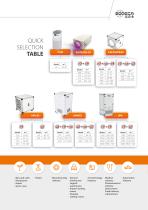
• Bars and cafes • Hotels • Restaurants • Hotels • Gyms, spas • Manufacturing • General industry warehouses • Logistic warehouses • Airport waiting rooms • Hospital waiting rooms 4.0 technology • Medical • Automotive industry industry industry Pharmaceutical industry Data centres Food industry • Laboratories
Open the catalog to page 7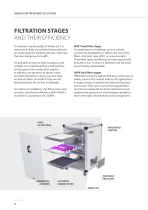
INDOOR AIR TREATMENT SOLUTIONS FILTRATION STAGES AND THEIR EFFICIENCY To maintain a good quality of indoor air, it is necessary to filter out particles that pollute the air, particularly the smallest particles, which are the most dangerous to health. Air pollution in areas of high occupancy and mobility are contaminated by small particles and by gases from combustion engines. In addition, the presence of spores, mites and other bacteria or viruses can also have an adverse effect on health if they are not eliminated from the air that we breathe. For optimum installation, the filters to be used...
Open the catalog to page 8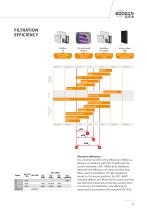
Industrial powder Solid pollutant particles Tobacco smoke Filtration efficiency It is common to refer to the efficiency of filters as being in accordance with EN 779 although the current standard is ISO 16890. Both standards deal with the efficiency of coarse and fine dust filters used in ventilation. The EN standard is based on 0.4 micron particles, the ISO 16890 standard defines the efficiency for various particle size fractions measured at intervals starting from 0.3 microns. For HEPA filters, the efficiency is measured in accordance with standard EN 1822.
Open the catalog to page 9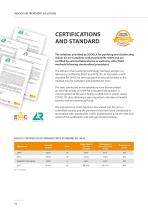
INDOOR AIR TREATMENT SOLUTIONS CERTIFICATIONS AND STANDARD The solutions provided by SODECA for purifying and disinfecting indoor air are compliant with standard EN 14476 and are certified by external laboratories as well as by other field methods following standardised procedures. The efficacy of air purifying technology has been proven in a laboratory certified by ENAC and APPLUS+ in accordance with standard EN 14476 for the evaluation of virucidal activity in the medical area for antiseptic and disinfectant tests. The tests conducted in this laboratory have demonstrated an antiviral activity...
Open the catalog to page 10
ACTUAL STUDY OF THE EFFECTIVENESS OF THE GERMICIDAL CHAMBER Bacteria measurements with and without a germicidal chamber SODECA, in collaboration with the Fluid Mechanics Department CATMech/Labson of Universitat Politècnica de Catalunya (UPC), has conducted an actual study to evaluate the effectiveness of a purifier with a germicidal chamber and HEPA H14 filters on bacteria and fungi inside a classroom. Fungi measurements with and without a germicidal chamber For two months we have sampled 390 petri dishes collecting environmental bacteria and fungi. In this case study we have concluded that in...
Open the catalog to page 11
INDOOR AIR TREATMENT SOLUTIONS TECHNOLOGIES USED FOR IMPROVING INDOOR AIR QUALITY The air that we breathe will be healthier when the most appropriate technology is used. More than ever these days, our well-being and health is dependent on the environmental conditions of the buildings and premises that we spend most of our time in. Opening windows is no longer a guarantee that our health is being protected and, more often than not, leads to discomfort. Knowing that we are guaranteed to breathe clean air gives us peace of mind. Also, modifying our buildings using equipment that complies with environmental...
Open the catalog to page 12All SODECA catalogs and technical brochures
 CJPF CJPF/ATEX
12 Pages
 SV/FILTER/EC SV/HEPA/EC
16 Pages
 CO2 CONTROL KITS
16 Pages
 CAP-CO2/EC
5 Pages
 PF/EC PF PF/ATEX
44 Pages
 HATCH/HP
12 Pages
 AIR CURTAINS
26 Pages
 EC TECHNOLOGY SOLUTIONS
184 Pages
 FANS FOR OVENS
42 Pages
 THT/WALL
8 Pages
 THT/WALL-F
5 Pages
 LOW PRESSURE FANS
28 Pages
 INDUSTRIAL FANS
340 Pages
 SOLUTIONS IN SMOKE EXHAUST
328 Pages
 PRESSURISATION CONTROL SYSTEMS
71 Pages


