
- Catalogs
- Smiths Interconnect
- Interposers


- Company
- Products
- Catalogs
- News & Trends
- Exhibitions
Interposers

Interposers
Smiths Interconnect is a leader in spring probe technology, offering solutions that enhance product capabilities. Their spring probes are known for their high compliance-to-length ratio, allowing for compact designs while maintaining significant compliance. These probes accommodate target misalignment and are reliable in harsh environments, providing low, stable resistance and high cycle life.
- Low profile and high-density design with stable contact resistance.
- Optimal signal integrity for frequencies ≥ 40 GHz.
- Advanced biasing techniques for RF power handling and high current capacity.
- Reliable performance under shock and vibration.
- Compression mount options for easy installation and removal.
- Design flexibility with a broad range of patterns and rapid prototyping capabilities.
- Ingress protection to IP68 and MIL-810 standards.
Smiths Interconnect's interposers are used in aerospace applications such as radar, satellites, and aircraft. They offer custom solutions tailored to specific requirements, ensuring high performance without contact interruption. The design process involves understanding electrical, mechanical, and environmental needs, with recommendations for the ideal spring probe.
Interposers can be soldered or compression mounted, reducing manufacturing costs and saving space. They handle substantial power, with some contacts capable of withstanding up to 30 Amps. Smiths Interconnect offers various housing materials and termination options, including surface and compression mounts.
Smiths Interconnect conducts rigorous testing, including thermal cycling and shock and vibration tests, to ensure reliability. Their probes demonstrate excellent performance, with typical resistance remaining below 30 mΩ during thermal cycling.
The document provides specifications for spring probe interposers, including materials such as nickel silver, stainless steel, and beryllium copper, all gold plated. The probe weighs 1.4 oz (40 g) with a travel of 0.014 inches (0.36 mm) and a resistance of less than 75 mΩ.
Vibration and shock tests were conducted according to EIA-364-28D standards. The interposer was tested under sinusoidal vibration conditions with a peak level of 20G and no discontinuities greater than 1 µs were detected. Shock tests involved 50G sine shocks with no physical damage observed.
The dynamic force deflection resistance test characterizes the relationship between force and resistance, showing stable resistance throughout the stroke. The current carrying capacity test ensures less than 80°C temperature rise at 6 Amps.
The probe's cycle life was tested for 10,000 cycles, with contact resistance measured at intervals. The average resistance was 30 mΩ, with 99.70% of measurements below 50 mΩ.
RF differential and single-ended performance were simulated using HFSS software. Differential performance showed insertion loss greater than 40 GHz and return loss greater than 30 GHz. Single-ended performance showed insertion loss greater than 40 GHz and return loss greater than 25 GHz.
Smiths Interconnect's spring probe technology provides reliable, high-performance solutions for demanding applications, with a focus on customization and innovation to meet specific customer needs. All specifications are subject to change without notice and are protected under export control regulations.
Catalog excerpts

bringing technology to life Custom Spring Probe Solutions
Open the catalog to page 1
Spring Probe Technology Smiths Interconnect is the world leader in spring probe design and the industry’s expert in applying spring probes as interposer contacts. Spring probes are an enabling technology that fundamentally change the capabilities of the products in which they are incorporated. Low Profile, High Compliance Ratio Spring probe technology permits an exceptionally high compliance-to-length ratio. This allows Smiths Interconnect to design interposers as compact as 0.08” (2.00 mm), while maintaining 0.02” (0.50 mm) of compliance. Accommodates Target Misalignment Spring probes are compliant...
Open the catalog to page 2
Spring Probe Interposers Features and Benefits Utilizes low profile, high density spring probe technology ■■ Low, stable contact resistance throughout long insertion life ■■ Optimal signal integrity ≥ 40 GHz ■■ Accommodates reduced package size or footprint ■■ Advanced biasing techniques for RF power handling and elevated current carrying capacity ■■ High compliance with 1:3 travel to length ratio ■■ Reliable performance under conditions of heavy shock and vibration without contact interruption ■■ Renowned longevity in the field without sacrificing performance Interposers Smiths Interconnect...
Open the catalog to page 3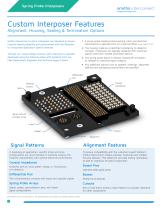
Spring Probe Interposers Custom Interposer Features Alignment, Housing, Sealing & Termination Options Smiths Interconnect custom interposers are designed to ensure industry-leading reliability and performance with the flexibility to incorporate application-specific features. Through our unique design process, each interposer is specially developed using the following steps with guidance from our Field Applications Engineers and technical support teams. 1 spring probe meeting board spacing, pitch and electrical A requirements is selected from our broad portfolio (see pages 6-9). 2 he housing material...
Open the catalog to page 4
Spring Probe Interposers Contact Terminations Smiths Interconnect offers termination options that are designed to amplify the unique advantages of our interposers. Surface Mount Smiths Interconnect surface mount interposers integrate easily with modern manufacturing processes. This style is soldered into place while still maintaining a low profile structure. Contact Terminations Compression Mount Smiths Interconnect compression mount solutions utilize spring probe compliance to ensure a reliable electro-mechanical connection. This solderless solution greatly simplifies the manufacturing process...
Open the catalog to page 5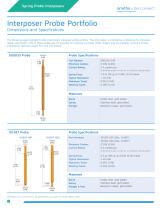
Spring Probe Interposers Interposer Probe Portfolio Dimensions and Specifications The following pages highlight Smiths Interconnect interposer probe portfolio. This information is intended as a reference for interposer design specification only as these probes are not available for individual purchase. Other designs may be available. Consult a Smiths Interconnect technical expert for more information. Probe Specifications Part Number Minimum Centers Current Rating 500033-000 0.039 (0.99) 3 A continuous (individual probe in free air at ambient temperature) Spring Force Typical Resistance Maximum...
Open the catalog to page 6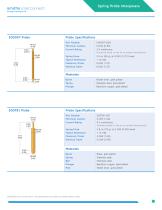
bringing technology to life Spring Probe Interposers 500057 Probe Probe Specifications 500781 Probe Probe Specifications Dimensions are in inches (mm) | All specifications are subject to change without notice
Open the catalog to page 7
Spring Probe Interposers smiths interconnect bringing technology to life Probe Specifications 500389 Probe Probe Specifications Dimensions are in inches (mm) | All specifications are subject to change without notice
Open the catalog to page 8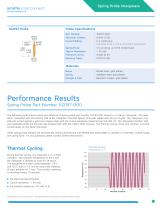
Spring Probe Interposers Part Number Minimum Centers Current Rating 102197-000 0.040 (1.02) 6 A continuous (individual probe in free air at ambient temperature) Spring Force Typical Resistance Maximum Travel Working Travel Materials Barrel Spring Plunger & Post Nickel silver, gold plated Stainless steel, gold plated Beryllium copper, gold plated Performance Results Spring Probe Part Number 102197-000 The following performance results are reflective of spring probe part number 102197-000 housed in a 128-pin interposer. The tests were conducted with the bottom side of the interposer mounted against...
Open the catalog to page 9
Spring Probe Interposers smiths interconnect bringing technology to life Initial Cycle 20G Sine Sweep X Axis Displacement vs. Frequency Testing was performed against Sinusoidal Vibration per EIA-364-28D, Test Condition IV, 20G peak level. The interposer was mounted between two PCBs which daisy chain the spring probe in series. Electrical continuity is monitored during vibration for any discontinuity greater than 1 ps under an electrical load condition of 100 mAmps maximum using a DM600-10 monitor. The sweep rate is 10 Hz to 2000 Hz at a rate of 20 minutes up and back. The sweep is repeated a...
Open the catalog to page 10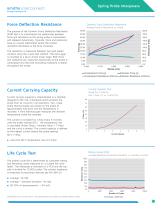
Spring Probe Interposers Force Deflection Resistance Compression Force (g) Compression Resistance (mOhms) Current Carrying Capacity The current is increased by 1 Amp every 5 minutes until the probe reaches 80°C. The temperature rise is calculated (Probe Temp - Ambient Temp = T-Rise) and the curve is plotted. The current capacity is defined as the highest current before the probe reaches 80°C T-Rise. Extension Force (g) Extension Resistance (mOhms) Current Capacity Test Single Pin in Free Air Max T-Rise (°C) vs. Current (A) 80 70 60 Current carrying capacity is characterized in a chamber designed...
Open the catalog to page 11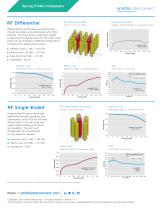
Spring Probe Interposers Near-End Crosstalk Differential RF performance was determined through simulation and optimization with HFSS software. The array shown (right) was utilized to determine the performance for this case. Probe arrays can be arranged in different configurations to achieve the desired performance. ■■ Near-End Cross Talk: > 50 dB ■■ Impedance: 102 Ω Insertion Loss Return Loss Rise Time Setting: 25 ps TDRZt (d1) Setup 1: Sweep RF Single-Ended Coax Model Insertion Loss Single-ended RF performance was determined through simulation and optimization using HFSS for the array shown...
Open the catalog to page 12All Smiths Interconnect catalogs and technical brochures
 Arinc 628 Connectors
2 Pages
 DaVinci Test Socket Gen V
4 Pages
 QN-Series
2 Pages
 R-Series H-Pin® Socket
2 Pages
 Q-Series H-Pin® Socket
2 Pages
 M-Series H-Pin® Socket
2 Pages
 K Series H-Pin® Socket
2 Pages
 ESJ Series H-Pin Socket
2 Pages
 ES Series H-Pin® Socket
2 Pages
 D Series H-Pin® Socket
2 Pages
 H-Pin Brochure
28 Pages
 C-Series H-Pin® Socket
2 Pages
 ARINC 801
4 Pages
 Optical Backplane Connectors
2 Pages
 Coaxial Couplers Brochure
12 Pages
 Micro-D Twinax
8 Pages
 Micro Quadrax/Twinax Catalog
10 Pages
 Rugged D-Sub
14 Pages
 NDL-T/NDL-Q Miniature Triax
16 Pages
 HYPERGRIP
12 Pages
 Diamond Rf Resistives®
10 Pages
 Lab-Flex® S Series
6 Pages
 Semi-Rigid Cable Brochure
12 Pages
 Planar X RF Filters
4 Pages
 HBB Catalog
36 Pages
 N Series Catalogue
21 Pages
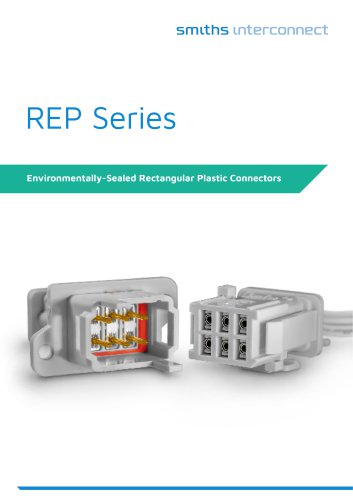 REP Series Brochure
12 Pages
 KM Series catalog
35 Pages
 KNB/KNC/KND Series Catalog
46 Pages
 HDLP Catalogue
16 Pages
 LightConex Series
5 Pages
 HR CTX Brochure
6 Pages
 Optical FMC Cards
2 Pages
 LightVISION 10G VM Series
2 Pages
 SNAP12
2 Pages
 Volta Series
6 Pages
 K2TVA Series
4 Pages
 TS06 Series
5 Pages
 CTX Series
5 Pages
 CEX Series
9 Pages
 M23 Industrial Catalogue
72 Pages
 Intercompact PCB
8 Pages
 K-Band Passive Components
12 Pages
 BOA Series
8 Pages
 NXS Series
12 Pages
 TSX Fixed Chip Attenuators
4 Pages
 Galileo Test Socket
3 Pages
 HDC Heavy Duty Connectors
42 Pages
 LR Series
52 Pages
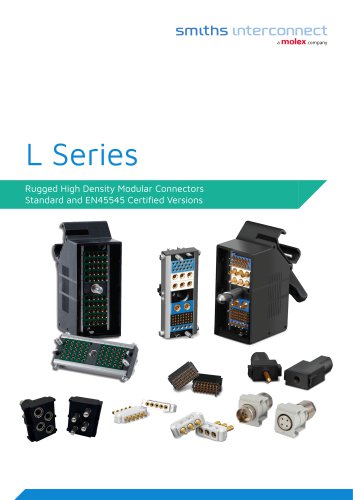 L Series Catalogue
53 Pages
 Thermocouple Spring Probes
4 Pages
 0.020” & 0.030” Centers
7 Pages
 0.156” & 0.187” Centers
5 Pages
 0.050” Centers
12 Pages
 0.187” Centers
5 Pages
 Component Catalog
102 Pages
 SNAP12
2 Pages
 LightVISION VM
2 Pages
 SH-100 & SHE-100 Se
8 Pages
 100563 Coax Series
6 Pages
 SS-30 Series
45 Pages
 D Series
16 Pages
 Resistor Family
10 Pages
 SpaceNXT™ AURORA Series
8 Pages
 SpaceNXT™ Ku Series
8 Pages
 SpaceNXT™ Q Series
6 Pages
 KuStream 2000 Antenna System
4 Pages
 Dovetail Brochure
4 Pages
 2mm cPCI Catalog
16 Pages
 TT9 SMT Brochure
6 Pages
 Lab-Flex T Series
6 Pages
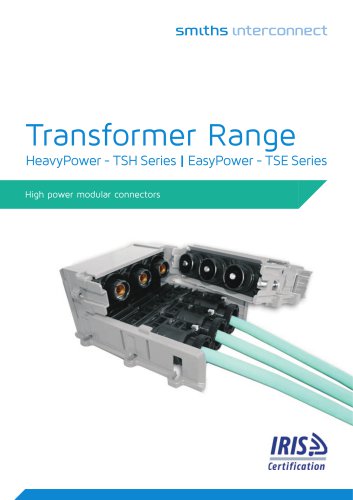
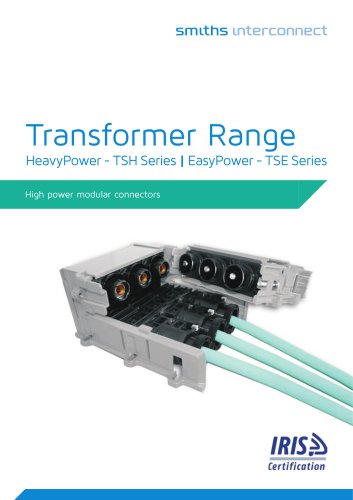 Transformer Range Brochure
16 Pages
 TT9 SMT Series Brochure
6 Pages
 B Series Catalogue
24 Pages
 C Series
32 Pages
 C9394
C939436 Pages
 Coax Contacts
7 Pages
 Filters and Diplexers
4 Pages
 K Series Catalogue
76 Pages
 KA series
44 Pages
 M12 Circular W Series
40 Pages
 M23 Stainless Steel
48 Pages
 M40 Circular P Series
16 Pages
 MHD Catalog
36 Pages
 Nebula Series
8 Pages
 SCX Coax
9 Pages
 Triax Contacts
13 Pages
 mDCX & mDHC ConneCtorS
9 Pages
 LHS LHZ LHT Series
36 Pages
 Standard coaxial connector
7 Pages
 Eclipta Edge Card Brochure
8 Pages
 Micro Series
7 Pages
 Filter Rack & Panel Catalog
17 Pages
 Filter D-Subminiature Catalogue
18 Pages
 Filter Circular Catalog
24 Pages
 CMD Catalogue
64 Pages
 C150 & C153 CONNECTOR SERIES
36 Pages
 C SERIES sPrinG PrOBes
8 Pages
 LSH Brochure
4 Pages
 LHS Catalogue
23 Pages
 KVPX Brochure
4 Pages
 KS Catalogue
4 Pages
 Hyperstac Datasheet
2 Pages
 HPH Catalogue
24 Pages
 HeavyPower Brochure
16 Pages
 C160 Datasheet
2 Pages
 C128 Datasheet
2 Pages
 C55 Datasheet
2 Pages
 Backplane Twinax Brochure
6 Pages
 KMC Catalogue
25 Pages
 2mm cPCI Brochure
6 Pages
 VME64X Catalogue
12 Pages
 HPW Catalogue
24 Pages
 HPD & HPF CONNECTOR SERIES
36 Pages
 CMD CONNECTOR SERIES
64 Pages
 C153
C15336 Pages
 MIL-DTL-38999 Quadrax/Twinax
10 Pages
 M23 Circular S Series
2 Pages
 Circulaires filtrés
24 Pages
 Quadsplitter
8 Pages
 Filtered D-sub connector
18 Pages
 N series
24 Pages









Archived catalogs
 Filtered Adapter
1 Page
 DO Series
2 Pages
 AST
AST2 Pages
 BST
BST5 Pages
 HDC / KDC
23 Pages
 CI-D
CI-D3 Pages
 KLC
KLC6 Pages
 KJB
KJB5 Pages
 CSC
CSC8 Pages
 KB
KB17 Pages
 HD
HD8 Pages
 Single Pole Power Connectors
2 Pages
 Heavy Duty Modular Connectors
25 Pages
 Modular Connectors
27 Pages
 Rack Panel connector
5 Pages
 Single Pole Power Connectors
2 Pages


- Smiths Interconnect connector
- Electrical cable
- Smiths Interconnect data connector
- Smiths Interconnect electrical power supply connector
- Copper cable
- Smiths Interconnect metal connector
- Copper electrical cable
- Smiths Interconnect circular connector
- Smiths Interconnect plastic connector
- Smiths Interconnect screw-in connector
- Socket electrical connector
- Smiths Interconnect industrial connector
- Smiths Interconnect IP67 connector
- Smiths Interconnect rectangular connector
- Male connector
- Current connector
- Smiths Interconnect straight connector
- Smiths Interconnect cable harness
- Smiths Interconnect RF connector
- Smiths Interconnect transceiver