

SMK900

SMK900
The SMK900 transceivers are designed for reliable, long-range, and low-power mesh networking applications. They use frequency hopping spread spectrum (FHSS) technology to enhance resistance to multipath fading and comply with 900 MHz unlicensed band regulations in Canada and the US. The module supports a CTS-enabled serial port interface with data rates from 1.2 to 230.4 kbps and offers two operational modes: transparent ASCII and protocol-formatted. Key features include multipath fading resistance, a range exceeding 10 km in free space, and AES 128-bit encryption.
The SMK900 system operates in two modes: gateway or node. The gateway acts as the main coordinator, bridging a host device with the mesh network, while nodes function as repeaters, facilitating communication between external devices and the gateway. Nodes can filter messages by MAC address or act as sniffers relaying all messages.
The module supports dynamic parameters and a structured broadcast frame, allowing for network segregation and addressing. Configuration is stored in non-volatile memory, supporting local and over-the-air configuration.
The SMK900 includes a Virtual Machine for leveraging the module's peripherals for operations such as signal processing and remote control. The VM is programmable both locally and remotely, with bytecode accessible via an IDE.
The hardware section details the serial port, module pinout, power supply, ESD protection, and antenna connector. The module supports multiple sleep synchronization clock sources for optimal sleep management.
The document outlines additional I2C functions and provides examples of VM user scripts. It details protocol-formatted messages, including various commands and events for data transmission and configuration.
This section describes the configuration registers, including address buffers, network IDs, power settings, and encryption data, with detailed information on register descriptions and settings.
The developer kit includes a Portia Adapter Board and an Arduino-compatible shield, facilitating integration and development with the SMK900 module.
The document concludes with certification information, ensuring compliance with relevant standards and regulations.
The SMK900 radio utilizes a broadcast-only mesh network topology, with sleep-wake synchronization managed by the gateway. Multiple mesh networks can coexist by configuring nodes with different FHSS channels, network IDs, or encryption patterns.
The SMK900 employs FHSS to allow co-located networks to coexist with minimal performance degradation. Nodes require a seek time to connect to their desired network, which varies based on the sleep interval.
Broadcast Frame: The gateway initiates a periodic broadcast beacon for synchronization, using a TDMA slotting mechanism for communication. Absolute Maximum Ratings: Supply voltage ranges from -0.5 to 6.5V, with operating temperatures between -20 to 70°C. Power Requirements: Supply voltage is 3.3 to 5.5V, with transmit and receive currents at 130 mA and 20 mA, respectively. Transceiver Range: Urban/Indoor range is 100 to 500m, while Outdoor/LOS exceeds 10km. Encryption: OTA AES 128 bits is used.
Each module has a unique 3-byte MAC address. Network segregation is achieved through configurable network IDs and FHSS channels.
The network can operate in transparent mode for basic integration or protocol-formatted mode for API-based communication.
The SMK900 includes an embedded VM for OTA firmware updates and user scripting. VM execution is triggered by various network events.
The module offers multiple interfaces, including a serial port, I2C port, and digital I/O. The serial port supports configurable baud rates, and the module pinout provides various I/O functionalities.
The module operates from a DC input of 3.3 to 5.5 V, with a maximum ripple of 5% over the temperature range of -40 to 85°C.
DC voltage outside the given range can cause damage or safety hazards. Logic inputs must remain within 0 to 3.3 V, and analog inputs should be within 0 to ADC_EXT_REF or 0 to VCC, depending on the reference used.
The SMK900 circuit boards are sensitive to electrostatic discharge (ESD). Proper precautions must be taken during handling and installation to prevent damage or safety hazards.
The antenna connector is a U.Fl type male connector, requiring a 50 Ohm impedance from the connector to the antenna.
The document lists additional I2C commands for execution from a custom user VM script, including reading configuration, changing I2C address, reference voltage, and RF channel.
An example script is provided for a node that queries the RF channel at boot-up and configures transceiver settings accordingly.
The SMK900 module supports two serial data modes: transparent and protocol. Protocol mode is necessary for advanced functionalities like sensor I/O commands and configuration commands.
Various message types and commands are outlined, including EnterProtocolMode, DeviceReset, and TxLongData. Each command has specific byte offsets and fields, with detailed descriptions provided.
This document outlines the structure and commands for protocol messages used in a network system. The protocol messages are formatted with specific byte offsets and packet types to indicate different operations and data types.
OTA (Over-The-Air) commands facilitate remote firmware updates and include various subcommands like FASTWRITE, STARTTRANSFER, and STOPTRANSFER.
Event messages are sent from transceivers to hosts to indicate various states and operations.
Commands for changing the network's dynamic configuration, applicable only to gateway transceivers.
Details on configuration registers, including address buffers, network IDs, power settings, and encryption data.
Includes a Portia Adapter Board and an Arduino-compatible shield for integration and development.
Ensures compliance with relevant standards and regulations, including FCC and Industry Canada.
Catalog excerpts

SMK900 Portia Radio Module Datasheet
Open the catalog to page 1
2.2 Mesh Network Systems . . . . . . . . . . . . . . . . . . . . . . . . . . . . . . . . . . . 2.3 Frequency Hopping Implications . . . . . . . . . . . . . . . . . . . . . . . . . . . . . . Dynamic parameters . . . . . . . . . . . . . . . . . . . . . . . . . . . . . . . . . Broadcast Frame Structure . . . . . . . . . . . . . . . . . . . . . . . . . . . . . 10 3.2 SMK900 Addressing and Network Segregation . . . . . . . . . . . . . . . . . . . . . . 11 3.3 Transparent and Protocol‐Formatted Mode . . . . . . . . . . . . . . . . . . . . . . . . 11 3.3.1 4.1 Description . . . . . . . . . . . . . ....
Open the catalog to page 2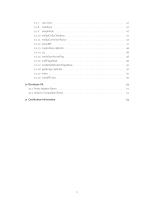
10.1 Portia Adapter Board . . . . . . . . . . . . . . . . . . . . . . . . . . . . . . . . . . . . . 51 10.2 Arduino‐Compatible Shield . . . . . . . . . . . . . . . . . . . . . . . . . . . . . . . . . . 51 11 Certification Information
Open the catalog to page 4
Typical structure of periodic network broadcast cycles for the DY N = 1, 2, 4, 1, 1, 5 configuration . . . . . . . . . . . . . . . . . . . . . . . . . . . . . . . . . . . . . . . . . 11 Mesh Network Triggers . . . . . . . . . . . . . . . . . . . . . . . . . . . . . . . . . . . . 12 Module Through Hole Pinout . . . . . . . . . . . . . . . . . . . . . . . . . . . . . . . . 15 Through Holes Mounting . . . . . . . . . . . . . . . . . . . . . . . . . . . . . . . . . . . 18
Open the catalog to page 5
Virtual Machine Triggers . . . . . . . . . . . . . . . . . . . . . . . . . . . . . . . . . . . 13 Calculating the effective baud rate fBAU D . . . . . . . . . . . . . . . . . . . . . . . . . 14 Standard baud rates list . . . . . . . . . . . . . . . . . . . . . . . . . . . . . . . . . . . . 15 Module Pinout (continued) . . . . . . . . . . . . . . . . . . . . . . . . . . . . . . . . . . 17 Protocol‐Formatted Common Header . . . . . . . . . . . . . . . . . . . . . . . . . . . 26 Packet Type Decoding . . . . . . . . . . . . . . . . . . . . . . . . . . . . . . . . . . . . 27 Packet Type Decoding ....
Open the catalog to page 6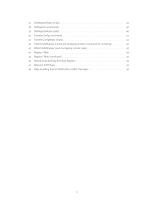
TXAirCmdWrapper (command wrapping another command for remoting) . . . . . . . 42 RXAirCmdWrapper (event wrapping remote reply) . . . . . . . . . . . . . . . . . . . . 43 Register Table (continued) . . . . . . . . . . . . . . . . . . . . . . . . . . . . . . . . . . 45 MeshExecActiveFlag Bit‐Mask Register . . . . . . . . . . . . . . . . . . . . . . . . . . . 49 Relevant Sniff Flags . . . . . . . . . . . . . . . . . . . . . . . . . . . . . . . . . . . . . . 49 Flags Enabling Special Notification UART Messages . . . . . . . . . . . . . . . . . . . 50
Open the catalog to page 7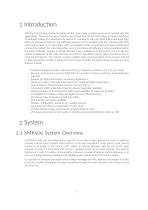
1 Introduction SMK900 transceivers provide for highly‐reliable, long‐range, and low power mesh networking radio applications. They use frequency hopping spread spectrum (FHSS) technology to ensure resistance to multipath fading and robustness, as well as for compliance with 900 MHz unlicensed band regu‐ lations in Canada and the US. The SMK900 supports a CTS‐enabled serial port interface with data rates ranging from 1.2 to 230.4 kbps, with two possible modes of operation (transparent ASCII and protocol‐formatted). For easy integration, error correction and buffering is all accomplished within...
Open the catalog to page 8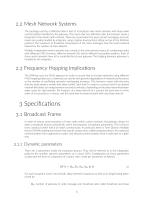
2.2 Mesh Network Systems The topology used by a SMK900 radio is that of a broadcast‐only mesh network, with sleep‐wake synchronization handled by the gateway. This mean that any SMK900 radio transmission sends a broadcast to the whole mesh network. There are no provisions for pure unicast messaging, and such needs are usually handled by integrator using a higher‐level protocol sitting on top of the SMK900 protocol. The maximum of broadcast transmission of the same messages over the mesh network depend on the number of hops allowed. Multiple independent mesh networks may coexist in the same physical...
Open the catalog to page 9
Not line of sight ** Line of sight BI: number of node to gateway messages (also called broadcast in phase count), Nh: the maximum number of hops for the network (i.e. maximum number of time a message can be relayed from node to node), Nr: number of random-access specialized hop slots (called redux),
Open the catalog to page 10
R: specialized slotting mechanism enabled D: inverted sleep‐wake duty cycle ratio D (min. value is 1), The broadcast time can be then calculated as: TBCAST [msec] = 10(NH (BO + BI ) + NR · R) The interval between each broadcast is: TIN T ERV AL [msec] = TBCAST · D For the vast majority of applications, the default settings, where BO = BI = 1 and R = 0, are applicable, in which case the timing equations simplify to: TBCAST [msec] = 20 · NH TIN T ERV AL [msec] = TBCAST · D Allowable values for each of those are, with default values in (boldface): BO : [(1), 2, 3, 4] BI : [(1), 2, 3, 4] NH : [1,...
Open the catalog to page 11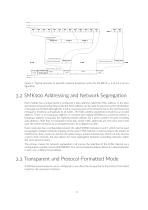
Regular broadcast \ phase level Regular broadcast cycle Phase redux Regular broadcast cycle Broadcast fCondTEoriaTWl Periodic sleep-wake cycle Figure 1: Typical structure of periodic network broadcast cycles for the DYN = 1, 2,4,1,1, 5 configuration Each module has a unique factory-configured 3-byte address, called the MAC address. In the standard protocol-based serial data mode, this MAC address can be used to specify to which destination a message is intended, although this is not a necessary part of the protocol due to the fact that every message is treated as a broadcast to all nodes. The...
Open the catalog to page 12
The transparent mode allows for basic, unsynchronized integration which emulate a simple point-to-multipoint serial link between a gateway and its nodes. In this case, the message is assumed to be of standard ASCII format, with the special ASCII terminator characters 0x13 (Carry) or 0x10 (Line Feed) are used as markers to trigger the end of a message stream, and thus to trigger transmission over radio waves. Protocol-formatted messages also referred to as Application Programing Interface (API) are discussed in the following sections. protocol-formatted messages usea start-of-message marker, followed...
Open the catalog to page 13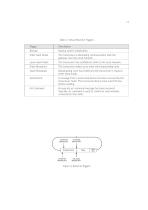
Table 2: Virtual Machine Triggers
Open the catalog to page 14
The SMK900 module provides multiple application interfaces: a primary communication serial port (CTS enabled), a dedicated I2C port (Master mode only), and 13 generic digital I/O. The latter can be reconfigured to ADC (2x), to DAC (2x) or to PWM hardware signalling or clock generation (2x). The SMK900 transceiver can also use advanced peripherals such as hardware timers and event capture/compare within custom bytecode executed by its VM engine. The host processor is tied to the SMK900 module over a full-duplex UART interface serial port with CTS pin hardware control. Baud rate is configurable...
Open the catalog to page 15All Smartrek Technologies Inc. catalogs and technical brochures
 Smartrek monitoring
142 Pages
 Quick Start Guide
11 Pages
 Smartrek Raven-Eye 2
2 Pages
 Smart Gateway+
10 Pages
- Flowmeter
- Temperature probe
- Liquid flow monitor
- Resistance temperature sensor
- Waterproof flow meter
- Level probe
- Stainless steel flow monitor
- Liquid level sensor
- Pressure probe
- Wireless remote control
- Industrial remote control
- Remote control with buttons
- Analog level sensor
- Industrial gateway
- Fieldbus gateway
- RS485 flow monitor
- Modbus flow meter
- Membrane pressure sensor
- RTD temperature sensor