
- Catalogs
- SLM solutions
- Discover the variety


Discover the variety

Discover the variety
- Properties: Discovered in 1791, titanium is known for high corrosion resistance and a strong strength-to-weight ratio, with a density of 4.54 g/cm3 and a melting point of 1677°C.
- Applications: Used in biomedical implants, aerospace, motorsport, jewelry, and maritime sectors.
- Alloys: Includes pure titanium, Ti6Al7Nb, Ti6Al4V, and custom grades.
- Development: Known for high hardness and toughness, achieved through heat treatment.
- Applications: Used in molds, medical implants, cutlery, maritime applications, and mechanical components.
- Alloys: Examples include 1.2709, 1.4404 (316L), 1.2344 (H13), and 1.4540 (15-5PH).
- Properties: A light metal with a density of 2.7 g/cm3 and a melting point of 660°C, often alloyed with silicon and magnesium.
- Applications: Common in automotive, aerospace, and consumer goods.
- Alloys: Includes AlSi12, AlSi10Mg, AlSi7Mg, AlSi9Cu3, and AlMg4.5Mn0.4.
- Properties: Known for high toughness, strength, and biocompatibility.
- Applications: Used in dental prostheses, medical implants, and high-temperature environments.
- Alloys: Co212-f according to ASTM F75.
- Properties: A nickel-chromium alloy with high corrosion resistance and mechanical strength, suitable for high-temperature applications up to 700°C.
- Applications: Used in aerospace, gas turbines, rocket motors, and nuclear reactors.
- Alloys: Includes Inconel 625, Inconel 718, and Inconel HX (2.4665).
- Break Strain (A [%]): Values are 35, 30, and 18 (±5).
- Thermal Conductivity at 20°C [W/mK]: Values are 11.6 and 11.4.
- Surface Roughness (RZ [μm]): Values are 28, 28, and 30.
- Average values are derived from both horizontal and vertical built samples.
- The turbine blade features internal conformal cooling channels to enhance jet engine performance.
- A bracket is available for the fixation of supply lines in jet turbines.
- Global distributors can be found on the provided website link.
- Special materials and individual material development are available upon request.
- SLM Solutions GmbH, located in Lübeck, Germany.
- Contact details include phone, fax, and email.
- SLM® is a registered trademark of SLM Solutions GmbH.
Catalog excerpts
Entdecken Sie die Vielfalt. Discover the variety. SLM Materialien NE-Metalle, Werzeugstähle, Edelmetalle und Leichtmetalle SLM Materials Non Ferrous Metals, Tool Steel, Stainless Steel and Light Alloys
Open the catalog to page 1
Titan Titanium Titan wurde erstmals 1791 in England entdeckt. Etwa 150 Jahre später wurde Titan durch den Kroll-Prozess für die kommerzielle Nutzung interessant. Titan (Ti), mit der Ordnungszahl 22 im Periodensystem der Elemente wird als Übergangsmetall bezeichnet. Es gehört zu den häufigen Elementen der Erdkruste und steht an 10. Stelle der Elementhäufigkeit. Es zeichnet sich durch seine hohe Korrosionsbeständigkeit und besonders durch sein Verhältnis von geringer Dichte zu den mechanischen Eigenschaften aus. Reintitan hat eine Dichte von 4,54 g/cm3 und einen Schmelzpunkt von 1677 °C. Materialeigenschaften...
Open the catalog to page 2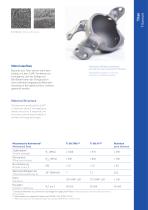
Titan Titanium Schliffbilder / Material Structure Individuelles Hüftpfannenimplantat aus Titan für einen australischen Patienten. Bauteile aus Titan weisen nach dem Aufbau mit dem SLM® Verfahren ein homogenes, dichtes Gefüge auf. Bei Bedarf kann das Gefüge durch eine individuell angepasste Wärmebehandlung in den gewünschten Zustand gebracht werden. Individual Hip Implant in Titanium made for an Australian patient. Material Structure Components produced by SLM® in titanium show a homogenous, dense structure. If required, the structure can be heat treated to achieve the required shape. Mechanische...
Open the catalog to page 3
Werkzeug- und Edelstahl Tool Steel and Stainless Steel Schon in der Antike wurde für die Klingenherstellung nach Materialien gesucht, die nicht nur hart sondern auch zäh sind. Mit der Industrialisierung Anfang des 19. Jahrhunderts begann die rasante Weiterentwicklung von Stählen und Legierungen, die letztendlich in den heute bekannten Stahlsorten für Werkzeug- und Edelstähle mündete. Diese Werkstoffe erreichen durch Wärmeverfahren eine hohe Randschichthärte mit einem Kohlenstoffgehalt von lediglich 0,5 - 1,5%. Durch den gezielten Einsatz von Legierungsbestandteilen sind die Eigenschaften dieser...
Open the catalog to page 4
Werkzeugschieber aus Werkzeugstahl mit integrierten, konturfolgenden Kühlkanälen. Foto mit freundlicher Genehmigung der Gardena AG. Mould inserts with integrated, surface conformal cooling channels. Photo with kind permission of Gardena AG. Materialaufbau Bauteile aus Stahl weisen nach dem Aufbau mit dem SLM® Verfahren ein homogenes, dichtes Gefüge auf. Durch die Besonderheit des Bauprozesses sind Härten realisierbar, die durch konventionelle Wärmebehandlung nicht zu erreichen sind. Durch eine anschließende Nachbe handlung können die Bauteile in den gewünschten Zustand gebracht werden. Material...
Open the catalog to page 5
Aluminium Aluminium Aluminium (Al, Ordnungszahl 13) gehört zur Gruppe der Leichtmetalle und kommt in der Natur nicht in gediegener Form vor. Aluminium wird aus Bauxit gewonnen. Bauxit ist das dritt häufigste Element der Erdkruste und somit das Metall mit dem höchsten Vorkommen. Aluminium hat eine Dichte von 2,7 g/cm3 und einen Schmelzpunkt von 660°C. Auf Grund seiner geringen Festigkeit wird es meist in Form von Legierungen eingesetzt. Typische Legierungszusätze sind Silizium, Magnesium, Mangan und Zink. Reines Aluminium lässt sich sehr gut in konventionellen Verfahren verarbeiten. Aluminiumoxid...
Open the catalog to page 6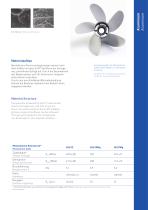
Aluminium Aluminium Schliffbilder / Material Structure Materialaufbau Bauteile aus Aluminiumlegierungen weisen nach dem Aufbau mit dem SLM® Verfahren ein homogenes, porenfreies Gefüge auf. Durch die Besonderheit des Bauprozesses sind für Aluminium untypisch hohe Härten erreichbar. Durch eine anschließende Wärmebehandlung können die Bauteile individuell den Bedürfnissen angepasst werden. Antriebspropeller für Rennboote als verkleinertes Modell zur Strömungsmessung. propeller for racing boats as scaled model for flow measurements. Material Structure Components produced by SLM® in Aluminium show...
Open the catalog to page 7
Kobalt-Chrom Cobalt-Chrome Kobalt-Chrom Legierungen gehören zu den Standardlegierungen der Medizin und Dentaltechnik. Aufgrund hoher Härte und guter Elastizitätswerte werden Kobalt-Chrom Legierungen häufig für Zahnprothesen eingesetzt. Dies hängt auch mit der guten Mundverträglichkeit des Materials zusammen. Da es sehr zäh ist, wird es häufig gegossen und weniger zerspant. Weitere Anwendungen finden sich bei Prothesen sowie Knie- und Hüftimplantaten. Materialeigenschaften • hohe Zähigkeit • hohe Festigkeit • gute Biokompatibilität • gute Korrosionsbeständigkeit Anwendungen • Dental, Brücken und...
Open the catalog to page 8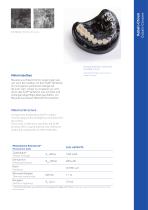
Kobalt-Chrom Cobalt-Chrome Schliffbilder / Material Structure Individuelle Brücken und Kronen aus Kobalt-Chrom. Individual bridges and crowns in cobalt-chrome. Materialaufbau Bauteile aus Kobalt-Chrom Legierungen weisen nach dem Aufbau mit dem SLM® Verfahren ein homogenes, porenfreies Gefüge auf. Da CoCr sehr schwer zu zerspanen ist, wird durch das SLM® Verfahren eine schnelle und kostengünstige Möglichkeit geschaffen, um Bauteile aus diesem Werkstoff herzustellen. Material Structure Components produced by SLM® in cobaltchrome alloys show homogenous and pore free structures. Since CoCr is difficult...
Open the catalog to page 9
Inconel Inconel Obwohl das Material Inconel 718 bereits in den frühen 60er Jahren des letzten Jahrhunderts entwickelt wurde, ist es immer noch das meisteingesetzte Material für Flugturbinen-Bauteile mit einer Betriebstemperatur unter 650°C. Es handelt sich um eine härtbare Chrom-Nickel-Legierung, die auch deutliche Anteile von Eisen, Niobium und Molybden enthält. Weiterhin sind geringe Anteile von Aluminium und Titan enthalten. Inconel vereint Korrosionsbeständigkeit und hohe Festigkeit mit sehr guter Schweißbarkeit und Beständigkeit gegen Rißbildung an den Schweißnähten. Es hat gute Zugfestigkeitswerte...
Open the catalog to page 10All SLM solutions catalogs and technical brochures
 3D Metals
16 Pages
 SLM® AUTOMOTIVE
2 Pages
 Power Supply Unit (PSV)
4 Pages
 SLM DENTAL
4 Pages
 SLM® 500 HL
5 Pages
 SLM® 280 HL
4 Pages
 SLM® 125 HL
6 Pages
 Metallgieen_RMC_1400
4 Pages
 SLM PSA 500
2 Pages
 RMC-Anlagen
8 Pages
 Material Overview Vacuum Casting
12 Pages
 RMC_200-400
2 Pages
 Vakuumgiesystem
2 Pages
 SLM_280
2 Pages
 SLM_500
2 Pages
 SLM_250
2 Pages
 SLM_125
2 Pages


- Additive manufacturing machine
- High-performance 3D printer
- Metal 3D printing machine
- Feeding unit
- Power monitoring module
- Automatic feeding unit
- 3D printing powder
- SLM 3D printing machine
- Industrial 3D printing powder
- Prototyping 3D printing powder
- Metal 3D printing powder
- Medical 3D printing powder
- Prototyping machine
- 3D printing powder for the automotive industry
- 3D printing powder for the aerospace industry
- Nickel 3D printing powder
- Titanium 3D printing powder
- Laser power monitoring system
- Dental 3D printing powder
- Aluminum 3D printing powder