
- Catalogs
- SKF Lubrication Systems Germany GmbH
- SKF lubrication solutions for rails and railway vehicles


- Company
- Products
- Catalogs
- News & Trends
- Exhibitions
SKF lubrication solutions for rails and railway vehicles

SKF lubrication solutions for rails and railway vehicles
- Metro and Track: Focus on reducing friction between wheels and tracks.
- Transit and Commuter Trains: Use on-board and wayside systems for consistent lubrication.
- High-Speed Trains: Address increased friction at high speeds.
- Freight Trains: On-board systems improve fuel efficiency and reduce maintenance costs.
- Construction and Service Vehicles: Reduce friction and wear on wheel flanges and rails.
Catalog excerpts

SKF lubrication solutions for rails and railway vehicles Increase vehicle and rail service life while reducing noise emissions UP TO 50% RE-PROFILING AND RE-GRINDING COST SAVINGS POSSIBLE
Open the catalog to page 1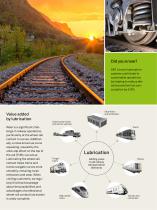
Did you know? SKF Lincoln lubrication systems contribute to sustainable operations by helping to reduce diesel locomotive fuel consumption by 5-8%. Value added by lubrication Wear is a significant challenge in railway operations, particularly at the wheel-rail contact in curves. Additionally, a noise known as curve squealing, caused by the stick-slip effect on the top of the rail (TOR), can occur. Lubricating the wheel-rail contact helps trains and trams navigate curves more smoothly, reducing noise emissions and wear. When visiting customers, we regularly find that knowledge about the possibilities...
Open the catalog to page 2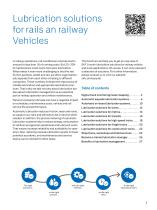
Lubrication solutions for rails an railway Vehicles Discover more on SKF.com In railway operations, rail conditioners and lubricants amount to less than 1% of running costs. But 20–30% of maintenance costs come from poor lubrication. What makes it even more challenging is that the two friction partners, wheel and rail, are often organizationally separate from each other or belong to different companies. These numbers indicate the importance of reliable lubrication and appropriate lubrication practices. That’s why we talk not only about lubrication but also about lubrication management as an essential...
Open the catalog to page 3
It starts with smart and digital track monitoring Digital noise maps Digital noise mapping offers significant advantages for identifying noisy curves and determining the need for lubrication. By capturing and analysing noise events generated by the wheel-rail contact, it allows for the selection and implementation of countermeasures such as lubrication. This proactive approach helps increase acceptance of rail and tram systems where noise is a dominant concern and frequent cause of complaints. Simultaneously, lubrication reduces maintenance costs and extends the lifespan of railway components...
Open the catalog to page 4
Recommended and market proven solutions IMx-Rail Remote monitoring solution for increased reliability in railway applications. SKF Multilog On-line System IMxRail is a multi-channel online condition monitoring system designed to monitor railway assets such as wheelset bearings, wheels, gearboxes and traction motors. IMx-Rail is railway certified and can be mounted on the boogie level or inside the train, according to customer preferences. Discover more on SKF.com Features and benefits: • 16 analogue inputs (typically vibration, but up to 8 directly connected noise or temperature sensors) • 4...
Open the catalog to page 5
Automatic wayside lubrication systems WIPER System R-Rail System This system was designed for the lubrication of rail gauge faces in curves on mainlines. The wheel sensor in the track counts the wheels and is connected to the controller in the pump station. Once the desired number of wheels has been counted, the controller activates the pump until 12 grease bubbles on the wiper bar are sufficiently large. The wheels running over the bar pick up the grease and carry it to the upcoming curve to lubricate the gauge faces. This system was developed for the lubrication of the additional guide rails...
Open the catalog to page 6
SLID System This system was developed for the top of rail conditioning in curves of mainlines. The wheel sensor in the track counts the wheels and is connected to the controller in the pump station. Once the desired number of wheels has been counted, the pump activates and supplies the injection devices with lubricant until a certain pressure level is reached. Each SLID device meters the incoming lubricant and dispenses a precise amount to the top of rail (TOR) or the gauge corner for the next approaching train. This system was designed for the top of rail conditioning in curves on freight lines....
Open the catalog to page 7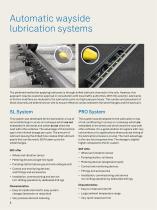
Automatic wayside lubrication systems The preferred method for applying lubricants is through drilled lubricant channels in the rails. However, this approach requires customer approval in consultation with local traffic authorities. With this solution, lubricants or friction modifiers are metered to the lubrication point via high-pressure hoses. The number and placement of these channels are determined on-site to ensure effective contact between the wheel flanges and the lubricant. This system was developed for the lubrication or top of rail conditioning in curves on tramways which are not embedded...
Open the catalog to page 8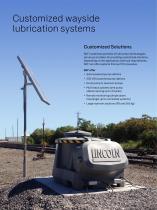
Customized wayside lubrication systems Customized Solutions SKF’s extensive portfolio of lubrication technologies serves as a toolbox for providing customized solutions. Depending on the application and local requirements, SKF can offer systems that are fit for purpose. SKF offer • Solar powered pump stations • 230 VAC powered pump stations • Drum pump or reservoir pumps • Multi track systems (one pump station serving up to 4 tracks) • Remote monitoring (simple alarm messenger up to connected systems) • Large reservoir solutions (90 and
Open the catalog to page 9
Automatic on-board lubrication systems The oil-air technology behind this type of system is the most popular solution on the market. The dosage is pre-set at the pump, and compressed air serves as the transport medium. The lubricant travels through the pipe system to the spraying nozzles. Instead of a pump, this system features an airpressurized reservoir. Consequently, the grease line to the nozzles is always under pressure. (Depending on the available air pressure). The lubricant is metered directly inside the spray nozzle and expelled by compressed air. SKF offer • Spray nozzles • Lubricant...
Open the catalog to page 10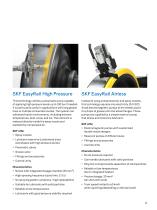
SKF EasyRail High Pressure This technology utilizes a pneumatic pump capable of applying high pressure levels up to 100 bar if needed. It is particularly useful in applications with long grease lines or multiple connected nozzles. The system can withstand harsh environments, including extreme temperatures, dust, snow, and ice. The lubricant is metered directly inside the spray nozzle and expelled by compressed air. Instead of using compressed air and spray nozzles, this technology requires only electricity (24 VDC). Small electromagnetic pumps at the wheels squirt tiny drops of grease onto the...
Open the catalog to page 11All SKF Lubrication Systems Germany GmbH catalogs and technical brochures
 SKF Compact greaser
8 Pages
 Pump unit PPS30
4 Pages
 ECP Product brochure
8 Pages
 Pulse meter IPM
4 Pages
 Product series 143 brochure
24 Pages
 Wire rope lubrication system
8 Pages
 Single- and Multi-circuit Pumps
16 Pages
 LubriLean brochure
4 Pages
 1154 flyer
2 Pages
 EDL1 product brochure
4 Pages
 DSA product brochure
4 Pages
 DSC3 product brochure
4 Pages
 DSB product brochure
4 Pages
 HCC product brochure
2 Pages
 LMC 301 product brochure
8 Pages
 SFZM product brochure
4 Pages
 SP/SMB14 product brochure
8 Pages
 SP/SMB13 product brochure
8 Pages
 SMBM product brochure
18 Pages
 Safeflow product brochure
4 Pages
 SMT 1 product brochure
8 Pages
 LP2 / LPC product brochure
8 Pages
 PSG product brochure
36 Pages
 VP product brochure
20 Pages
 VPK product brochure
20 Pages
 VPB product brochure
12 Pages
 SPVS product brochure
8 Pages
 SKF Maxilube Solution
8 Pages
 SGA/SG product brochure
6 Pages
 SLC product brochure
12 Pages
 SL-6 product brochure
4 Pages
 SL-32HV product brochure
2 Pages
 310 series product brochure
4 Pages
 BPH product brochure
4 Pages
 Lubrigun product brochure
15 Pages
 EOP2 product brochure
2 Pages
 MPB product brochure
2 Pages
 FK product brochure
12 Pages
 VectoLub product brochure
30 Pages
 Gear Pump Units brochure
12 Pages
 P502 product brochure
2 Pages
 LubriLean product brochure
16 Pages
 P603S product brochure
8 Pages
 P212 product brochure
2 Pages
 P205/ P215 product brochure
2 Pages
 MKx series product brochure
24 Pages
 Product Series OLA, MV and 161
28 Pages
 CLK product brochure
8 Pages
 Gear wheel indicator SFZM
4 Pages
 Oil conditioning unit OCU
4 Pages
 LFC 5000
4 Pages
 SSV-D
SSV-D2 Pages
 Improved Centro-Matic SL-11
12 Pages
 SL-V XL
4 Pages
 12-volt Reel 'n F
2 Pages
 New 90-lb. Reservoir
12 Pages
 HTL 429
4 Pages
 Lincoln
8 Pages
 AC FlowMaster
12 Pages
 EOS
EOS2 Pages
 LFR Series
4 Pages
 Hand Vacuum Pumps
6 Pages
 Pumps PMV Pump Family
16 Pages


