
- Catalogs
- SKF Lubrication Systems Germany GmbH
- Single-line automatic lubrication systems


- Company
- Products
- Catalogs
- News & Trends
- Exhibitions
Single-line automatic lubrication systems

Single-line automatic lubrication systems
The document is a product catalogue for the SL-32 Adjustable Modular Grease Metering Device, part of SKF's single-line automatic lubrication systems. It includes an electronic part library with CAD product data, allowing users to download and integrate lubrication system components into their design processes.
The catalogue provides a comprehensive overview of various lubrication system components, including pumps, metering devices, control units, pressure sensors, flow monitors, and solenoid valves. Each section details specific models and their applications.
SKF and Lincoln offer a wide range of lubrication solutions, from manual lubricators to advanced automatic systems. These solutions cater to industries such as pulp and paper, steel, mining, agriculture, and more. The document emphasizes the importance of proper lubrication to improve machine reliability, reduce maintenance, and increase productivity.
The catalogue explains the types of lubricants used in lubrication systems, including oils and greases. Oils are classified by viscosity, while greases are categorized by NLGI grades. Compatibility checks are recommended before using any lubricant with SKF systems.
The document outlines the applications of lubrication systems, highlighting their role in ensuring efficient operation and maintenance of machinery. It also discusses the benefits of using SKF's global network for installation and support.
SKF's lubrication systems, including Monoflex and Centromatic, are designed for easy expansion and assembly, suitable for small-to-medium line lengths and quantities of lubricant. These systems are applicable in various industries such as machine tools, mobile on-road vehicles, assembly automation, food packaging, and injection molding.
These systems are used in diverse environments, from the cold regions of Canada and Siberia to the hot deserts of Africa and Australia. They are employed in industries like mining, construction, cement, food and beverage, and more. The systems deliver precise amounts of lubricant at controlled intervals, ensuring efficient lubrication.
These systems are total loss lubrication systems for oil, fluid grease, and grease. They consist of reservoirs, pumps, metering devices, and control units. The central pump delivers lubricant through a single supply line, with each metering device serving one lubrication point. Benefits include continuous automatic lubrication, easy installation, and operation over long distances and wide temperature ranges.
Designing a lubrication system involves determining the number of lubrication points, operating temperature range, and other factors. SKF engineers assist in laying out systems to ensure the correct amount of lubricant is supplied at the right time, reducing wear and avoiding over-lubrication.
Various pump units are available, including manually operated, air-operated, and electrically operated pumps. Each type has specific features, benefits, and applications, such as the MCP manual pump for simple machinery and the P-846-2 air-operated pump for remote oil applications.
The document provides detailed technical data for different pump models, including operating pressure, metering quantity, and suitable lubricants. It also includes information on the construction materials and dimensions of the pumps.
SKF's lubrication systems offer reliable and efficient solutions for various industrial applications, ensuring precise lubrication and reducing maintenance needs.
- Function Principle: Most pumps operate on an air-operated piston principle, suitable for mineral and synthetic oils, and some for fluid grease.
- Operating Conditions: Operating temperatures range from -23°C to +80°C, with pressures up to 70 bar (1,000 psi).
- Reservoir Capacity: Varies by model, ranging from 0.5 liters to 7.1 liters.
- Materials: Reservoirs are typically made from acrylic or polycarbonate, with other components made from zinc die-cast, brass, and steel.
- Material handling, presses, and assembly lines
- Lubrication of pneumatic cylinders and machine tool spindles
- Steel mills, glass manufacturing, packaging, and food and beverage industries
- Reduced maintenance time and improved process safety
- Optimal metering of lubrication points regardless of line lengths
- Space-saving design and fast sequence of pulses
- Reliable operation with simple maintenance
The PPS30-2A is a pneumatically actuated piston pump designed for oil and fluid grease applications. It features a delivery rate of 30 cm3 per stroke and offers various configurations for lubricant reservoirs, pressure switches, and connections.
- Delivery Rate: 30 cm3/stroke
- Lubricant Reservoir Options: 1.5 l with or without oil filler screen
- Pressure Switch: Available at 16 bar or without
- Electrical Connection: M12×1 plug, 4-pin
- Pneumatic Connection: Multiple options including pipe thread and plug connectors
- 3/2-way air inlet valve, 24 V DC
- Pressure-reducing valve
- Oil filler screen
- Plastic processing
- Food and beverage
- Material handling
- Packaging
P-886: High-volume oil pump for remote or bulk-fill applications, operating at max 35 bar.
82676: High-volume pump with max operating pressure of 70 bar, suitable for steel mills and packaging.
82570: Similar to 82676 but with an acrylic reservoir.
1826: Modular pump with a reciprocating piston design, operating at max 70 bar.
ECP: Electric Cartridge Pump for small machines, operating at 38 bar with a 24 V DC power supply.
P 653S: Electrically driven oil pump with integrated components, suitable for automation and machine tools.
KFB: Gear pump unit for fluid grease, designed for SKF single-line systems.
- Function: Manually operated piston pump with a single outlet.
- Specifications: Metering quantity of 2.6 cm³/stroke, suitable for grease NLGI 0, 1, 2, operating temperature from -20 to +65 °C, and pressure range of 82 to 240 bar.
- Features: Translucent reservoir, spring-loaded follower, indicator pin for pressure control, and refillable via Model 81834 filler pump.
- Applications: Construction machinery and agriculture.
- Function: Air-operated piston pump with a single outlet.
- Specifications: Metering quantity of 40 cm³/stroke, suitable for grease NLGI 0, 1, operating temperature from -30 to +70 °C, and pressure up to 150 bar.
- Features: Compact design, splash-proof, available with various reservoir sizes, and includes a low-level alarm and pressure switch.
- Applications: Buses, trucks, and heavy vehicles.
- Function: Air-operated, positive-displacement pumps with single-stroke operation.
- Specifications: Metering quantity of 7.4 cm³/stroke, suitable for grease NLGI 0, 1, 2, operating temperature from -18 to +65 °C, and pressure range of 82 to 240 bar.
- Features: Integrated solenoid air valves, adjustable time controls, and translucent reservoirs.
- Applications: Cement industry, woodworking, food, and beverage.
- Function: Air-operated, positive-displacement pumps designed for single-line metering devices.
- Specifications: Metering quantity ranges from 22.9 to 35.2 cm³/stroke, suitable for grease NLGI 0, 1, 2, operating temperature from -18 to +65 °C, and pressure range of 82 to 240 bar.
- Features: High-volume refill fitting, remote system components available, and integrated time controls.
- Applications: Oil and gas industry.
- Function: Air-operated, reciprocating piston pump with a single outlet.
- Specifications: Metering quantity of 197 cm³/stroke, suitable for grease NLGI 0, 1, 2, operating temperature from -35 to +104 °C, and pressure range of 82 to 240 bar.
- Features: Includes vent valve assembly, transparent reservoir, and requires a 3-way air valve.
- Applications: Cement industry, food, and beverage.
- Function: Air-operated, reciprocating piston pump with a single outlet.
- Specifications: Metering quantity of 197 cm³/stroke, suitable for grease NLGI 0, 1, 2, operating temperature from -34 to +121 °C, and pressure range of 82 to 240 bar.
- Features: Includes a base-mounting kit, metal reservoir with indicator rod, and vent valve assembly.
- Applications: Machine tools and industrial machinery.
- Function: Hydraulic lubricators for automatic lubrication in machines with hydraulic circuits.
- Specifications: Metering quantity up to 2000 cm³/stroke, suitable for grease NLGI 0, 1, operating temperature from -25 to +80 °C, and pressure range of 50 to 150 bar.
- Features: Simple piston pump, pressure rise and fall operation, and optional low-level alarm.
- Applications: Vehicles, machines, dismountable hoists, and small lift trucks.
- Function: Hydraulically operated barrel pumps for heavy machinery.
- Features: Heavy-duty construction, compact design, adjustable flow rate and reverse pressure, and built-in sensors for monitoring.
- Applications: Excavators, loaders, haul trucks, and other heavy machinery in construction and mining.
- Innovative sealing concepts to prevent hydraulic oil and lubrication grease leakage.
- Multiple outlet directions (front, left, right) for flexible installation.
- Compact and robust designs suitable for harsh environments.
- Optional monitoring sensors for enhanced reliability.
- Compatibility with grease metering devices of categories 5, 6, and 7.
- Operating temperature ranges from -40°C to +80°C (-40°F to +176°F) for hydraulic pumps and -10°C to +55°C (14°F to 131°F) for air-operated pumps.
- Operating pressures up to 320 bar (4,642 psi) for hydraulic pumps and 300 bar (4,350 psi) for air-operated pumps.
- Material construction includes steel, brass, copper, polyurethane, and nitrile for durability.
- Protection class IP 65 for environmental resistance.
- Various reservoir capacities and dimensions to suit different application needs.
- Function: Air-operated, double-acting piston pump.
- Applications: Suitable for industries like pulp and paper, construction machinery, food and beverage, and mining.
- Technical Data: Operating temperature range from -23 to +60 °C, pressure range from 82 to 240 bar, and a metering quantity of 492 cm³ per stroke.
- Features: Bulk filling method, remote system components available, and compatibility with grease metering devices of category 5, 6, and 7.
- Function: Air-operated, reciprocating piston pump.
- Applications: Used in agriculture, chemical, and steel industries.
- Technical Data: Operating temperature range from -15 to +121 °C, pressure range from 82 to 240 bar, and a metering quantity of 492 cm³ per stroke.
- Features: Modular structure, suitable for U.S. standard refinery drums, and designed for clean and safe drum replacement.
- Function: Electrically operated piston pump.
- Applications: Ideal for wind turbines, construction machinery, and commercial vehicles.
- Technical Data: Operating temperature range from -40 to +70 °C, pressure up to 300 bar, and metering quantity of 12 cm³/min.
- Features: Simple maintenance, robust design, and suitable for fast-separating lubricants.
- Function: Electrically operated piston pump for vehicles with few lubrication points.
- Applications: Suitable for small excavators, wheel loaders, buses, and delivery trucks.
- Technical Data: Operating temperature range from -30 to +70 °C, pressure up to 250 bar, and metering quantity of 6.5 to 13 cm³/min.
- Features: Compact system, improves worker safety, and minimizes lubricant waste.
- Function: Electrically driven piston pump.
- Applications: Used in wind turbines, construction machinery, and vehicle aftermarket.
- Technical Data: Operating temperature range from -25 to +70 °C, pressure up to 300 bar, and metering quantity of 5.0 to 15 cm³/min.
- Features: Reliable design, versatile applications, and safe operation with fill-level monitoring.
The document provides detailed technical information on various pump units designed for lubrication applications in both heavy vehicles and industrial settings. The main focus is on the Multilube MLPV/MLPI, P 653S, E-PUMP, and FK pump units, highlighting their features, benefits, applications, and technical specifications.
- Designed for optimal lubrication with reduced energy and lubricant consumption.
- Features include a compact, modular design, easy installation, pressure-relief valve, and heating device for cold conditions.
- Applications include stand-alone machines, construction machinery, and mining.
- Available in different reservoir capacities and operating voltages.
- Offers a cost-effective solution with integration of major components to reduce operation costs.
- Features plug-and-play design, neutral switch for reduced grease consumption, and compatibility with telematics technology.
- Applications include construction machinery, mining, commercial vehicles, and renewable energy.
- Electrically operated pump suitable for centralized lubrication systems using oil or grease up to NLGI grade 2.
- Features include internal pressure control, heating element, and compatibility with various lubrication systems.
- Applications span heavy industries, mining, machinery workshops, and the food and beverage sector.
- Versatile, modular piston pump suitable for single-line, dual-line, or progressive systems.
- Features high functional reliability, fill-level monitoring, and easy retrofitting to other systems.
- Applications include the automotive industry, rotary applications, and assembly lines.
- Each pump unit has specific technical data including function principle, metering quantity, operating temperature and pressure, reservoir capacity, and material composition.
- Protection classes and dimensions vary across models, ensuring suitability for different environmental conditions and installation requirements.
- Various accessories and control units are available to enhance the functionality of the pump units.
- Order information includes specific model numbers, operating voltages, and reservoir capacities.
The document outlines the specifications for the FlowMaster electric pump unit, including gear ratios of 17.8:1, 19:1, and 34:1. The nominal power ranges from 5 to 50 rpm and 9.5 to 100 rpm. It operates on electric currents of 12/24 V DC (1 to 7.5 A), 120 V AC (1 to 4.6 A), and 230-460 V AC (0.5 to 2.4 A). Dimensions vary with weight, with options including 16 to 180 kg and corresponding dimensions in mm and inches. The mounting position is vertical.
The FlowMaster pump is compact and versatile, featuring a unique rotary drive and modular gear set that allows speed adjustment to fit specific applications. It is available in various models that can be plugged into different voltage sources. The pump's rotary drive converts electric motor motion into reciprocating pump motion, ensuring efficient lubricant flow. An optional mechanical overflow prevention system enhances safety by preventing reservoir overfilling.
Key features include advanced brushless DC motor technology, optional overflow prevention, temperature and overload protection, and a sealed design that withstands washdowns. It is suitable for use with grease metering devices of categories 5, 6, and 7.
The pump is applicable in industries such as mining, construction machinery, food and beverage, paper mills, and steel mills.
The document provides detailed order information for various pump models, including descriptions, power specifications, reservoir capacities, ratios, metering quantities, operating pressures, and speed ranges.
Accessories include drum covers, follower assemblies, vent valve assemblies, and strainers. Vent valves are available with different IP ratings for explosion-proof and standard applications.
The document details single-line metering devices for oil and fluid grease, specifying product categories, metering quantities, operating pressures, and relief pressures. It includes technical data on materials, connection types, and dimensions.
Further technical information, drawings, accessories, spare parts, and product function descriptions are available on the SKF website.
- Series 370: Designed for single-line lubrication systems, available in two, three, and five-port models. Operating pressure ranges from 20 to 80 bar, with a temperature range of -20 to +80°C. Materials include zinc die-cast, brass, copper, and steel.
- Series 391: Single-port devices for oil and fluid grease, suitable for manifolds with one to six ports. Operating pressure ranges from 8 to 45 bar, with a temperature range of 0 to +80°C. Materials include aluminum, brass, and nickel-plated brass.
- Series 390: Prelubrication devices for two or three ports, designed for direct installation on machines. Operating pressure ranges from 8 to 45 bar, with a temperature range of 0 to +80°C. Materials include zinc die-cast and brass.
- Series 321: Single-port devices for direct connection to lubrication points, eliminating the need for separate lubrication lines. Operating pressure ranges from 12 to 45 bar, with a temperature range of 0 to +80°C. Materials include steel and brass.
- Flexible system design with exchangeable metering nipples for different output quantities.
- Direct installation on machines, reducing the need for additional fittings and lines.
- Suitable for various industries including machine tools, printing, packaging, and textiles.
The document provides detailed specifications for various metering devices used in centralized lubrication systems. It includes information on metering quantities, operating temperatures, pressures, and materials used. The devices are designed for use with oil and fluid grease, with specific models catering to different lubrication needs.
The document describes several series of metering devices, including AB, VN, OI-AL-SR, and SL-42. Each series is designed for specific applications and offers different features such as the number of outlets, metering quantities, and material construction. The devices are suitable for various industries, including machine tools, printing, packaging, textile, commercial vehicles, and construction machinery.
- AB series: Designed for installation in manifolds, offering flexibility in lubrication system design with up to six ports.
- VN series: Suitable for direct installation on vehicles or machinery, available with two, four, or six ports.
- OI-AL-SR series: Features integrated control pins and is designed for use in manifolds or base plates with up to 40 lubrication points.
- SL-42 series: Offers externally adjustable lubricant output and is compatible with other SL series devices.
The metering devices are applicable in various industries, including machine tools, printing, packaging, textile, commercial vehicles, construction machinery, glass industry, paper converting, plastic processing, metalworking, and material handling equipment.
Further technical information, drawings, accessories, spare parts, and product function descriptions are available on the SKF website. The document also includes order information for cartridges, manifolds, base plates, and adapters.
The document provides detailed specifications for various metering devices used in lubrication systems. Key specifications include:
- Metering quantity adjustable from 0.016 to 1.31 cm3 depending on the model.
- Operating temperature ranges from -26 to +93 °C for standard devices, with heat-resistant models up to +176 °C.
- Operating pressure ranges from 52 to 70 bar, with relief pressure under 10 bar.
- Materials used include carbon steel, stainless steel, and fluoroelastomer packings for heat resistance.
The document describes several series of metering devices, including SL-41, SL-43, SL-44, OS-33, and OS-4. Each series is designed for specific applications and environments:
- SL-43: Suitable for single-line lubrication systems, with adjustable output and visual operation check.
- SL-41: Designed for high-temperature applications, with tamper-resistant adjustment.
- SL-44: Developed for centralized lubrication systems, featuring fluoroelastomer packings for heat resistance.
- OS-33 and OS-4: Used in single-line systems for heavy-duty applications, offering adjustable oil flow.
The metering devices are applicable in various industries, including:
- Glass processing
- Paper converting
- Plastic processing
- Printing and packaging
- Metalworking
- Material handling equipment
- Solid fuel power plants
- Saw and plywood mills
- Pulp and paper mills
- Agriculture
The document lists accessories such as manifolds, adapters, and replacement injectors. Manifolds are available with different port numbers to match lubrication points, and various materials are offered for different environmental conditions.
Further technical information, drawings, and product descriptions are available on the SKF website.
The document outlines the specifications for lubricant grease with NLGI grades 0, 1, and 2, suitable for operating temperatures ranging from -40 to +70 °C (-40 to +158 °F) and pressures between 140 to 300 bar (2,030 to 4,350 psi). Relief pressure is specified at ≤ 60 bar (≤ 870 psi). Materials used include steel, black cromated, and polyurethane. Connections are specified for main lines and outlets with specific dimensions.
The QSL metering devices are designed for 300 bar pressure, allowing NLGI 2 greases to be pumped at sub-zero temperatures. Each device operates independently, ensuring continuous lubrication even if one device fails. Features include corrosion-resistant surfaces and visual operation checks via indicator stems. Applications include renewable energy, construction machinery, and mining.
The VR series offers 1 to 12-port prelubrication metering devices for centralized lubrication systems. They feature a compact design, optional metering devices, and high functional reliability. Applications include wind energy systems and heavy industry.
The SLC metering device is modular, designed for high-pressure systems, and allows for adjustable delivery volumes. It is suitable for harsh conditions and offers easy maintenance. Applications include renewable energy and heavy industry.
These devices are for high-pressure centralized lubrication systems, with externally adjustable outputs and visual operation checks. They are suitable for construction machinery and the steel industry.
Further technical details, drawings, and product descriptions are available on SKF's website.
The document provides detailed specifications for metering devices and control units used in lubrication systems. Metering devices are compatible with lubricants up to NLGI 2 and operate within a temperature range of -40 to +82 °C. They can handle pressures from 128 to 413 bar, with relief pressure set at 70 bar. The materials used are primarily carbon steel, and the devices feature adjustable outputs and polyurethane seals.
The SL-V XL series is highlighted for its high-output capabilities in centralized lubrication systems. These devices are externally adjustable and include a visual indicator for operation checks. They are suitable for various industrial applications, including construction and mining.
The document describes several control units, such as the EXZT and IGZ series, which are used for electronic control and monitoring in lubrication systems. These units support various operating modes and are equipped with features like pulse monitoring and pressure build-up monitoring. The ST-2240-LUB control center is noted for its modular design and compatibility with multiple lubrication channels.
The systems are designed for use in heavy industries such as steel, mining, and food processing. Key features include easy installation, remote control capabilities, and compatibility with various sensors and monitoring devices.
The document provides order numbers and designations for different configurations of metering devices and control units, allowing for customization based on specific industrial needs.
Further technical information, drawings, and product descriptions are available on the SKF website, providing users with comprehensive support for installation and maintenance.
- Function: Controls and monitors lubrication systems in 12V or 24V DC vehicles, supporting single-line and dual-line systems.
- Features: Reliable, durable, IP 65 rated, user-configurable settings.
- Applications: Small excavators, wheel loaders, trucks, and buses.
- Function: Controls lubrication cycle frequency for air-operated pumps.
- Features: Retains memory during power interruptions, preventing over-lubrication.
- Applications: Cement industry, food and beverage, assembly lines.
- Function: Universal control for single-line and progressive lubrication systems.
- Features: Programmable via USB, data logging, alarm settings.
- Applications: Off-highway vehicles, mobile equipment.
- Function: Time controllers for lubrication pumps in single-line or progressive systems.
- Features: Flexible time settings, suitable for retrofit installations.
- Applications: Agriculture, chain lubrication systems.
- Function: Provides visual and audible fault notifications for lubrication systems.
- Features: Easy error code identification, compact design.
- Applications: Off-road equipment, general industry, agriculture machinery.
- Function: Universal control for centralized lubrication systems.
- Features: Compact design, integrated counters for operation monitoring.
- Applications: Commercial vehicles, construction machinery.
- Function: Electronic management and monitoring of lubrication systems.
- Features: Integrated lubrication programs, IP54 enclosure.
- Applications: Railway lubrication, food and beverage, chain lubrication systems.
- Function: Modularly expandable control and monitoring device.
- Features: LCD display, programmable settings.
- Features: The LMC 301 control unit supports integrated lubrication programs with 10 digital inputs and 8 outputs. It can be expanded with up to seven additional modules, each with similar input/output capabilities. It can control and monitor up to three lubrication pumps.
- Applications: Suitable for industries such as cement, steel, food and beverage, and mining.
- Order Information: Various models are available with different voltage specifications and configurations, including master and slave units with or without LCD displays.
- Accessories: Includes cable gland kits, gasket sets, motor relay assemblies, and housing options.
- DSA Pressure Sensors: These are mechanical diaphragm pressure switches used for monitoring lubrication system pressure. They are easy to install and cost-efficient, with factory-set switching pressures for plug-and-play operation. Suitable for machine tools, printing machines, and heavy industries.
- DSD Pressure Sensors: These sensors are compact and used for pressure monitoring with various electrical connections. They are suitable for machine tools, printing machines, and food and beverage industries.
- DSB Pressure Sensors: Designed for use with NLGI 1-2 greases, these sensors prevent grease bleeding and are adaptable to VR lubricant metering devices. They are suitable for machine tools, wind turbines, and heavy industries.
- 69630 Pressure Sensor: This sensor monitors supply line pressure and signals system operation to a controller. It is designed for vertical mounting and has a robust switching capacity.
This document provides detailed technical specifications and descriptions of various electronic pressure switches designed for pressure monitoring and control in industrial applications. The pressure switches are primarily used in sectors such as machine tools, printing, wind turbines, vehicles, steel, and heavy industries.
- DSC1: An electronic pressure switch with an integrated digital display, suitable for pressures from 1 to 40 bar. It features IO-Link, hysteresis, and window function modes, and is used in applications like machine tools and printing machines.
- DSC2: Similar to DSC1 but supports pressures up to 100 bar. It includes a four-digit digital display and operates in multiple modes, including switching point and hysteresis.
- DSC3: Designed for easy integration into lubrication lines, this model supports pressures up to 100 bar and features a pivoted digital display for easy readability.
- 234-13161-9: A compact, maintenance-free switch with a 3-digit display, suitable for marine and off-shore applications, and supports pressures up to 250 bar.
- 2340-00000118: An analogue/digital switch with a flush design, supporting pressures up to 400 bar. It features a pivotable housing and IO-Link interface.
- 234-10330-4: This model supports pressures up to 600 bar and features a waterproof housing with a pivotable digital display.
- 234-11272-4: Designed for automatic single-line lubrication systems, it supports pressures up to 600 bar and features a microprocessor-controlled display.
- 234-13161-5: Similar to 234-13161-9, this model supports pressures up to 600 bar and is suitable for marine and heavy industry applications.
- Most models feature digital displays for easy monitoring and configuration.
- They offer protection against reverse polarity, overvoltage, and short circuits.
- Many models include programmable parameters and password protection for security.
- They are designed to be maintenance-free and suitable for various mounting positions.
The pressure switches are applicable in diverse industries, including marine, steel, wind turbines, and service vehicles, providing reliable pressure monitoring and control solutions.
The document describes a pressure sensor with selectable units such as bar, mbar, psi, or MPa. Key features include IO-link with counters for operating hours, pressure peaks, and inner temperature, menu-guided adjustments, pre-adjustable hysteresis, and programmable parameters with password protection. The sensor is suitable for marine, offshore, steel, heavy industries, wind turbines, and service vehicles.
- Order Number: 2340-00000108
- Function: Analogue/digital pressure switch
- Operating Temperature: –40 to +85 °C
- Operating Pressure: Max. 600 bar
- Overload Pressure: 1,000 bar
- Burst Pressure: 1,570 bar
- Operating Voltage: 18–30 V DC
- Output Signal: 2x PNP/NPN adjustable
- Protection Class: IP 67
Flow sensors monitor the flow of oil from a metering point to the lubrication point, suitable for intermittent, centralized lubrication systems. They provide simple control and are used in machine tools, automotive manufacturing, and industrial assembly.
The HCC monitors high-pressure lubrication hoses for line breakage, alerting operators immediately. It is expandable, easy to retrofit, and suitable for construction, mining machines, and agriculture machinery.
Solenoid valves are used to operate air-controlled pumps in single-line systems. They are available in 3-way or 4-way configurations and are suitable for mining, mineral processing, and heavy machinery. The E-VALV-S shut-off valve operates independent lubrication zones and is used in industries like steel, pulp and paper, and food and beverage.
- Operating Temperature: Varies by model
- Operating Pressure: Up to 700 bar
- Voltage: 12/24 V DC, 110/230 V AC
- Protection Class: Up to IP 67
The document provides detailed technical specifications and descriptions of various solenoid valves used in industrial applications. These valves are designed for controlling the flow of lubricants in different systems and are suitable for a range of industries including steel, pulp and paper, food and beverage, mining, and construction machinery.
- Function Principle: The valves operate on a 2/2 or 3/2-way solenoid principle, with some models featuring a 4/2-way valve.
- Operating Temperature: Ranges from -40 to +80 °C (-40 to +176 °F) depending on the model and lubricant type.
- Operating Pressure: Varies from 0 to 700 bar (0 to 10,150 psi) across different models.
- Supply Voltage: Available in 24 V DC, 110 V AC, and 230 V AC options.
- Protection Class: IP 54 to IP 67, ensuring durability in various environments.
- Materials: Constructed from steel and aluminum for robustness.
- Modular design allows for easy installation and multiple lubrication zones.
- Electrically driven, eliminating the need for pressurized air.
- Suitable for bidirectional flow operation and resistant to compression in both flow directions.
- Manual action possible for certain models.
- Steel industry
- General industry
- Pulp and Paper industry
- Food and beverage industry
- Mining and cement industry
- Construction machinery
- Wind turbines
The document lists various order numbers and designations for different valve models, specifying their voltage and type (e.g., closed or open circuit).
Further technical details, drawings, accessories, and spare parts are available on the SKF website.
Catalog excerpts

Single-line automatic lubrication systems Product catalogue 2023 INCL. ADJUSTABLE MODUL AR GRE ASE METERING DEVICE SL-32
Open the catalog to page 1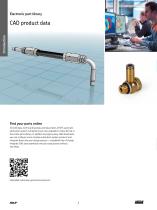
Electronic part library Find your parts online 3D CAD data, technical drawings and data sheets of SKF automatic lubrication system components are now available in native format in the online parts library. In addition to enjoying easy CAD downloads, you can configure more complex lubrication system products and integrate them into your design process – completely free of charge. Integrate CAD data seamlessly into your layout plans without any delay.
Open the catalog to page 2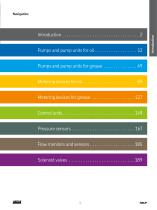
Introduction . . . . . . . . . . . . . . . . . . . . . . . . . . . . . . . . . 2 Pumps and pump units for oil . . . . . . . . . . . . . . . . . . 13 Pumps and pump units for grease . . . . . . . . . . . . . . 49 Metering devices for oil . . . . . . . . . . . . . . . . . . . . . . . 89 Metering devices for grease . . . . . . . . . . . . . . . . . . 127 Control units. . . . . . . . . . . . . . . . . . . . . . . . . . . . . . . 149 Pressure sensors . . . . . . . . . . . . . . . . . . . . . . . . . . . 167 Flow monitors and sensors . . . . . . . . . . . . . . . . . . . 185 Solenoid valves . . . ....
Open the catalog to page 3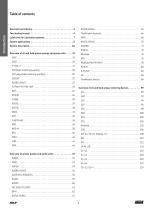
Electronic part library Lubricants for lubrication systems System applications System description Overview of oil and fluid grease pumps and pump units Multilube MLPV / MLPI. . . . . . . . . . . . . . . . . . . . . . . . . . . . . . . . . 78 501 (fixed metering quantity) . . . . . . . . . . . . . . . . . . . . . . . . . . . 18 501 (adjustable metering quantity) . . . . . . . . . . . . . . . . . . . . . . . 20 Overview of oil and fluid grease metering devices Overview of grease pumps and pump units
Open the catalog to page 4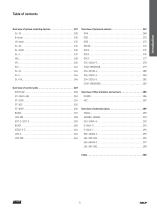
Overview of grease metering devices Overview of pressure sensors Overview of control units 149 Overview of flow monitors and sensors ST-102 . . . . . . . . . . . . . . . . . . . . . . . . . . . . . . . . . . . . . . . . . . . . 155 Overview of solenoid valves
Open the catalog to page 5
One global leader SKF and Lincoln have joined forces to provide you with the world’s most complete portfolio of innovative lubrication solutions – from manual lubricators and tools, to the most advanced centralized and automatic lubrication systems available. In addition to traditional lubrication products and systems, we offer customized solutions for many industries such as pulp and paper, steel, mining, agriculture, marine, rail, wind, construction, machine tool and automotive. SKF engineering and technical specialists partner with OEMs and end-users to develop system solutions based on customer...
Open the catalog to page 6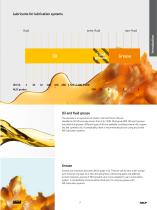
Lubricants for lubrication systems Fluid grease NLGI grades Oil and fluid grease The viscosity is an expression of a fluid’s internal friction. Oils are classified in ISO VG viscosity classes from 2 to 3 200. NLGI grade 000, 00 and 0 greases are called fluid greases. Different types of oils are available, including mineral oils, organic oils and synthetic oils. A compatibility check is recommended prior to using any oil with SKF lubrication systems. Grease Greases are consistent lubricants (NLGI grade 1–6). They are soft to hard, triple-component mixtures of a base oil as the lubricating fluid,...
Open the catalog to page 7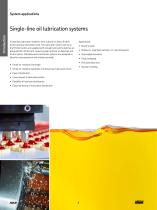
System applications Single-line oil lubrication systems In total loss lubrication systems, fresh lubricant is fed to friction points during a lubrication cycle. The lubrication cycle is set up so that friction points are supplied with enough lubricant to build up an adequate film of lubricant, reducing wear and tear on bearings and friction points. Monoflex and Centromatic systems are designed to allow for easy expansion and simple assembly. • Small-to-medium line length • Small-to-medium quantities of lubricant per lubrication point Applications: • Machine tools • Mobile on-road (fleet vehicles,...
Open the catalog to page 8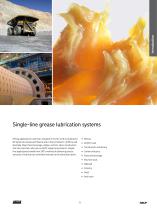
Single-line grease lubrication systems Mining applications have been installed in the far north including the Oil Sands of Canada and Siberia and in the hot deserts of Africa and Australia. Major food, beverage, oil/gas, cement, steel, construction and rail customers also rely on SKF’s single-line products. Singleline applications benefit from SKF’s method of delivering precise amounts of lubricant at controlled intervals to the lubrication point. • Mining • On/Off-road • Construction machinery • Cement industry • Food and beverage • Machine tools • Railroad • Forestry •
Open the catalog to page 9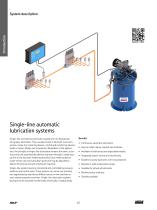
System description System video Single-line automatic lubrication systems Single-line are total loss lubrication systems for oil, fluid grease and grease lubrication. They usually consist of lubricant reservoirs, pumps, single-line metering devices, control and monitoring devices, tubes or hoses, fittings and accessories. Regardless of the application, the principle of single-line lubrication remains the same: a central pump unit automatically delivers lubricant through a single supply line to the lubricant metering device(s). Each metering device outlet serves only one lubrication point and...
Open the catalog to page 10
System design Step by step towards your tailor-made system Product categories to support a quick system layout SKF engineers have developed single-line metering device categories that allow an easy assignment of system key components as metering devices and pumps. At product selection phase it is now possible to choose a pump that matches with the correct category of lubrican metering devices given in product features list. For planning a lubrication system, conditions the system will be used in need to be determined first. The number of lubrication points, back pressures at the lubrication points,...
Open the catalog to page 11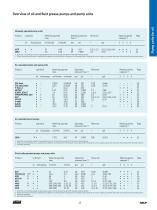
Manually operated pump units Metering device category 2) fluid grease Select the correct fittings, adjust the operating pressure to fit the pressure range of the selected metering devices. Single-line metering devices are classified into categories according to their vent pressure in ascending order. Choosing the correct category guarantees the proper functioning of the lubrication system. Air-operated pumps and pump units Lubricant fluid grease Metering device category 2) Air-operated barrel pumps Lubricant Metering device category 2) fluid grease Select the correct fittings, adjust the operating...
Open the catalog to page 13All SKF Lubrication Systems Germany GmbH catalogs and technical brochures
 SKF Compact greaser
8 Pages
 Pump unit PPS30
4 Pages
 ECP Product brochure
8 Pages
 Pulse meter IPM
4 Pages
 Product series 143 brochure
24 Pages
 Wire rope lubrication system
8 Pages
 Single- and Multi-circuit Pumps
16 Pages
 LubriLean brochure
4 Pages
 1154 flyer
2 Pages
 EDL1 product brochure
4 Pages
 DSA product brochure
4 Pages
 DSC3 product brochure
4 Pages
 DSB product brochure
4 Pages
 HCC product brochure
2 Pages
 LMC 301 product brochure
8 Pages
 SFZM product brochure
4 Pages
 SP/SMB14 product brochure
8 Pages
 SP/SMB13 product brochure
8 Pages
 SMBM product brochure
18 Pages
 Safeflow product brochure
4 Pages
 SMT 1 product brochure
8 Pages
 LP2 / LPC product brochure
8 Pages
 PSG product brochure
36 Pages
 VP product brochure
20 Pages
 VPK product brochure
20 Pages
 VPB product brochure
12 Pages
 SPVS product brochure
8 Pages
 SKF Maxilube Solution
8 Pages
 SGA/SG product brochure
6 Pages
 SLC product brochure
12 Pages
 SL-6 product brochure
4 Pages
 SL-32HV product brochure
2 Pages
 310 series product brochure
4 Pages
 BPH product brochure
4 Pages
 Lubrigun product brochure
15 Pages
 EOP2 product brochure
2 Pages
 MPB product brochure
2 Pages
 FK product brochure
12 Pages
 VectoLub product brochure
30 Pages
 Gear Pump Units brochure
12 Pages
 P502 product brochure
2 Pages
 LubriLean product brochure
16 Pages
 P603S product brochure
8 Pages
 P212 product brochure
2 Pages
 P205/ P215 product brochure
2 Pages
 MKx series product brochure
24 Pages
 Product Series OLA, MV and 161
28 Pages
 CLK product brochure
8 Pages
 Gear wheel indicator SFZM
4 Pages
 Oil conditioning unit OCU
4 Pages
 LFC 5000
4 Pages
 SSV-D
SSV-D2 Pages
 Improved Centro-Matic SL-11
12 Pages
 SL-V XL
4 Pages
 12-volt Reel 'n F
2 Pages
 New 90-lb. Reservoir
12 Pages
 HTL 429
4 Pages
 Lincoln
8 Pages
 AC FlowMaster
12 Pages
 EOS
EOS2 Pages
 LFR Series
4 Pages
 Hand Vacuum Pumps
6 Pages
 Pumps PMV Pump Family
16 Pages


