- Catalogs
- Sketch CO., LTD.
- The development history of IRUV Cut Coat


The development history of IRUV Cut Coat
The development history of IRUV Cut Coat
Japan initially used black films to address overheated public telephone boxes. The demand for transparent heat-shielding window products led to the development of thermal barrier coatings in 2000. High initial investment and complex application processes resulted in many companies failing to monetize their investments.
The 2010 Energy Conservation Law and extreme summer heat increased interest in heat-shielding glass coats as a cost-effective alternative to Low-E double glazing, supported by government subsidies.
The Fukushima disaster in 2011 increased the urgency for power-saving measures, leading to the adoption of heat-shielding films. Major paint manufacturers expanded the market.
Market challenges included dominance by major manufacturers, shifting government subsidies, application difficulties, and performance inconsistencies.
The market now focuses on high-performance products with specific criteria, certified application personnel, and transparent consumer information.
IRUV cut coats offer cost-effective heat insulation and UV protection, appealing to corporate and private customers.
Sketch Co., Ltd. leads in IRUV cut coats with global sales and a strong distribution network, though recent price increases have affected market differentiation.
Sketch's IRUV cut coat is a top product due to its superior performance and competitive pricing, with ongoing innovation to maintain market position.
Sketch's IRUV cut coat offers superior heat shielding, easy application, and consistent quality. It is supported by extensive technical resources and is designed for large window glass.
The IRUV cut coat holds the No.1 market share in Japan, sold in 33 countries, with over 1 million sqm applied. It is priced lower than competitors like 3M films.
More cost-effective than 3M films, with prices from 8800 to 12000 yen per sqm in Japan, offering 15 years of durability and a 10-year warranty.
Provides 90% near-infrared cut, superior heat shielding, and over 99% UV cut rate, reducing air conditioning costs by 25-30% and preventing UV damage.
Compatible with LOW-E double glazing and single glass, offering transparency and minimal reflection, safe for children and pets once dried.
More durable and easier to apply than films, with better heat insulation than Low-E double glazing glass.
Contributes to energy savings, with proven annual reductions in energy use in offices and homes.
Safe to lick after drying, with no harmful chemicals like formaldehyde and benzene.
Uniform application using a roller, with high visible light transmittance and excellent leveling characteristics.
Pencil hardness of 4H, indicating durability unless the glass is damaged.
Easy initial application for small windows, with practice needed for larger windows. Environmental factors are important.
Complete curing takes half a month in summer and a month in winter. Cleaning should be done with water or neutral detergent.
10-year guarantee against yellowing, cloudiness, or peeling, excluding customer negligence.
Finger contact drying in 30 to 60 minutes, safe to touch after 3 hours.
Use 4mm masking tape on the sash frame, with a scraper for peeling.
Interior application is preferred for price, durability, and warranty reasons.
Helps retain indoor heat, reducing window cooling and condensation by about 50%.
Catalog excerpts
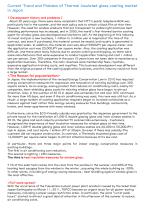
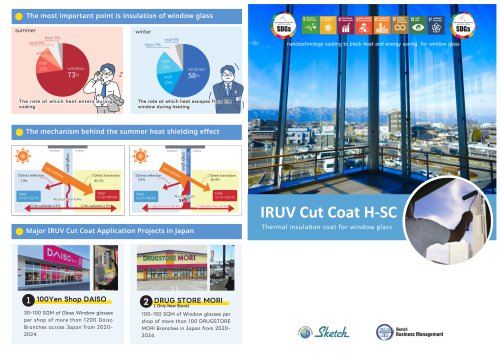
Current Trend and Problem of Thermal insulated glass coating market in Japan 〈 Development history and problems 〉 About 20 years ago, there were many complaints that NTT‘s public telephone BOX was particularly hot in the summer, and the main policy was to attach a black film at that time. However, the need for window products that are transparent to visible light and have heat shielding performance has increased, and in 2000, the world’s first thermal barrier coating agent for window glass was developed and started to sell. At the beginning of this industry, to invest and join a new business, 1 million to 3 million yen is required at the time of the contract, and even if purchased, the material cannot be resold, and royalty is generated in application sales. In addition, the material cost was about 5000JPY per square meter, and the application cost was 20,000JPY per square meter. Also, the coating application was difficult, and there were many failures due to uneven coloring and dripping, so there were some manufacturers that were expensive to conduct application training and cost 1 million yen per person. Over 300 companies in the past 10 years have not been able to monetize as a application business, Therefore, the main revenues were membership fees, royalties, expensive application training costs, and royalties. This business development was different from the original purpose of the coating application business, and this industry could not form a large market. In Japan, the implementation of the revised Energy Conservation Law in 2010 has required energy conservation measures for expansion and renovation of existing buildings over 300 square meters. As an energy-saving product that reduces air conditioning costs, mainly for companies, heat-shielding glass coats for existing window glass have begun to attract attention. Also, in the summer of 2010 in Japan was extremely hot and over 30℃ continued for more than 40 days, and even if the air conditioning was used, the room was still hot. As a result, a large number of coating application requests began to increase nationwide as a measure against heat rather than energy-saving measures from buildings, restaurants, hotels, and tower apartments with many windows. Furthermore, since the ECO-Friendly subsidy was granted by the Japanese government to the private house for the installation of LOW-E double glazing glass and inner window sashes in 2010, the glass and sash industry promoted TV commercials extensively . Customers recognized the importance of heat insulation measures for window glass at that time. However, LOW-E double glazing glass and inner window sashes are 40,000 to 50,000JPY/ sqm in Japan, and cost nearly 1 million JPY at 20sqm. So even if there was subsidy.The customer did not request construction. In contrast, a Thermally insulated glass coat of 12,000JPY per square meter began to attract attention because of its low cost. In particular, there are three major points for indoor energy conservation measures in existing buildings. The first is air conditioning cost reduction, The second is lighting / LED measures, The third is heat insulation measures for window glass. 71% of the solar heat comes into the room from the window in the summer, and 48% of the heating heat escapes from the window in the winter , assuming the whole building as 100%. In other words, in building of energy saving measures , heat shielding against window glass is the most effective. With the occurrence of the Fukushima nuclear power plant accident caused by the Great East Japan Earthquake on March 11, 2011, TEPCO became an urgent issue for all power-saving measures, including a power usage restriction order. In particular, the word “cut at peak hours” started to attract a great deal of attention in the afternoon of the summer to reduce air conditio
Open the catalog to page 1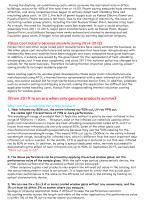
During the daytime, air conditioning costs, which consume the most electricity in office buildings, account for 48% of the total time at 14:00. Power saving measures have attracted attention, and many companies have begun to actively adopt heat shielding films and insulating glass coat. In 2012, the lack of power supply such as Kansai Electric Power and Kyushu Electric Power became a hot topic. Due to the shortage of electricity, the issue of restarting nuclear power plants, including the Daii Nuclear Power Plant, became a big topic. As a result, the need for insulating glass coats has expanded....
Open the catalog to page 2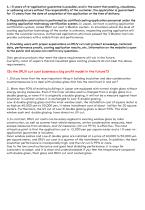
4、10 years of re-application guarantee is possible, and in the event that peeling, cloudiness, or yellowing occurs without the responsibility of the customer, the application is guaranteed for 10 years from the date of completion of the application at the time of delivery. 5、Responsible construction is performed by certified coating application personnel under the coating application technology certification system. In Japan, we have a coating application certification system, called IRUV cut coat 3 Meister system. In situations where the level of coating application technology of the worker...
Open the catalog to page 3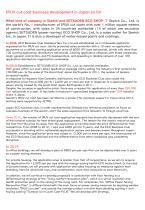
IRUV cut coat business development in Japan so far What kind of company is Sketch and SETSUDEN ECO SHOP ? Sketch Co., Ltd. is the world's No. 1 manufacturer of IRUV cut coats with over 1 million square meters of construction, with sales in 34 countries worldwide (14 of which are exclusive agents).SETSUDEN(power-saving) ECO SHOP Co., Ltd. is a sales outlet for Sketch Inc. in Japan. It is also a developer of water-based paints and coatings. In 2008, ECO Business Club Headquarters Co.,Ltd was established as a nationwide applicator organization for IRUV cut coat. Jointly promoted sales promotion...
Open the catalog to page 4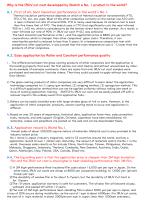
Why is the IRUV cut coat developed by Sketch a No. 1 product in the world? A.1. First of all, heat insulation performance is the world's No.1. Thermal insulation performance depends on which of thermal insulation nanomaterials ATO, ITO, CTO, etc. are used. Most of the other companies currently on the market use ATO with a near-infrared cut rate of around 50%. ITO is rarely used because its material cost is more than five times that of ATO. The sketch uses a CTO that significantly cuts the near infrared 900 to 1,100 nm, which is considered to be the hottest direct heat in the summer. As a result,...
Open the catalog to page 5All Sketch CO., LTD. catalogs and technical brochures
 IRUV CUT COAT
7 Pages
 Super Glass Barrier
5 Pages
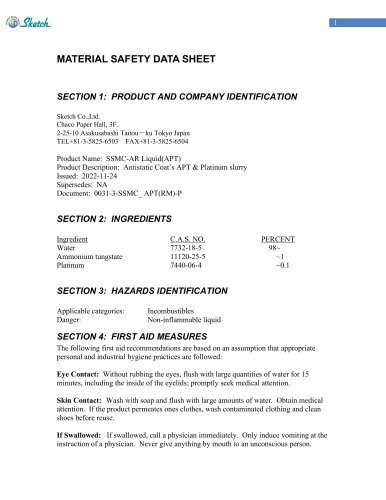 (EN_MSDS)SSMC-AR Liquid(APT)
4 Pages
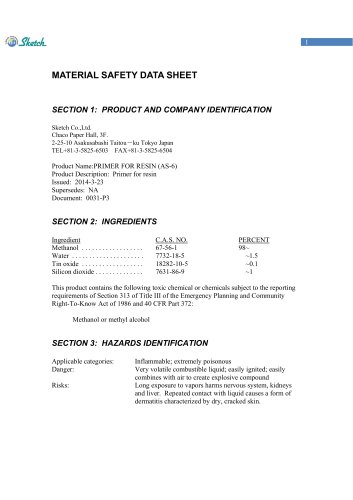 ・Primer for resin
5 Pages
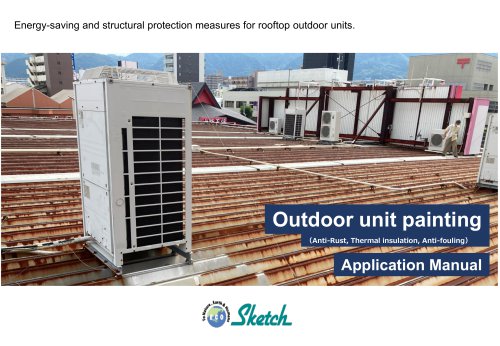 Outdoor unit painting
15 Pages
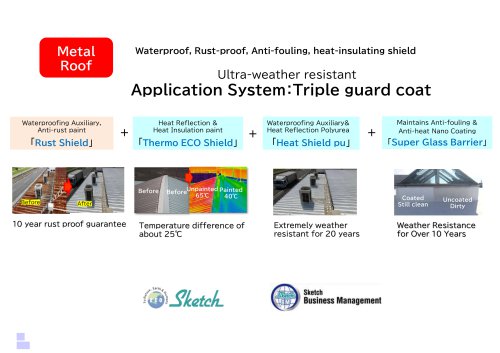 Triple Guard Coat
11 Pages
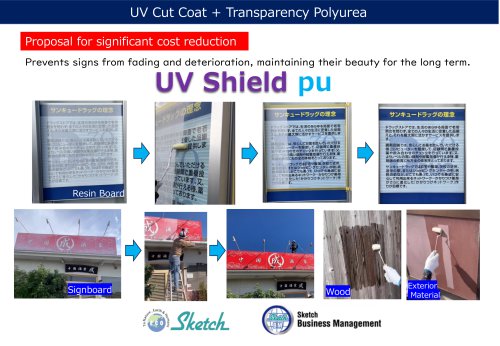 UV Shield
4 Pages
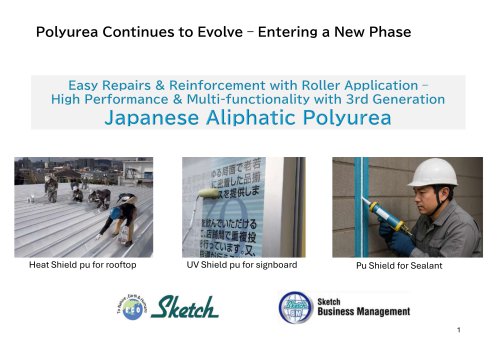 Aliphatic Polyurea Product2025
13 Pages
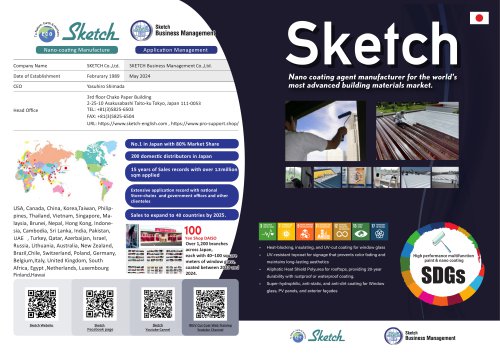 Sketch New Brochure2025
2 Pages
 Sketch Company profile
15 Pages