
- Catalogs
- SIT Società Italiana Tecnospazzole
- Precision Machining Catalogue


Precision Machining Catalogue

Precision Machining Catalogue
- Choosing the Right Brush: This section discusses the factors influencing brush selection, noting that no single brush is perfect for all applications. The selection depends on specific surface finishing requirements, with eight variables identified by SIT Tecnospazzole that determine brush performance.
- Brush Types and Materials: Brushes are categorized by filament materials, including synthetic, abrasive synthetic, ferrous and non-ferrous metals, and natural fibers. Each material's properties and suitable applications, such as resistance to chemicals, temperature, and abrasion, are described.
- Application Guidelines: A table provides guidance on the suitability of different brush materials for various materials like aluminum, brass, and cast iron, categorizing applications into best fit, admissible solution, and non-recommended uses.
- Operational Parameters: The document explains the impact of power, speed, and pressure on brush performance, emphasizing that brushes work by cutting rather than abrasion to reduce surface damage.
- Consider power source characteristics when selecting a brush, as they affect the surface finish.
- Understand that brushes are impact tools that remove surface adherence delicately compared to abrasive tools.
- Evaluate operational quality and efficiency of the surface finish, as they may not always align.
Catalog excerpts

MECCANICA DI PRECISIONE PRECISION MACHINING
Open the catalog to page 1
MECCANICA DI PRECISIONE PRECISION MACHINING Indice / Index > LA SPAZZOLA GIUSTA PER OGNI OPERAZIONE HOW TO CHOOSE THE RIGHT BRUSH > SBAVATURA E FINITURA SUPERFICIALE DEBURRING AND SURFACE FINISHING > SPAZZOLE COMPOSITE E SBAVATURA AUTOMATIZZATA p. 14 COMPOSITE BRUSHES AND AUTOMATED DEBURRING > TRATTAMENTO LEGHE LEGGERE E APPLICAZIONI DEL NYLON ABRASIVO ALUMINIUM ALLOYS TREATMENT AND ABRASIVE NYLON APPLICATIONS > Spazzole Composite a disco Composite disc brushes > Spazzole circolari Wheel brushes > Anelli Single section wheels > Scovoli per sbavatura Twisted-in brushes for deburring > Spazzole...
Open the catalog to page 3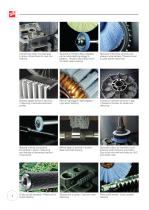
Circolare per pulire uno stampato in ghisa / Wheel brush for cast iron cleaning Spazzole in Tampico (fibra vegetale) per la pulizia degli ingranaggi in plastica / Tampico (plant fiber) brush for plastic gears ceaning Spazzola in filamento ceramico per sbavare ruote dentate / Ceramic brush for gear splines deburring Sbavare oggetti estrusi in alluminio / Deburring of extruded aluminium profiles Rifinire ingranaggi in leghe leggere / Light alloys finishing Scovoli per sbavare cerchioni in lega / Twisted-in brushes for wheel rims deburring Sbavare e rifinire componenti biomedicali in titanio / Deburring...
Open the catalog to page 4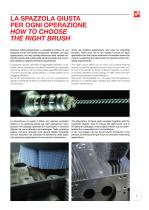
LA SPAZZOLA GIUSTA PER OGNI OPERAZIONE HOW TO CHOOSE THE RIGHT BRUSH Esistono infinite applicazioni e modalità di utilizzo di una spazzola. Forse non esiste la spazzola “perfetta” per ogni applicazione, ma una corretta selezione delle variabili costruttive guida alla scelta della spazzola ideale per la propria specifica esigenza di finitura superficiale. There are endless applications and uses for industrial brushes. There may not be the “perfect” brush for each application but the proper selection of variables drives the choice in selecting the ideal brush for specific surface finishing requirements....
Open the catalog to page 5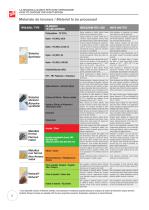
LA SPAZZOLA GIUSTA PER OGNI OPERAZIONE HOW TO CHOOSE THE RIGHT BRUSH TIPOLOGIA / TYPE FILAMENTO FILLING MATERIAL Polipropilene - PP (PPL) Nylon - PA (NYL) 6/6.6 Sintetici Synthetic Nylon - PA (NYL) 46 Nylon - PA (NYL) 6 BILON PolyVinilChloride (PVC) PET - PBT Poliestere / Polyestere Nylon abrasivo / Abrasive Nylon Sintetici abrasivi Abrasive synthetic Carburo di Silicio / Silicon carbide Ossido o Silicato di Alluminio / Alluminium oxide Ceramico Diamantato Metallici ferrosi Ferrous metal Acciaio / Steel Acciaio Inossidabile (Inox) AISI 302-304-316 / Stainless Steel AISI 302-304-316 Metallici...
Open the catalog to page 6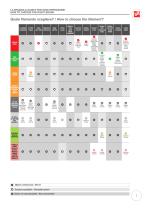
LA SPAZZOLA GIUSTA PER OGNI OPERAZIONE HOW TO CHOOSE THE RIGHT BRUSH Quale filamento scegliere? / How to choose the filament? ALLUMINIO ALUMINIUM OTTONE BRASS GHISA COMPOSITO CAST IRON COMPOSITE RAME COPPER ACCIAIO STEEL VETRO GLASS METALLI DURI HARD METAL CARBIDES PLASTICA PLASTIC Irruvidire, Rusticare Roughening, Aging GOMMA RUBBER ACCIAIO STEEL Raspare Buffing Rimuovere rivestimenti, Preparare/Pulire saldature, Sbavare Coating removal, Weld preparation / cleaning, Deburring ACCIAIO INOX STAINLESS STEEL PIETRA, MATTONI STONE, BRICK OTTONE BRASS LEGNO WOOD Rusticare, Rimuovere rivestimenti Aging,...
Open the catalog to page 7
LA SPAZZOLA GIUSTA PER OGNI OPERAZIONE HOW TO CHOOSE THE RIGHT BRUSH Peso Assorbimento specifico acqua Specific Water weight absorption 3 g/cm % Materiale / Material Polypropylene - PP (o PPL) 0,91 Nylon - PA (NYL) 6 1,12 Nylon - PA (NYL) 6.6 1,14 Nylon - PA (NYL) 6.12/6.10 1,08 Nylon - PA (NYL) 46 1,18 Nylon - PA (NYL) HT150 1,09 Nylon - PA (NYL) 6 BILON 1,12 Nylon abrasivo / Abrasive Nylon - PA6 ~1,25* Nylon abrasivo / Abrasive Nylon - PA6.12/6.10 ~1,25* Nylon abrasivo / Abrasive Nylon - AbraMaXX ~1,25* Polyphenylene sulfide - (PPS) Pekalon II 1,35 Polyetheretherketone - PEEK 1,30 PolyVinilChloride...
Open the catalog to page 8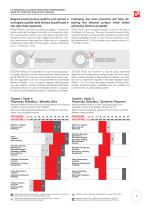
LA SPAZZOLA GIUSTA PER OGNI OPERAZIONE HOW TO CHOOSE THE RIGHT BRUSH Seguire poche buone pratiche può aiutare a Following few best practices will help obconiugare qualità della finitura superficiale e taining the desired surface finish whilst vita utile della spazzola achieving lifetime durability PRIMA REGOLA: lavorare con pressione leggera, in modo che solo le punte dei fili vengano a contatto con la superficie di lavoro: esercitando il massimo urto, asportando le asperità velocemente e senza spezzarsi. Nella maggior parte dei casi, il corretto meccanismo d’asportazione si ottiene se non si...
Open the catalog to page 9
LA SPAZZOLA GIUSTA PER OGNI OPERAZIONE HOW TO CHOOSE THE RIGHT BRUSH Identificata la velocità periferica, si possono scegliere, come riportato nel passo 3, il diametro e la velocità di rotazione compatibili. Si riporta di seguito la formula, con tabella dei risultati, per risalire, nota la velocità lineare periferica desiderata, alla velocità di rotazione della spazzola e il suo diametro ottimali. Once the peripheral speed is identified, as explained in Step 3, we should choose compatible diameter and angular velocity dictated by the available tool. Below the table to match the desired peripheral...
Open the catalog to page 10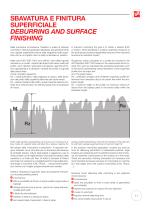
SBAVATURA E FINITURA SUPERFICIALE DEBURRING AND SURFACE FINISHING Nella meccanica di precisione l’obiettivo è quello di ottenere una finitura / texture superficiale desiderata, più specificamente una rugosità superficiale (misura delle irregolarità della superficie) che ha un impatto critico a livello funzionale ed estetico. In precision machining the goal is to obtain a desired finish or texture. More specifically a surface roughness (measure of the total spaced surface irregularities) because of the improved functional an aesthetic impact. Nella norma ISO 4287:1997 sono definiti i valori della...
Open the catalog to page 11
SBAVATURA E FINITURA SUPERFICIALE DEBURRING AND SURFACE FINISHING Qualunque sia il processo di lavorazione, la finitura mediante spazzolatura abrasiva migliora le caratteristiche funzionali delle parti nel rispetto del profilo e delle geometrie. Infatti la spazzola funziona per “erosione abrasiva” della superficie. Ad esempio filamenti abrasivi sottili “accarezzano” la superfice e lavorano sulle tracce lasciate dalla lavorazione precedente (senza penetrazione nel materiale). A seconda della qualità della lavorazione (Ra(rettifica) < Ra(fresatura)), la dimensione della grana abrasiva impregnata...
Open the catalog to page 12All SIT Società Italiana Tecnospazzole catalogs and technical brochures
 Sport Solutions
20 Pages
 Industrial Brushes Catalogue
228 Pages
 SIT Company Profile
7 Pages
 Woodworking Brushes Catalogue
12 Pages
 Chimney Cleaning Catalogue
16 Pages


- SIT surface treatment brush
- SIT cleaning brush
- Sanding disc
- SIT metal brush
- SIT circular brush
- Flap disc
- Metal abrasive disc
- SIT deburring brush
- SIT plastic brush
- SIT steel brush
- Grinding abrasive disc
- Finishing flap disc
- SIT finishing brush
- Stainless steel flap disc
- Safety goggles
- SIT cylindrical brush
- SIT stainless steel brush
- SIT strip brush
- Cleaning abrasive disc