

Novamini 180 - Novamix 1600

Novamini 180 - Novamix 1600
Summary of Welding Equipment Specifications and Parameters
This document appears to provide technical specifications and operational parameters for welding machines, specifically models named Novamini 180 and Novamix 1600. The focus is on MIG, MMA, and TIG welding processes, with details on voltage, current, duty cycle, and wire diameters.
1. Welding Processes and Modes
- MIG (Metal Inert Gas)
- MMA (Manual Metal Arc)
- TIG (Tungsten Inert Gas)
- LIFT - likely referring to Lift TIG ignition method
- DC (Direct Current) operation with inverter technology
2. Equipment Models and Electrical Specifications
- Novamini 180 and Novamix 1600 are the two main models referenced.
- Operating voltage: 230 V
- Power supply phases: 3 (three-phase)
- Current ranges vary by model and welding mode, e.g., 50-140 A for Novamini 180 MIG
- Duty cycle percentages at different current levels are provided (e.g., 40%, 60%, 100%) indicating machine operating limits to avoid overheating.
3. Welding Wire and Electrode Parameters
- Wire diameters for MIG welding: 0.6 - 0.8 mm (5 Kg spool)
- Electrode diameters for MMA: 2.5 - 3.25 mm
- Wire feed speeds and burn back settings are mentioned but not fully detailed.
4. Physical Dimensions and Weight
- Dimensions given in millimeters (e.g., 510 x 260 x 450 mm)
- Weight parameters are indicated but not fully clear from the excerpt.
5. Operational Parameters and Controls
- Open circuit voltage (O.C.V.) values are referenced.
- Duty cycle (l2 %) and burn back control settings are noted.
- Polarity options (+/-) for DC welding are indicated.
6. Color Codes and Printing Marks
- References to color codes (C, M, Y, CM, MY, CY, CMY, K) suggest printing or labeling standards, possibly for documentation or machine interface.
Critical Information: The document provides essential technical data for selecting and operating Novamini 180 and Novamix 1600 welding machines, including electrical requirements, welding parameters, and consumable specifications. Duty cycle and current ranges are key to ensuring safe and effective machine use. Wire and electrode diameters must be matched to the welding process and machine capabilities.
All SINCOSALD catalogs and technical brochures
 Specialized robotic automation
12 Pages
 GENERAL CATALOGUE 2024 rev.1,0
72 Pages
 NOVACUT 46
2 Pages
 TOP VIEW
2 Pages
 NOVAMIG 322 C
2 Pages
 NOVAMIX 203 SYN PFC
2 Pages
 NOVACUT 70 - 110 - 150
2 Pages
 NOVASTICK 300 - 400
2 Pages
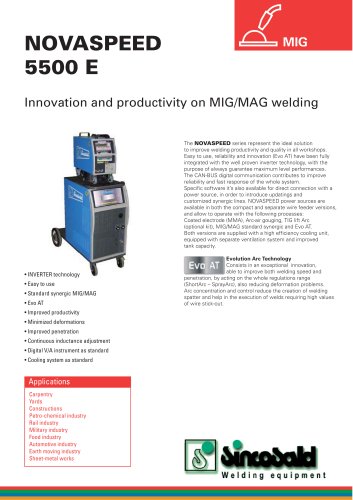 NOVASPEED 5500 E
2 Pages
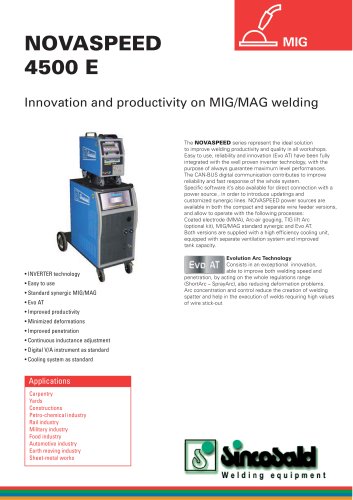 NOVASPEED 4500 E
2 Pages
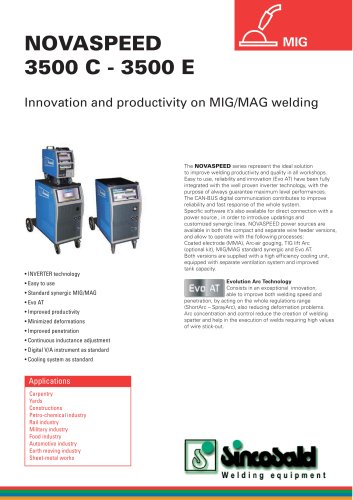 NOVASPEED 3500 C - 3500 E
2 Pages
 General Catalogue
52 Pages


- Welder
- Arc welder
- Portable welder
- Inverter welder
- MIG-MAG welder
- TIG welder
- MMA welder
- Three-phase welder
- Welding power supply
- Arc welding torch
- Air-cooled welding torch
- Welder with integrated display
- Welding helmet
- Arc welding power supply
- Steel welder
- Stainless steel welder
- Welder with wire feeder
- Inverter welding power supply
- Three-phase welding power supply
- Water-cooled welding torch