

SYSTEMS ENGINEERING FOR PRODUCT DEVELOPMENT

SYSTEMS ENGINEERING FOR PRODUCT DEVELOPMENT
In today's competitive global environment, industries face intense pressures in new product development. Systems Engineering is crucial for managing the complexity of product development throughout its lifecycle, from concept to production and operation. It integrates technical and business aspects, ensuring a comprehensive product definition.
Dassault Systèmes introduces the RFLP approach, which stands for Requirements, Functional, Logical, and Physical design. This approach centralizes development efforts around a unified product definition, fostering collaboration and innovation across disciplines.
- Requirements Engineering: Involves capturing and managing requirements, validating specifications, and ensuring traceability across systems engineering tools.
- System Architecture: Provides a modeling environment for defining functional and logical architecture, simulating global architecture, and managing the full lifecycle.
- Embedded Systems and Software: Focuses on model-based design and simulation, compliance with industry standards, and rapid development of embedded systems.
- 3D for Systems: Involves creating 3D representations and pathways, and performing trade-off analysis using Knowledgeware.
- Dynamic Behavior Modeling: Enables easy modeling of multi-discipline systems using a graphical editor and ready-to-use model libraries.
- Compliance with standards and regulations.
- Improved product quality and customer satisfaction.
- Reduced development costs and rework.
- Enhanced visibility and collaboration through a central repository.
- Realistic simulation early in the design phase.
Dassault Systèmes provides virtual universes for sustainable innovations, transforming product design, production, and support. Their solutions foster social innovation and improve real-world applications, serving over 150,000 customers in more than 80 countries.
Catalog excerpts
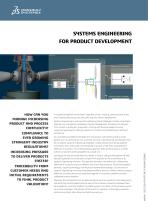
SYSTEMS ENGINEERING FOR PRODUCT DEVELOPMENT In a global competitive environment, regardless of your industry, these are some of the most intense pressures you are facing for any new product development. Systems Engineering is paramount for addressing these challenges. It helps comprehend, organize, and manage the complexity of product development throughout its lifecycle from concept to production to operation, starting with the early stages including answering requirements, defining a product’s functions, and establishing its technical architecture. To successfully complete the development of a product, both technical and business aspects such as performance, cost, schedule, sourcing, manufacturing, and disposal must be considered. Systems Engineering integrates multiple domains and brings together contributors from diverse technical disciplines to provide a high-level, comprehensive definition of a product. This interdisciplinary approach looks at the product as a whole, with all components working together as a single unit. Leveraging its long-time experience as a leader in Product Lifecycle Management (PLM), Dassault Systèmes has introduced a unique RFLP approach as the cornerstone of its Systems Engineering solutions. This approach provides a comprehensive, collaborative definition of a product across its different views from Requirements, Functional (targeted services), Logical (technology), and Physical (implementation) design. DS solutions for Systems Engineering centralize all development efforts around a unified, collective product definition, and bring the various disciplines together on a common platform to foster collaboration and innovation. Moreover, the components from multiple disciplines (such as mechanics, thermodynamics, and electricity including electronics) as well as the numerous interactions between them are modeled on a common platform to enable dynamic simulation of the complete system via a virtual prototype. The behavior of the product in operation is thoroughly assessed while various design alternatives are tested very early on. HOW CAN YOU MANAGE INCREASING PRODUCT AND PROCESS COMPLEXITY? COMPLIANCE TO EVER GROWING STRINGENT INDUSTRY REGULATIONS? INCREASING PRESSURE TO DELIVER PRODUCTS FASTER? TRACEABILITY FROM CUSTOMER NEEDS AND INITIAL REQUIREMENTS TO FINAL PRODUCT VALIDATION?
Open the catalog to page 1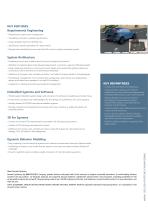
KEY FEATURES Requirements Engineering • Requirements capture and management • Traceability matrices to validate specifications • Impact analysis reports to identify risks • Specification reports generation for requirements • Requirement traceability across more than 60 common systems engineering tools System Architecture • odeling environment to define the functional and logical architecture M • Definition of implementation links between Requirement, Functional, Logical and Physical objects • ssign behaviors (discrete or continuous) to each object and simulate the global architecture, A including...
Open the catalog to page 2Archived catalogs
 SIMULIA
6 Pages
 CATIA ELECTRICAL SOLUTIONS
8 Pages
 SIMULIA ExSight
2 Pages
 Abaqus for CATIA V5
6 Pages
 SIMULIA V6R2013
6 Pages
 SIMULIA DesignSight Thermal
2 Pages
 Isight 5.8
3 Pages
 CATIA Structural Analysis
2 Pages
 CATIA Surface FE Modeling
2 Pages
 CATIA Advanced FE Modeling
2 Pages
 SIMULIA Execution Engine
2 Pages
 CATIA ICEM SHAPE DESIGN
5 Pages
 CATIA ICEM AEROEXPERT
5 Pages
 CATIA for Creative Designers
9 Pages
 power of CATIA
1 Page
 EN O V IA V 6R 2013x
12 Pages
 SIMULIA V6R2013x_2012
7 Pages
 SIMULIA V5-6R2016
6 Pages
 ABAQUS UNIFIED FEA
6 Pages
 fe-safe
6 Pages
 Isight
6 Pages
 SIMULIA
28 Pages
 CST STUDIO SUITE® 2017
32 Pages
 XFlow
XFlow6 Pages
 XFlow 2019x
2 Pages
 Opera
Opera12 Pages
 ABAQUS/CAE 2017
4 Pages
 ABAQUS/STANDARD 2017
3 Pages
 SIMULIA V6R2013x_2015
4 Pages
 Abaqus 6.8
8 Pages


- Automation software solution
- Management software solution
- SIMULIA analysis software
- SIMULIA process software
- Real-time software
- SIMULIA CAD software
- Cloud-based software
- Control software
- SIMULIA design software
- Industrial software
- SIMULIA 3D software
- Measurement software
- SIMULIA interface software
- Visualization software solution
- SIMULIA quality software
- SIMULIA simulation software
- Automated software
- SIMULIA development software
- Network software
- SIMULIA engineering software