
- Catalogs
- Simpac Europe GmbH
- MX_Technical Specifications


MX_Technical Specifications

MX_Technical Specifications
- Utilizes torque motors for high torque at low speeds, enhancing dynamic processes.
- Offers maximum production flexibility with programmable slide motion, velocity, and strokes.
- Achieves higher output rates compared to conventional presses through dynamic torque motors and pendulum motion.
- Adapts production processes to specific part and die requirements.
- Components such as motors and electronics are of German origin, ensuring durability and performance.
- Includes an intelligent energy management system with capacitor banks.
- Allows integration of downstream processes like nut welding and thread forming.
- Features time-saving set-up and tryout processes with full press force available at low speeds.
- Water-cooled servo torque motors and power electronics.
- Electrical lifting gate with safety glass windows.
- Moving bolster with mobile control panel.
- Electrical slide adjustment and mechanical slide locking.
- Hydraulic unit with lubrication and overload protection.
- Press force monitoring and vibration isolation.
- VPN interface for remote maintenance.
- Additional moving bolster configurations (SX).
- Die change systems with retractable clamping plate or tandem carts (MX).
- Press force monitoring with signature curve.
- Noise reduction press enclosure concepts.
- Type: Servo presses.
- Press capacity: 3,000-10,000 kN (MX) and 8,000-30,000 kN (SX).
- Part size: Medium to large.
- Slide kinematics: Servo motion.
- Applications: Cutting, stamping, bending, embossing, drawing, and integration of downstream processes.
The MX and SX series servo presses are designed for highly dynamic forming processes, offering maximum flexibility and high part quality. The direct drive system allows for significant output increases and optimal adaptation of forming processes to die and part requirements. Operators can choose from predefined slide movement curves for different applications, enhancing process efficiency.
Technical SpecificationsThe MX series offers models with press capacities ranging from 3,000 to 10,000 kN, while the SX series ranges from 8,000 to 30,000 kN. Each model has specific stroke rates, slide strokes, and dimensions tailored to various manufacturing needs.
Catalog excerpts

MX AND SX SERIES Features and benefits • Dynamic processes through the use of torque motors that provide high torque even at low speeds • Maximum production flexibility as slide motion, slide velocity and slide strokes are freely programmable • Significantly higher output rates compared to conventionally driven presses by means of highly dynamic torque motors and pendulum motion of the slide • Optimum adaption of the production process to the requirements of part and die • Motor(s), power electronics, holding brake, lubrication and press control are of German origin and guarantee a long service life and maximum dynamics • Intelligent energy management system with capacitor banks • Downstream processes like nut welding or thread forming can be reliably integrated into the production process by programming holding times at BDC • Set-up features and tryout processes are time-saving and the process is safer due to the availability of the full press force even at lowest speeds Overview • Type: Servo presses • Press capacity: 3,000-10,000 kN (MX) and 8,000-30,000 kN (SX) • Part size: medium to large • Slide kinematics: servo motion • Application: cutting, stamping, bending, embossing, drawing, integration of downstream processes Description Presses with servo direct drive stand for highly dynamic forming processes and offer maximum flexibility in the production. In combination with a high stiffness value of press body and drive, they deliver consistently high part quality. Standard equipment • Water-cooled servo torque motor(s) and power electronics • Electrical lifting gate with safety glass windows • Moving bolster with mobile control panel • Electrical slide adjustment, mechanical slide locking, pneumatic slide counterbalance • Hydraulic unit and lubrication unit with progressive distributor • Hydraulic overload protection • Press force monitoring (single and sum force) • Vibration isolation with spring dampers • VPN interface for remote maintenance Options • Additional moving bolster in front-to-back or t-track arrangement (SX) • Die change systems with retractable die clamping plate or tandem die change carts (MX) • Press force monitoring (signature curve) • Different press enclosure con
Open the catalog to page 1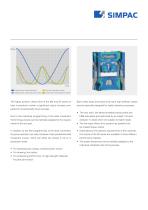
Time Crank/eccentric motion (full stroke) Link motion (pendulum stroke) Crank/eccentric motion (pendulum stroke) Knuckle-joint motion (pendulum stroke) The highly dynamic direct drive of the MX and SX series al- Both, press body and press drive have high stiffness values lows in pendulum motion a significant output increase com- and are specially designed for highly dynamic processes: pared to conventionally driven presses. • The very solid, low-stress annealed press bodies are Due to the individual programming of the slide movement, FEM-calculated and optimized by so-called “hot-spot the forming...
Open the catalog to page 2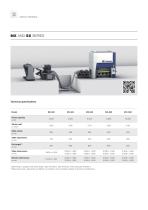
SERVO PRESSES MX AND SX SERIES Technical specifications Model 'Depending on programmed stroke length, slide kinematics, part dimension and existing die limitations **Slide stroke down, adjustment up (SDAU) | All models in 2-point design | Subject to technical modifications
Open the catalog to page 3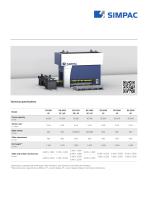
Technical specifications Slide and bolster dimensions in mm 'Depending on programmed stroke length, slide kinematics, part dimension and existing die limitations **Slide stroke down, adjustment up (SDAU) | 2P = 2-point design, 4P = 4-point design | Subject to technical modifications
Open the catalog to page 4All Simpac Europe GmbH catalogs and technical brochures
Archived catalogs
 SIMPAC Product overview
20 Pages
 SX_Technical specifications
4 Pages
 MC_Technical specifications
2 Pages
 PDH_Technical specifications
2 Pages
 DTL_Technical data
2 Pages
 DTE_Technical specifications
2 Pages
 CS/ECS_Technical data
2 Pages


- Industrial press
- Forming press
- Hydraulic press
- Automatic press
- Electric press
- Pneumatic press
- Punching press
- Stamping press
- Process press
- Cutting press
- Mechanical press
- Frame press
- Bending press
- Sheet metal press
- Straight-side press
- Press for the automotive industry
- Press for industrial applications
- C-frame press
- Compact press
- Drawing press