- Catalogs
- Silicon Designs
- Silicon Designs Model 2276 Analog Accelerometer Module

Silicon Designs Model 2276 Analog Accelerometer Module

Silicon Designs Model 2276 Analog Accelerometer Module
Catalog excerpts
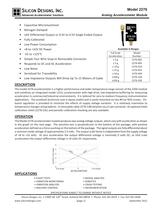
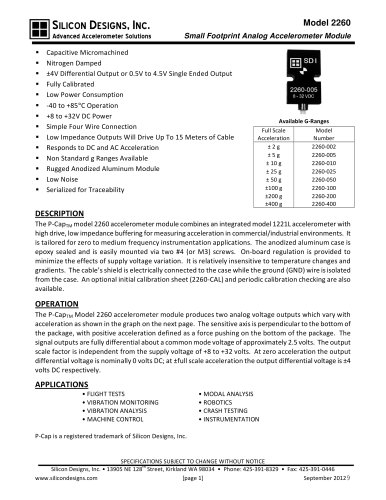
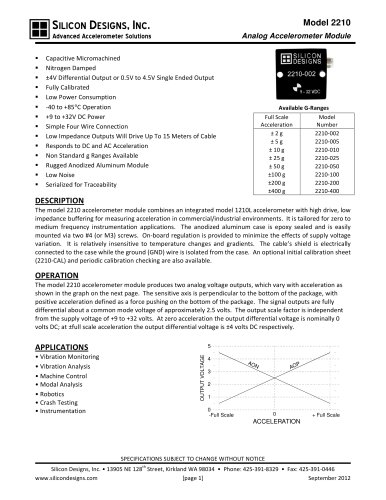
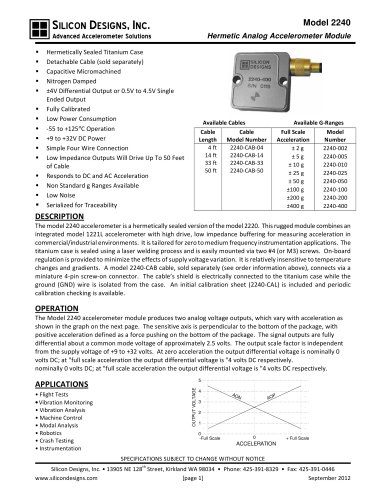
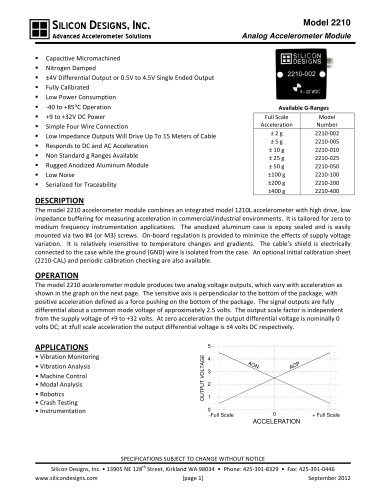
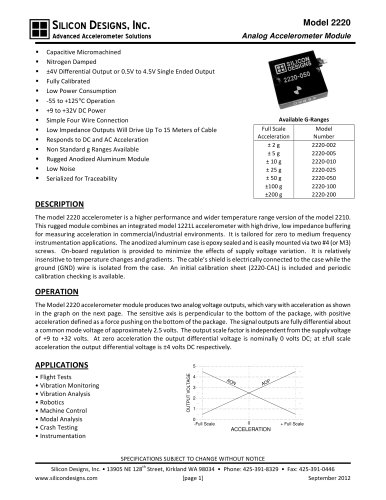
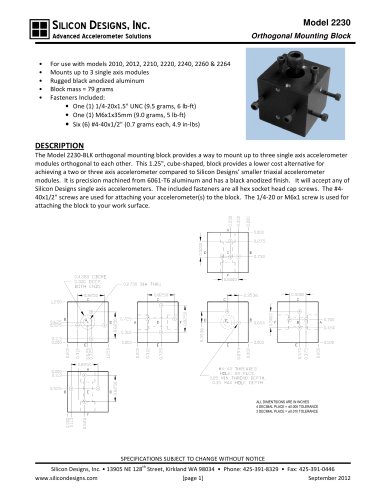
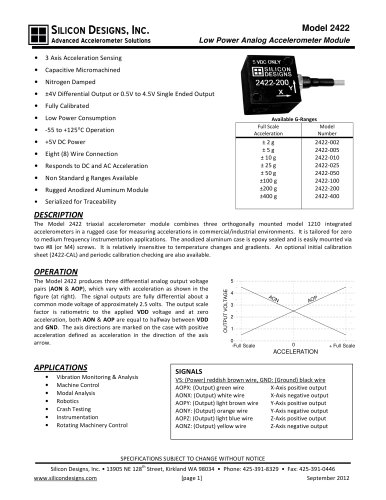
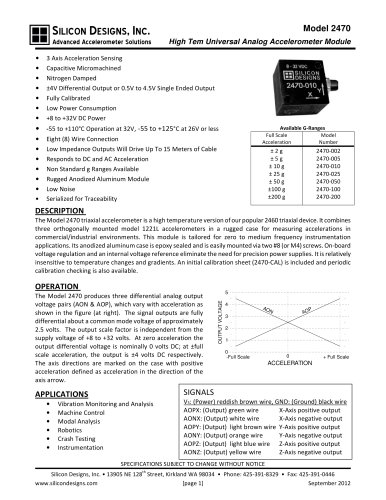
SILICON DESIGNS, INC. Model 2276 Advanced Accelerometer Solutions Analog Accelerometer Module • Capacitive Micromachined • Nitrogen Damped • ±4V Differential Output or 0.5V to 4.5V Single Ended Output • Fully Calibrated • Low Power Consumption • +8 to +32V DC Power • -55 to +125°C • Simple Four Wire Snap-In Removable Connector • Responds to DC and AC Acceleration • Low Noise • Serialized for Traceability • Low Impedance Outputs Will Drive Up To 15 Meters of Cable Available G-Ranges Full Scale Model Acceleration Number ±2g 2276-002 ±5g 2276-005 ± 10 g 2276-010 ± 25 g 2276-025 ± 50 g 2276-050 ±100 g 2276-100 ±200 g 2276-200 DESCRIPTION The model 2276 accelerometer is a higher performance and wider temperature range version of the 2266 module and combines an integrated model 1221L accelerometer with high drive, low impedance buffering for measuring acceleration in commercial/industrial environments. It is tailored for zero to medium frequency instrumentation applications. The anodized aluminum case is epoxy sealed and is easily mounted via two #4 (or M3) screws. Onboard regulation is provided to minimize the effects of supply voltage variation. It is relatively insensitive to temperature changes and gradients. A removable cable 2276-CAB attaches via a 5-pin connector. An optional initial calibration sheet (2276-CAL) and periodic calibration checking are also available. OPERATION The Model 2276 accelerometer module produces two analog voltage outputs, which vary with acceleration as shown in the graph on the next page. The sensitive axis is perpendicular to the bottom of the package, with positive acceleration defined as a force pushing on the bottom of the package. The signal outputs are fully differential about a common mode voltage of approximately 2.5 volts. The output scale factor is independent from the supply voltage of +8 to +32 volts. At zero acceleration the output differential voltage is nominally 0 volts DC; at ±full scale acceleration the output differential voltage is ±4 volts DC respectively. OUTPUT VOLTAGE 5 4 AO N P AO 3 2 1 0 -Full Scale 0 + Full Scale ACCELERATION APPLICATIONS • FLIGHT TESTS • VIBRATION MONITORING • VIBRATION ANALYSIS • MACHINE CONTROL • MODAL ANALYSIS • ROBOTICS • CRASH TESTING • INSTRUMENTATION SPECIFICATIONS SUBJECT TO CHANGE WITHOUT NOTICE th Silicon Designs, Inc. • 13905 NE 128 Street, Kirkland WA 98034 • Phone: 425-391-8329 • Fax: 425-391-0446 www.silicondesigns.com [page 1] September 2012
Open the catalog to page 1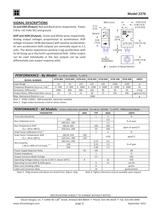
Model 2276 SIGNAL DESCRIPTIONS 0.63 [16.0] 0.48 [12.2] 0.315 [8.0] INCH [mm] AOP and AON (Output): Green and White wires respectively. Analog output voltages proportional to acceleration; AOP voltage increases (AON decreases) with positive acceleration. At zero acceleration both outputs are nominally equal to 2.5 volts. The device experiences positive (+1g) acceleration with its lid facing up in the Earth’s gravitational field. Either output can be used individually or the two outputs can be used differentially (see output response plot). 0.12 [3.0] Serial # 8 - 32 VDC XXXXX Vs and GND (Power):...
Open the catalog to page 2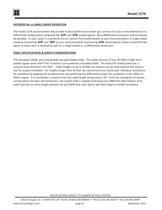
Model 2276 DIFFERENTIAL vs SINGLE ENDED OPERATION The model 2276 accelerometer will provide its best performance when you connect it to your instrumentation in a differential configuration using both the AOP and AON output signals. But a differential connection may not always be possible. In such cases, it is perfectly fine to connect the accelerometer to your instrumentation in single ended mode by connecting AOP and GND to your instrumentation and leaving AON disconnected. Keep in mind that the signal to noise ratio is reduced by half for a single-ended vs. a differential connection. CABLE...
Open the catalog to page 3All Silicon Designs catalogs and technical brochures
 Silicon Designs Model 1010
8 Pages
 LG Series
3 Pages
 Model 3320 G-Logger
2 Pages