- Catalogs
- Silicon Designs
- Silicon Designs Model 1221 Low Noise Analog Accel ±4V Differential Output

Silicon Designs Model 1221 Low Noise Analog Accel ±4V Differential Output

Silicon Designs Model 1221 Low Noise Analog Accel ±4V Differential Output
- Hotplate Method: Use Sn62 or Sn63 solder paste, apply flux if pre-tinning, and heat on a 250°C hotplate until solder flows.
- Solder Iron with Paste: Apply solder paste, position the accelerometer, and secure by soldering two opposite corner pads.
- Solder Iron with Wire: Pre-tin two opposite corner pads, position the accelerometer, and solder the tinned pads.
Catalog excerpts
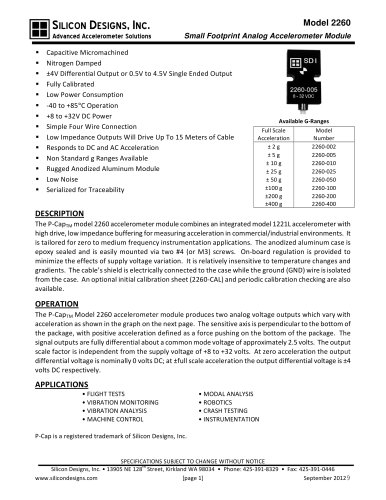
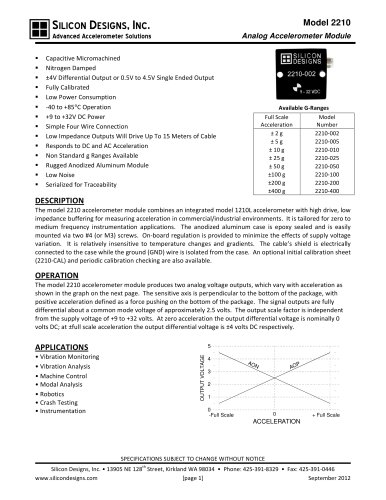
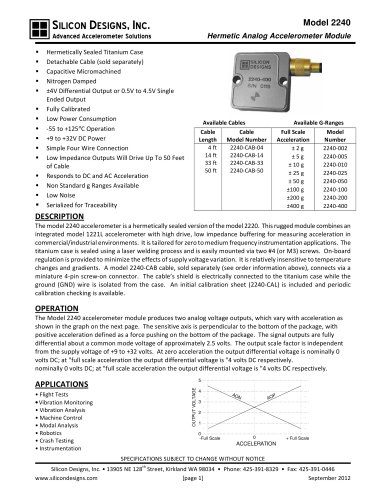
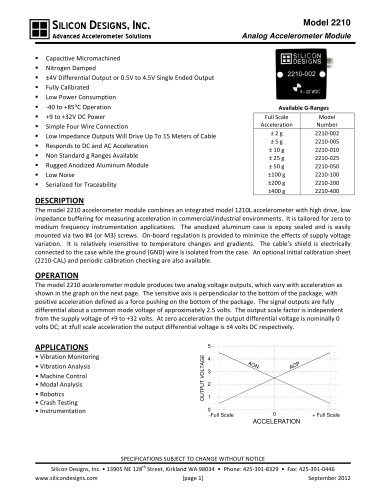
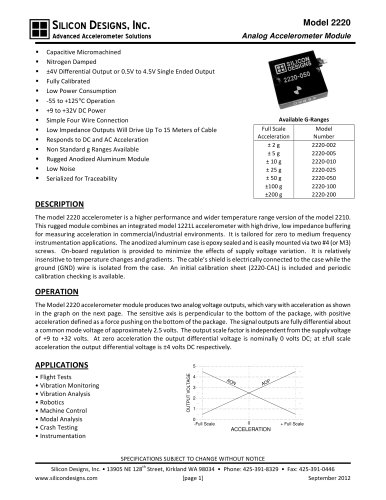
SILICON DESIGNS, INC. Advanced Accelerometer Solutions • • • • • • • • • • • • • • • Model 1221 Low Noise Analog Accelerometer ___ Low Noise: 5 μg/√Hz typical for 2g Full Scale Version Internal Temperature Sensor Capacitive Micromachined Nitrogen Damped & Hermetically Sealed ±4V Differential Output or 0.5V to 4.5V Single Ended Output Fully Calibrated Responds to DC and AC Acceleration -55 to +125°C Operation +5 VDC, 8 mA Power (typical) Non Standard g Ranges Available Integrated Sensor & Amplifier LCC or J-Lead Surface Mount Package Serialized for Traceability Pin Compatible with Model 1210 RoHS Compliant Available G-Ranges Full Scale 20 pin LCC 20 pin JLCC Acceleration ±2g 1221L-002 1221J-002 1221L-005 1221J-005 ±5g ± 10 g 1221L-010 1221J-010 ± 25 g 1221L-025 1221J-025 1221L-050 1221J-050 ± 50 g ±100 g 1221L-100 1221J-100 ±200 g * 1221L-200 1221J-200 ±400 g * 1221L-400 1221J-400 * Recommended for Down Hole Drilling DESCRIPTION The Model 1221 is a low-cost, integrated accelerometer for use in zero to medium frequency instrumentation applications that require extremely low noise. The 2g version is ideally suited for seismic applications. Each miniature, hermetically sealed package combines a micro-machined capacitive sense element and a custom integrated circuit that includes a sense amplifier and differential output stage. It is relatively insensitive to temperature changes and gradients. Each device is marked with a serial number on its bottom surface for traceability. An optional calibration test sheet (1221-TST) is also available which lists the measured bias, scale factor, linearity, operating current and frequency response. OPERATION The Model 1221 produces two analog output voltages, which vary with acceleration as shown in the figure below. The outputs can be used either in differential or single ended mode. Two reference voltages, +5.0 and +2.5 volts (nominal), are required; the output scale factor is ratiometric to the +5 volt reference voltage, and both outputs at zero acceleration are nominally +2.5 volts. The sensitive axis is perpendicular to the bottom of the package, with positive acceleration defined as a force pushing on the bottom of the package. • Seismic Monitoring • Earthquake Detection • Security Systems • Machine Control • Modal Analysis • Instrumentation • Appliances • Robotics • Crash Testing • Vibration Monitoring • Vibration Analysis • Vehicle Dynamics OUTPUT VOLTAGE 5 APPLICATIONS 4 AO N P AO 3 2 1 0 -Full Scale 0 + Full Scale ACCELERATION 0.350 "L" SUFFIX PACKAGE 0.350 Positive Acceleration 0.350 0.105 "J" SUFFIX PACKAGE 0.350 Positive Acceleration 0.165 SPECIFICATIONS SUBJECT TO CHANGE WITHOUT NOTICE th Silicon Designs, Inc. • 13905 NE 128 Street, Kirkland WA 98034 • Phone: 425-391-8329 • Fax: 425-391-0446 www.silicondesigns.com [page 1] September 2012
Open the catalog to page 1
Model 1221 PERFORMANCE - By Model: VDD=VR=5.0 VDC, TC=25°C. MODEL NUMBER UNITS 1221-002 1221-005 1221-010 1221-025 Input Range g ±2 ±5 ±10 ±25 Frequency Response (Nominal, 3 dB) Hz 0 - 400 0 - 600 0 - 1000 0 - 1500 1 Sensitivity, Differential mV/g 2000 800 400 160 Output Noise, Differential μg/ 5 7 10 25 (RMS,typical) (root Hz) Max. Mechanical Shock (0.1 ms) g (peak) 2000 PERFORMANCE - All Models: 1221-100 1221-200 1221-400 ±50 ±100 ±200 ±400 0 - 2000 80 0 - 2500 40 0 - 3000 20 0 - 4000 10 50 100 200 400 5000 Unless otherwise specified VDD=VR=5.0 VDC, TC=25°C, Differential Mode. PARAMETER MIN...
Open the catalog to page 2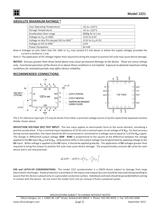
Model 1221 ABSOLUTE MAXIMUM RATINGS * Case Operating Temperature -55 to +125°C Storage Temperature -55 to +125°C Acceleration Over-range 2000g for 0.1 ms Voltage on VDD to GND -0.5V to 6.5V 4 Voltage on Any Pin (except DV) to GND -0.5V to VDD+0.5V 5 Voltage on DV to GND ±15V Power Dissipation 50 mW Note 4: Voltages on pins other than DV, GND or VDD may exceed 0.5 volt above or below the supply voltages provided the current is limited to 1 mA. Note 5: The application of DV voltages higher than required to bring the output to positive full scale may cause device damage. NOTICE: Stresses greater...
Open the catalog to page 3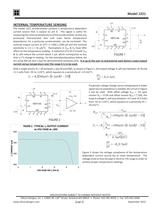
Model 1221 + 5V INTERNAL TEMPERATURE SENSING 0.1 uF 11 14 3 9 The model 1221 accelerometer contains a temperature dependent VDD VR current source that is output on pin 8. This signal is useful for 5K 4 IT 8 VT measuring the internal temperature of the accelerometer so that any DV 1221x-xxx AOP 12 previously characterized bias and scale factor temperature 17 RT 2.5V 16 dependence, for a particular accelerometer, can be corrected. The AO N 2K G ND nominal output current at 25°C is ≈500 (±200) μA and the nominal 5K .01uF 2 5 19 6 18 sensitivity is 1.5 (±0.5) μA/°C. Fluctuations in VDD & VR have...
Open the catalog to page 4
Model 1221 BIAS STABILITY CONSIDERATIONS Bias temperature hysteresis can be minimized by temperature cycling your model 1221 accelerometer after it has been soldered to your circuit board. If possible, the assembled device should be exposed to ten cycles from -40 to +85°C minimum (-55 to +125°C recommended). The orientation to the Earth's gravitational field during temperature cycling should preferably be in the same orientation as it will be in the final application. The accelerometer does not need to have power applied during this temperature cycling. PACKAGE DIMENSIONS "L" SUFFIX PACKAGE (20...
Open the catalog to page 5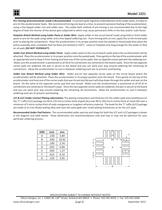
Model 1221 Pre-Tinning of Accelerometer Leads is Recommended: To prevent gold migration embrittlement of the solder joints, it is best to pre-tin the accelerometer leads. We recommend tinning one lead at a time, to prevent excessive heating of the accelerometer, using a fine-tipped solder iron and solder wire. The solder bath method of pre-tinning is not recommended due to the high degree of heat the interior of the device gets subjected to which may cause permanent shifts in the bias and/or scale factor. Hotplate Attach Method using Solder Paste or Solder Wire: Apply solder to the circuit board’s...
Open the catalog to page 6All Silicon Designs catalogs and technical brochures
 Silicon Designs Model 1010
8 Pages
 LG Series
3 Pages
 Model 3320 G-Logger
2 Pages