

CR170

CR170
Biresin® CR170 with Biresin® CH170-3 is an epoxy resin system designed for high-performance fiber-reinforced components, particularly suitable for injection processes requiring high thermal performance up to 180°C.
Physical Data
- Mixing Ratio: 100:16 by weight, 100:19 by volume.
- Viscosity at 25°C: Resin ~13,000 mPa.s, Hardener ~30 mPa.s.
- Density at 25°C: Resin 1.14 g/ml, Hardener 0.96 g/ml.
- Potlife: Approximately 90 minutes at room temperature.
Applications
Ideal for automotive parts production due to its viscosity range and reactivity, processed at elevated temperatures (60°C).
Processing Guidelines
- Maintain material and processing temperatures between 18 - 35°C.
- Accurate mixing ratio is crucial for optimal performance.
- Precuring at 60°C for at least 2 hours is recommended before demoulding.
- Final properties depend on postcuring cycles.
- Clean tools immediately after use with Sika Reinigungsmittel 5.
Features and Advantages
- Low mixed viscosity at 60°C for effective wetting of fabrics.
- Glass transition temperatures up to 170°C achievable.
Mechanical Properties
- Tensile Strength: 69 MPa
- Flexural Strength: 128 MPa
- Compressive Strength: 135 MPa
- Impact Resistance: 28 kJ/m²
Thermal Data
Heat distortion temperature of 170°C and glass transition temperature of 172°C after specific curing cycles.
Storage and Handling
- Shelf life: 24 months for resin, 12 months for hardener at 18 - 25°C.
- Crystallization can occur at low temperatures; resolved by warming to 60°C.
- Containers should be tightly closed after use.
Health and Safety
Refer to the Safety Data Sheet for safe handling, storage, and disposal information.
Disposal
Dispose of in accordance with regulations. Recycle completely emptied packaging.
Legal Notice
Information provided is based on current knowledge and experience. Users must test product suitability for specific applications. Sika reserves the right to change product properties.
Catalog excerpts
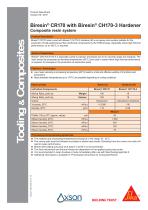
Tooling & Composites Product Data Sheet Version 05 / 2017 Biresin® CR170 with Biresin® CH170-3 Hardener Composite resin system | Product Description Biresin® CR170 resin cured with Biresin® CH170-3 hardener (B) is an epoxy resin system suitable for the production of high performance fibre reinforced components by the RTM process, especially where high thermal performance, up to 180°C, is required. Areas of Application Biresin® CR170/CH170-3 is especially suited to injection processes due to its viscosity range and reactivity. The resin should be processed at elevated temperatures (60°C) and used in areas where high thermal performance is required, for example in the production of automotive parts. Features / Advantages ■i Low mixed viscosity at processing temperature (60°C) leads to a fast and effective wetting of dry fabrics and nonwovens ■ Glass transition temperatures up to 170°C are possible depending on curing conditions Processing and processing properties ■ The material and processing temperatures should be in the range 18 - 35°C. ■ The mixing ratio must be followed accurately to obtain best results. Deviating from the correct mix ratio will lead to lower performance. ■ Before demoulding precuring of at least 2 h at 60°C is recommended. ■ The final mechanical and thermal values are dependent on the applied postcuring cycles. ■ It is recommended to clean brushes or tools immediately after use with Sika Reinigungsmittel 5. ■ Additional information is available in “Processing Instructions for Composite Resins”.
Open the catalog to page 1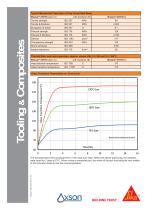
Typical Mechanical Properties of Fully Cured Neat Resin Thermal Data, neat resin specimen: approx. values after 3 h / 60 and 4 h / 160°C The test specimens were produced from 3 mm thick pure resin. Before the above postcuring, the samples were cured for 7 days at 23°C. When curing a composite part, the whole of the part (including the very middle of the laminate) needs to see the cure temperature. BUILDING TRUST
Open the catalog to page 2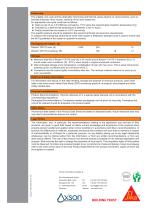
Postcuring The suitable cure cycle and the attainable mechanical and thermal values depend on various factors, such as laminate thickness, fibre volume, reactivity of the resin system etc. An appropriate cure cycle could look as follows: Heat-up rate of ca. 0.2°C/Minute until approx. 10°C below the required glass transition temperature (Tg) Followed by a dwell at that temperature of between 2 and 12 hours. Part(s) should then be cooled at ~0.5°C per minute The specific postcure should be adapted to the required technical and economic requirements. To measure the mechanical performance...
Open the catalog to page 3All Sika Deutschland catalogs and technical brochures
 Sika® Separol® W-161
2 Pages
 Sika® Lightcrete-400 2025
2 Pages
 Retardan®-200 L
2 Pages
 Sika® ViscoCrete® G-2
3 Pages
Archived catalogs
 Biresin CR
2 Pages
 SikaBlock® M150
2 Pages
 Biresin® M72
2 Pages
 Biresin® M60
2 Pages
 Biresin® VG70
2 Pages
 Biresin® U1419
2 Pages
 Biresin® RG50
2 Pages
 Biresin® RG51 HS
2 Pages
 Biresin® RG53 Fibre
2 Pages
 Biresin® S5
2 Pages
 Biresin® L89
2 Pages
 Imagebrochure
8 Pages
 Low Pressure RIM Systems
2 Pages
 Overview Brochure
15 Pages
 Ideas take shape
14 Pages
 SikaBlock Board Materials
3 Pages
 Composite Systèmes
3 Pages
 Milling Parameters
9 Pages
 M1000g
2 Pages
 M73
M733 Pages
 M700
M7002 Pages
 M650
M6502 Pages
 M450
M4502 Pages
 M440
M4402 Pages
 M330
M3302 Pages
 M150
M1502 Pages
 u1419
u14192 Pages
 VG70
VG702 Pages
 M75
M752 Pages
 Sika® Release LG
2 Pages
 Biresin® G26
2 Pages
 Biresin® S15
2 Pages
 Biresin® M67
2 Pages
 M72
M722 Pages
 Biresin® LS
2 Pages
 CR80
CR806 Pages
 Biresin® CR120
6 Pages
 LOW PRESSURE RIM-SYSTEMS
4 Pages
 ADHESIVES STRUCTURAL BONDING
8 Pages
 additive
4 Pages
 Sika® Lightcrete-400
2 Pages
 retardan-l
2 Pages
 Brochure English / German
9 Pages
 Sika® PowerPack-10 MF
2 Pages
 SikaRapid®-800 P
2 Pages
 PNEUMATIC GUNS
2 Pages
 SIKA GYPSUM ADDITIVES
12 Pages