


ST 151

ST 151
- Supports 2-phase motors with output voltage dependent on supply (18-55 V) and a maximum output current of 5 A RMS.
- Current controller frequency up to 32 kHz, with continuous current limits based on environmental temperature.
- Operating modes include step frequency mode with various step resolutions.
- Voltage and temperature measurements ensure safety, with shutdowns for under/over voltage and temperature warnings.
- Supports RS422 and TTL encoder signals with a maximum input frequency of 125 kHz and counter frequency of 500 kHz.
- Includes a 16-bit counter resolution and short-circuit proof encoder power supply.
- Features one output with GND switching, a maximum current of 6 A, and short-circuit protection.
- External power resistor required with specific switching thresholds.
- Two inputs with a voltage range of +18 V to +30 V, complying with safety standards EN ISO 13849-1 and SIL3.
- Safety function STO ensures no energy supply to the motor, preventing torque generation.
- Motor supply voltage ranges from +18-55 V DC with a maximum current consumption of 6 A.
- Additional power requirements for the S-DIAS bus and incremental encoder.
- Two inputs with typical voltage of +24 V and specific signal levels and input delays.
- Article number: 20-014-151, compliant with UL 61800-5-1 and CE approved.
- Storage temperature range from -20 to +85 °C, operational temperature from 0 to +55 °C.
- Humidity tolerance up to 95% non-condensing, with specific installation altitude and derating conditions.
- Complies with EMC and vibration resistance standards, with protection type IP20.
Catalog excerpts
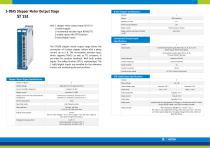
S-DIAS Stepper Motor Output Stage Brake Chopper Specifications Maximum current with 1 stepper motor output stage 50 V/5 A 1 brake chopper 1 incremental encoder input RS485/TTL 2 enable inputs with STO function 2 latch/digital inputs The S-DIAS stepper motor output stage allows the connection of 2-phase stepper motors with a phase current up to 5 A. The incremental encoder input, which supports RS422 as well as TTL encoders, is pro-vided for position feedback. With both enable inputs, the safety function STO is implemented. The 2 latch/digital inputs are provided for the reference motion and monitoring the end positions. Short-circuit protection Regen resistor External power resistor Regen resistor switching threshold on/off Incremental Encoder Input Specifications Number Input signals 1 Incremental encoder signals RS422 (A, /A, B, /B, R, /R) RS422 signal (150 Ω termination, integrated in the module) Incremental encoder signal TTL (A, B, R) TTL level (1200 Ω Pull-Up, integrated in the module) Input frequency Counter frequency Signal analysis Counter resolution Encoder power supply STO Enable Input Specifications Stepper Motor Output Specifications Number of phases Output voltage Number 2 dependent on the supply (18-55 V) Input voltage Input voltage range Current controller frequency Signal level Output current Switch hysteresis Output current over the environmental temperature DC-link capacitance Operating modes Step resolution Voltage measurement Temperature measurement maximum 5 A continuous current at 45 °C maximum 3 A continuous current at 55 °C 10 µF step frequency mode full step, half step 4-/8-/16-/32-/64x micro step 15-70 V with an under voltage < 15 V or over voltage > 70 V, the motor output is shut down through the hardware. Input current Input delay Safety Level complies with the requirements of Category 4, Performance Level "e" according to EN ISO 13849-1 and SIL3 according to 62061 Safety function STO according to EN61800-5-2, section 4.2.2.2 The motor is not supplied with energy, which can cause a turn. The stepper motor output stage does not supply energy to the motor, which can generate torque. 0-125 °C with temperature warning at 103 °C with temperature warning at 108 °
Open the catalog to page 1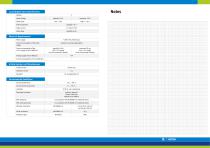
Latch/Digital Input Specifications Number Input voltage Signal level Switch hysteresis Input current Input delay Electrical Requirements Motor supply Current consumption of the motor supply Current consumption of the +24 V supply on the S-DIAS bus maximum 6 A (load-dependent) typically 80 mA (incl. +5 V supply of the incremental encoder) Voltage supply from S-DIAS bus Current consumption on the S-DIAS bus maximum 120 mA (incl. +5 V supply of the incremental encoder) +5 V Article Number and Miscellaneous Article number Environmental Conditions Storage temperature Environmental temperature Humidity...
Open the catalog to page 2All SIGMATEK GmbH & Co KG catalogs and technical brochures
 INNOVATIONS 2025
8 Pages
 PS 101
1 Page
 CP 731
1 Page
 CP 112
1 Page
 CP 311
1 Page
 CP 312
1 Page
 IPC 221
2 Pages
 Control System S-DIAS
12 Pages
 Remtoe Access
4 Pages
 CP 102
1 Page
 C-IPC 171
1 Page
 PC 521
1 Page
 PC 444-W
1 Page
 PVDM 086
1 Page
 PVDM 087
1 Page
 PVAI 011
1 Page
 SCP 111
1 Page
 SDI 101
1 Page
 STO 081
1 Page
 SDM 081
2 Pages
 SNC 021
1 Page
 SRO 021
1 Page
 SSI 021
1 Page
 SIB 061
1 Page
 DC 061-1
2 Pages
 Flexible & SAFe Wireless hmi
4 Pages
 SIGMATEK- Product Catalog
415 Pages
 Human Machine Interface
28 Pages
 Motion Control System
32 Pages
 Smart Factory
8 Pages
 Packaging Technology
8 Pages
 Emergency Stop
4 Pages
Archived catalogs
 Compact Industrie PC
1 Page
 CP 111
1 Page
 HGW 1033
2 Pages
 Human Machine Interfaces
28 Pages
 NEW PRODUCTS
8 Pages
 S-DIAS Axis Module DC 062
2 Pages
 VARAN Stepper Module VST 012
2 Pages
 Energy Management
8 Pages
 Automation System
36 Pages
 2018 S-DIAS Control System
12 Pages
 2021 s-dias control system
12 Pages
 2018 LASAL Engineering Tool
32 Pages
 2019 Lasal Engineering Tool
32 Pages
 2020 S-DIAS Control System
12 Pages
 Product catalog
330 Pages