
- Catalogs
- SIGMA ELEKTRIK
- Residual Current Circuit Breakers

Residual Current Circuit Breakers

Residual Current Circuit Breakers
Sigma residual current circuit breakers (RCCBs) are designed to protect against electric shocks and prevent fires due to isolation errors. They are available in 2 and 4 poles, adhering to the TS EN 61008-1 standard and CE norms under ISO 9001:2008 quality assurance.
Key factors for selecting Sigma RCCBs include:
- Rated Residual Current Level: 30 mA for human protection, 300 mA for fire protection.
- Number of Poles: 2 poles for single-phase, 4 poles for three-phase networks.
- Rated Current: Should match or exceed the preceding switch's rated current.
- Selectivity: Available in General (G) and Delayed (S) types.
RCCBs operate using electromagnetic principles with toroidal transformers to detect differential currents. An imbalance due to isolation failure causes the breaker to trip.
Electromagnetic breakers do not require auxiliary voltage, ensuring safety during voltage fluctuations. Electronic types need auxiliary voltage, posing risks if the neutral line is disconnected.
Electrical current affects nerves, muscles, and the heart. Severity depends on voltage, current intensity, duration, current path, and body resistance. For instance, 30 mA can cause breathing difficulty, while 75 mA can lead to heart palpitations.
Exposure duration is critical. Currents over 80 mA for more than 0.3 seconds can cause fibrillation. The threshold value is 30 mA, with varying physiological effects based on intensity and duration.
RCCBs provide protection against direct and indirect contacts, reducing electric shock risks.
RCCBs help prevent fires by detecting and interrupting fault currents before overheating or ignition occurs.
Selectivity ensures only the faulty circuit section is disconnected, minimizing disruption. Tripping time varies based on fault conditions.
Proper assembly and connection are essential for effective RCCB operation. Regular testing and maintenance are recommended for reliability.
The document references IEC 60479-1 and IEC 60364 standards, discussing electrical current effects on the human body and emphasizing the danger of currents above 750 ms. A limit value of 30 mA is specified for safe exposure.
IEC 60364 mandates protection against electric shocks through measures against direct and indirect contact. The document details maximum breaking times for protection equipment at various touch voltages, highlighting grounding and RCCBs with a 30 mA threshold.
Direct contact involves current flowing through the body to the earth, with resistance varying in dry and humid environments. Indirect contact occurs when equipment's metal cover becomes live due to insulation faults. The document explains grounding types (TN, TT, IT) and subcategories (TN-C, TN-S, TN-C-S) as per IEC 60364.
RCCBs for fire protection should have a 300 mA threshold, as tests show this level can prevent overheating and fire.
RCCBs are available in delayed and non-delayed types. Non-delayed RCCBs trip instantly in less than 300 ms, while delayed types ensure selectivity by tripping after a minimum of 130 ms, preventing unnecessary power outages.
The document provides technical specifications, procedures, and recommendations for Sigma RCCBs, including testing, assembly, connection, and various models.
RCCBs are designed to detect residual currents and prevent electric shocks, available in types AC and A, with rated currents from 25A to 100A. They comply with EN 61008-1 and have a rated short circuit current of 6 kA or 10 kA.
Tests should be conducted between phase and neutral conductors, and between neutral and grounding conductors. Insulation strength must exceed 40 kOhm. Regular testing is recommended.
RCCBs are designed for easy installation on a 35 mm DIN rail, with a cable connection capacity of 35 mm². Maximum tightening torque for screws is 3 Nm. Connection terminals have an IP20 protection rating.
Various models such as SGM-2, SGM-4, SFM-2, and SFM-4 are listed, each with specific features like life protection and fire protection thresholds. Most models trip without delay, ensuring quick fault response.
RCCBs have a mechanical life of 20,000 operations and an electrical life of 6,000 operations at 230V. They operate within a temperature range of -25°C to +60°C and have a protection degree of IP20 after installation.
The document includes diagrams for 2-pole and 4-pole RCCBs, and a section on a residual current protection switch test instrument, which measures trip times and residual current levels.
Catalog excerpts

Res idua l Cu rre nt C Bre ircuit Inte ake rru rs pto r Di fer enc ial
Open the catalog to page 1
Residual Current Circuit Breakers INTERRUPTOR DlFERENCIAL
Open the catalog to page 2
Residual Current Circuit Breakers Interruptor Diferencial Content Classification . . . . . . . . . . . . . . . . . . . . . . . . . . . . . . . . . . . . . . . . 139 Residual Current Circuit Breaker Markings . . . . . . . . . . . . . . . 140 Categorización . . . . . . . . . . . . . . . . . . . . . . . . . . . . . . . . . . . . . . . . . . . 139 Información De Etiquetado De Los Interruptores Diferenciales. . . 140 Residual Current Circuit Breaker Operating System . . . . . . . . . . . . . . . . . . . . . . . . . . . . . . . . . . . . . . .140 Residual Current Impact On Human Body . . . . . . . ....
Open the catalog to page 3
Residual Current Circuit Breakers Interruptor Diferencial No of poles Residual current circuit breakers with 2 poles and 4 poles are used for single phase networks and three-phase networks respectively. Número de polos En las redes monofásicas deben utilizarse interruptores diferenciales de dos polos, mientras que en las redes trifásicas han de utilizarse interruptores diferenciales de cuatro polos. Rated current Residual current circuit breakers must be equal to, or higher than the rated current of compact switch or automatic switch, which were connected before them. It must be paid attention...
Open the catalog to page 4
Residual Current Circuit Breakers Interruptor Diferencial What is the difference between electromagnetic and electronic type of residual current circuit breakers? Electromegnetic type residual current circuit breakers do not need auxiliary voltage for tripping case of any residual current. Thus it ensures exact safety thereby performing its function independent of supply voltages even in case of low- and high voltages. Equipment operating under electro mechanic method maintain to protect residual current in the phase line which they supply even in case of disconnection of neutral line. As the...
Open the catalog to page 5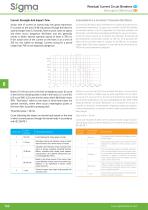
Sigma ^^elektrik Residual Current Circuit Breakers <U> Interruptor Diferencial © Current Strength And Impact Time Action time of current on human body has great importance. If a current at the level of 80 mA passes through the heart for a period longer than 0,3 seconds, heart muscle starts to spasm and there occurs dangerous fibrillation and this generally results in death. Normal operation period of heart is 750 ms. If the action level of the current on the heart is at a level of 200 ms, this makes no damage. Currents acting for a period longer than 750 ms are especially dangerous. Intensidad...
Open the catalog to page 6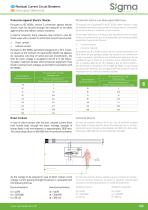
Protection Against Electric Shocks Protection Contra Las Descargas Electricas Pursuant to IEC 60364, section 5, protection against electric shocks must be ensured through the measures to be taken against direct and indirect contact conditions. In electric networks, living creatures may contact in two different ways with a system in which fault current has occurred. • Direct contact • Indirect contact Pursuant to IEC 60364, permitted voltage limit is 50 V in electric plants at the moment of a fault before death risk appears. As resistance will drop in humid and wet environments, the limit for...
Open the catalog to page 7
Residual Current Circuit Breakers Interruptor Diferencial Ud: Touch voltage (V) Rm: Body internal strength (Ω) Id: Body internal strength (mA) Ud: Tensión de contacto (V) Rm: Resistencia Interior del cuerpo (Ω) Id: La corriente que fluye del cuerpo de la persona a la tierra (mA) This is why, wet sockets at home and the sockets of all equipment with direct contact risk must be connected to residual current circuit breaker with 30 mA threshold value. Consecuentemente, los enchufes húmedos y los de todos los dispositivos que supongan un riesgo de contacto directo deben de conectarse a interruptores...
Open the catalog to page 8
Residual Current Circuit Breakers di> Interruptor Diferencial As the earth system used in our country is TT, neutral of LV distribution transformer to supply the system is grounded. This is called operation grounding. As for the houses and workplaces, base grounding is made and metal covers of all utilized equipment are connected with base grounding of consumer facility through protection line. And this is called protection grounding. Debido a que el sistema de puesta a tierra utilizado en nuestro pais es el TT, el transformador-distribuidor BT de neutro que alimenta el sistema se conecta a tierra....
Open the catalog to page 9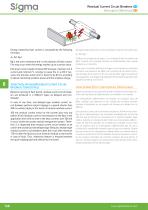
Residual Current Circuit Breakers Interruptor Diferencial Energy created by fault current is calculated by the following formulae; A= Ih2. Rg.t Rg is the trans-resistance and t is the duration of fault current. Fire may occur when this energy reaches up to a certain value. Electrical current needs minimum 60 W power, minimum 0,3 A current and minimum 5 J energy to cause fire. In a 220 V network, the shortest action time is found to be 83 ms according to above mentioned smallest power and the smallest energy. Selectivity Among Residual Current Circuit Breakers (Selectivity) Based on sensing of...
Open the catalog to page 10
Residual Current Circuit Breakers di> Interruptor Diferencial Tripping Time Of Residual Current Circuit Breaker In case Of Fault A leakage current protection implementation that meets minimum requirements Protection de corriente residual que supla las necesidades minimas An ideal application of leakage current protection Aplicacion Ideal de proteccion de corriente residual When a ground residual current occurs on the side of load in the above figure, G type quick-tripping residual current circuit breaker will perform tripping, S type residual current circuit breaker on the side of supply will...
Open the catalog to page 11
Residual Current Circuit Breakers Interruptor Diferencial Issues To Be Taken Into Consideration In Residual Current Application 1. Cuestiones A Tener En Cuenta En La Aplicación De Corriente Residual. 1. Residual current circuit breakers do not perform protection against short circuit. Therefore, system must definitely have miniature circuit breakers or a similar protection equipment against short circuit and over load currents. 2. Grounding has been made within the systems where residual current circuit breakers are used and neutral line must be isolated and dependent of ground. 3. It is essential...
Open the catalog to page 12All SIGMA ELEKTRIK catalogs and technical brochures
 ORDER CATALOGUE LOW VOLTAGE PRODUCTS
180 Pages
 Relays
20 Pages
 Low Voltage Contactors
46 Pages
 Low voltage products
120 Pages
 Low Voltage Power Capacitors
10 Pages
 LV Surge Protection Devices
8 Pages
 Modular Products
10 Pages
 Miniature Circuit Breaker
32 Pages
 Automatic Transfer Switches
18 Pages
 L.V Air Circuit Breakers
18 Pages
 SIGMA ELEKTRIK PRODUCTS CATALOGUE
134 Pages
 LV CURRENT TRANSFORMERS
32 Pages
 Panelmeter
19 Pages
 MOULDED CASE CIRCUIT BREAKERS
42 Pages
 Miniature Circuit Breakers
23 Pages
 LV Contactor
39 Pages
 AIR CIRCUIT BREAKERS
13 Pages


Archived catalogs

- Measuring device
- Dry transformer
- Surge protector
- Technology switch
- Protection relay
- Current transformer
- Digital gauge
- Electromechanical switch
- Low-voltage lightning arrester
- Low-voltage transformer
- Rotary electric switch
- Time relay
- Contactor
- Multipole surge arrester
- LED indicator light
- Instrument transformer
- Protection transformer
- Electrical socket