
- Catalogs
- SIGMA ELEKTRIK
- RCCB RESIDUAL CURRENT CIRCUIT BREAKERS

RCCB RESIDUAL CURRENT CIRCUIT BREAKERS

RCCB RESIDUAL CURRENT CIRCUIT BREAKERS
Residual Current Circuit Breakers (RCCBs) by Sigma Elektrik are designed to protect equipment and individuals from ground faults. They are used in systems like heating, pumps, and wet location equipment, detecting faults by monitoring load currents and tripping when imbalances exceed the rated level.
RCCBs are suitable for protection against indirect and direct contact (≤ 30 mA). They function effectively in environments with high leakage currents and during voltage fluctuations.
RCCBs are marked with test buttons, indicators, and rated currents. They operate within specific temperatures and frequencies, with models offering different sensitivity levels.
RCCBs work on the principle of equal incoming and outgoing currents. A core balance transformer and relay detect imbalances, tripping the relay to disconnect the supply.
RCCBs protect against shock currents by disconnecting high voltages and offer additional protection against direct contact at ≤ 30 mA, tripping within specific time frames.
RCCBs can be used in various network types, requiring grading for selective tripping. Selective RCCBs have a tripping delay, marked with 'S'.
RCCBs have high immunity to transient currents, preventing nuisance tripping from surges, tested against specific standards.
Installation by qualified electricians is essential, with proper earthing and use of devices like MCBs for short circuit protection.
Specifications for RCCB models include dimensions, rated currents, and order codes, available in 2-pole and 4-pole configurations.
- 2P 30 mA 10 kA RCCBs: Rated currents of 25A, 40A, and 63A. Order codes: SGM2025030, SGM2040030, SGM2063030.
- 2P 300 mA 10 kA RCCBs: Rated currents of 25A, 40A, and 63A. Order codes: SGM2025300, SGM2040300, SGM2063300.
- 4P 30 mA 10 kA RCCBs: Rated currents of 25A, 40A, and 63A. Order codes: SGM4025030, SGM4040030, SGM4063030.
- 4P 300 mA 10 kA RCCBs: Rated currents of 25A, 40A, and 63A. Order codes: SGM4025300, SGM4040300, SGM4063300.
- ISO 9001:2008 certified.
- Address: Ekşioğlu Mah. Yeni Şile Cad. No:40 34794 Alemdağ - Çekmeköy / İstanbul / TURKEY
- Phone: +90 216 429 72 01 (pbx)
- Fax: +90 216 484 41 01
- Website: www.sigmaelektrik.com
- Email: [email protected]
Do not risk your safety!
Catalog excerpts

RCCB Residual Current Circuit Breakers General Information Sigma RCCB’s are designed to protect equipment and people from low level ground faults. Typical applications include resistance and impedance heating systems; submersible pumps; semiconductor process equipment and wet location equipment. The RCCBs use the residual current sensing method to detect ground faults. The units monitor the load currents and will trip immediately should they detect any imbalance greater than the rated trip level. Sigma RCCB’s derive the energy required to trip from the ground fault current alone. They will operate...
Open the catalog to page 2
Residual Current Circuit Breakers RCCB principle, the residual current behaviour and frequency show an effect upon tripping. When using a device designed for 50/60 Hz in a network with a different frequency, the user must count on a change of the tripping threshold i.e. a change of IΔn Rated conditional short-circuit current Inc – short-circuit strength. The function and design principle does not allow for the residual current circuit breaker use for protection against short-circuit. For circuit protection it is necessary to use a circuit breaker or a fuse. These elements cut the shortcircuited...
Open the catalog to page 3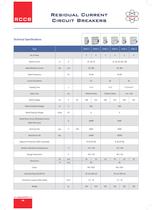
CIRCUIT BREAKERS RESIDUAL CURRENT
Open the catalog to page 4
RESIDUAL CURRENT CIRCUIT BREAKERS Working Principle RCCB works on the principle that in an electrical circuit the incoming current is the same as out going current as shown in the diagram. RCCB incorpo- rates a core balance transformer having primary and secondary windings and a sensitive relay for instantaneous detection of fault signal. The primary winding lies in series with the supply mains and load. Secondary winding is connected to a very sensitive relay. In a faultless situtation, the magnetized effects of the current carrying conductors cancel each other out. There is no residual magnetic...
Open the catalog to page 5
RCCB Residual Current Circuit Breakers Protective Action While RCCBs for rated fault current I∆n > 30 mA provide protection against indirect contact, the installation of RCCBs with I∆n ≤ 30 mA provides a high level of additional protection against unintentional direct contact with live parts. The above diagram shows the physiological responses in the human body when current flows through it, classified into current ranges. Current/time values in range 4 are dangerous, as they can initiate heart fibrillation which can result in death. The tripping range for RCCBs with rated fault currents of 10...
Open the catalog to page 6
RESIDUAL CURRENT CIRCUIT BREAKERS RCCBs may be used in all three distribution network types (DIN VDE 0100 Part 410) and in an IT network system provided that the capacity of the net- work to ground is sufficient to allow a fault current to flow which has the same level as the rated fault current. The IT network can still be monitored using an insulation monitor. Both protective systems do not mutually interfere with one another. Selective Tripping Residual current operated circuit-breakers normally have an instantaneous release. This means that a series connection of such residual current ope-...
Open the catalog to page 7
RESIDUAL CURRENT CIRCUIT BREAKERS • Wiring should be done by a trained & qualified electrician as per the wiring diagram. • All wiring necessary for operation shall be passed through the RCCB. • The neutral conductor must be insulated against earth to the same extent as the live conductors. • All equipments used must be properly earthed. • To ensure correct functioning care must be taken that the neutral conductor on the load side of the RCCB must not be connected to earth, otherwise nuisance tripping may occur or tripping may be impaired. • Suitable device either MCB or HRC fuses shall be used...
Open the catalog to page 9
RESIDUAL CURRENT CIRCUIT BREAKERS
Open the catalog to page 10
Residual Current Circuit Breakers RCCB 2P 30 mA 10 kA RCCB's Type Code No Of Poles Rated Current Rated Residual Current (In) A IΔn (mA) SGM-2 2 25 30 SGM2025030 SGM-2 2 40 30 SGM2040030 SGM-2 2 63 30 SGM2063030 Order code 2P 300 mA 10 kA RCCB's Type Code No Of Poles Rated Current Rated Residual Current (In) A IΔn (mA) SGM-2 2 25 300 SGM2025300 SGM-2 2 40 300 SGM2040300 SGM-2 2 63 300 SGM2063300 Order code 4P 30 mA 10 kA RCCB's Type Code No Of Poles Rated Current Rated Residual Current ( In) A IΔn (mA) SGM-4 4 25 30 SGM4025030 SGM-4 4 40 30 SGM4040030 SGM-4 4 63 30 SGM4063030 Order code 4P 300...
Open the catalog to page 12
Do not risk your safety! Ekşioğlu Mah. Yeni Şile Cad. No:40 34794 Alemdağ - Çekmeköy / İstanbul / TURKEY Tel: +90 216 429 72 01 (pbx) Fax: +90 216 484 41 01 www.sigmaelektrik.com [email protected]
Open the catalog to page 14All SIGMA ELEKTRIK catalogs and technical brochures
 ORDER CATALOGUE LOW VOLTAGE PRODUCTS
180 Pages
 Relays
20 Pages
 Low Voltage Contactors
46 Pages
 Low voltage products
120 Pages
 Low Voltage Power Capacitors
10 Pages
 LV Surge Protection Devices
8 Pages
 Modular Products
10 Pages
 Miniature Circuit Breaker
32 Pages
 Automatic Transfer Switches
18 Pages
 L.V Air Circuit Breakers
18 Pages
 SIGMA ELEKTRIK PRODUCTS CATALOGUE
134 Pages
 LV CURRENT TRANSFORMERS
32 Pages
 Panelmeter
19 Pages
 MOULDED CASE CIRCUIT BREAKERS
42 Pages
 Miniature Circuit Breakers
23 Pages
 LV Contactor
39 Pages
 AIR CIRCUIT BREAKERS
13 Pages


Archived catalogs

- Measuring device
- Dry transformer
- Surge protector
- Technology switch
- Protection relay
- Current transformer
- Digital gauge
- Electromechanical switch
- Low-voltage lightning arrester
- Low-voltage transformer
- Rotary electric switch
- Time relay
- Contactor
- Multipole surge arrester
- LED indicator light
- Instrument transformer
- Protection transformer
- Electrical socket