
- Catalogs
- Siglent Technologies Co., Ltd
- Spectrum Analyzer Bandwidth

- Company
- Products
- Catalogs
- News & Trends
- Exhibitions
Spectrum Analyzer Bandwidth

Spectrum Analyzer Bandwidth
Spectrum analyzers are essential for broadcast monitoring, RF component testing, and EMI troubleshooting. This document introduces resolution bandwidth (RBW) and video bandwidth (VBW) and their impact on measurements.
RBW is the frequency span of the final filter applied to the input signal. Smaller RBWs offer finer frequency resolution, allowing differentiation of closely spaced signals. However, smaller RBWs increase sweep time, which is inversely proportional to the square of RBW. A spectrum analyzer with a wide range of RBW settings is recommended for flexibility.
The shape and shape factor of the RBW filter are crucial. A Gaussian-shaped filter with a 3 dB point is common, but a 6 dB filter may be required for EMC measurements. The shape factor measures filter sharpness, affecting out-of-band signal rejection.
Phase noise affects frequency resolution, observed as noise amplitude increase near the center frequency. It is caused by oscillator fluctuations and can obscure small signals. Instruments with lower phase noise than the signal source are preferable.
VBW affects trace quality by smoothing and reducing noise. It does not alter measurement results but helps in clearer signal observation by reducing noise, albeit at the cost of increased sweep time.
Modern spectrum analyzers offer adjustable RBW/VBW settings and lower phase noise. Adjusting RBW lowers noise floor and improves resolution, while reducing VBW smooths traces for easier signal identification. For EMI measurements, a 6 dB filter is recommended for better peak detection.
For more details, visit the SSA3000X Product Page or contact Siglent offices in America, Europe, or Headquarters in China.
Catalog excerpts

APPLICATION NOTE Spectrum Analyzer Basics: Bandwidth INTRODUCTION: Spectrum analyzers are useful tools for broadcast monitoring, RF component testing, and EMI troubleshooting. There are a number of common adjustments available with many modern analyers that can optimize performance for a particular application. In this application note, we will introduce resolution bandwidth (RBW) and video bandwidth (VBW) and how they affect measurements. Resolution Bandwidth (RBW): Bandwidth is defined as the span of frequencies that are the focus of a particular event. For example, the bandwidth of transmission signal is the span of frequencies that the transmission occupies. The bandwidth of a measurement defines the range of frequencies that were used for the measurement. In spectrum analysis, the resolution bandwidth (RBW) is defined as the frequency span of the final filter that is applied to the input signal. Smaller RBWs provide finer frequency resolution and the ability to differentiate signals that have frequencies that are closer together. Why not use the smallest RBW setting for all measurements? Sweep Time. Sweep time is the length of time it takes to sweep the detector from the start to the stop frequency. Here is the equation governing the sweep speed: In this formula, the meaning of the first factor is the number of frequency selections under SPAN, each step is 1 / k of RBW, to ensure the accuracy of amplitude measurement. The second factor means that each selection The time required depends on the smaller value between RBW and video bandwidth (VBW). Usually when we do not focus on noise, the VBW can be set to a value greater than or
Open the catalog to page 1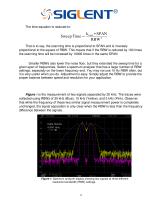
The time equation is reduced to: That is to say, the scanning time is proportional to SPAN and is inversely proportional to the square of RBW. This means that if the RBW is reduced by 100 times the scanning time will be increased by 10000 times in the same SPAN Smaller RBWs also lower the noise floor, but they extended the sweep time for a given span of frequencies. Select a spectrum analyzer that has a large number of RBW settings, especially on the lower frequency end. You may not use 10 Hz RBW often, but it is very useful when you do. Adjustment is easy. Simply adjust the RBW to provide the...
Open the catalog to page 2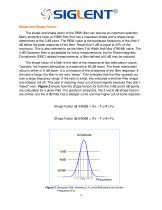
Shape and Shape Factor: The shape and shape factor of the RBW filter can also be an important selection. Many analyzers have an RBW filter that has a Gaussian shape and a shape factor determined at the 3 dB point. The RBW value is the bandpass frequency of the filter 3 dB below the peak response of the filter. Recall that 3 dB is equal to 50% of the maximum. This is also referred to as the filters Full Width Half Max (FWHM) value. The 3 dB Gaussian filter is acceptable for many measurements, but for Electromagnetic Compliance (EMC) related measurements, a filter defined at 6 dB may be required....
Open the catalog to page 3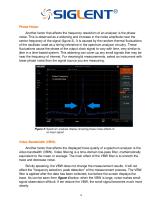
Phase Noise: Another factor that affects the frequency resolution of an analyzer is the phase noise. This is observed as a widening and increase in the noise amplitude near the center frequency of the signal (figure 3). It is caused by the random thermal fluctuations of the oscillator used as a timing reference in the spectrum analyzer circuitry. These fluctuations cause the phase of the output clock signal to vary with time, very similar to jitter in a time-based system. This widening can cover up any small signals that may be near the frequency of interest. For meaningful measurements, select...
Open the catalog to page 4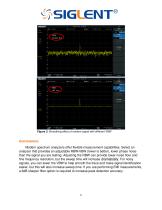
Figure 2: Smoothing effect of random signal with different VBW Conclusions: Modern spectrum analyzers offer flexible measurement capabilities. Select an analyzer that provides an adjustable RBW/VBW (lower is better), lower phase noise than the signal you are testing. Adjusting the RBW can provide lower noise floor and fine frequency resolution, but the sweep time will increase dramatically. For noisy signals, you can lower the VBW to help smooth the trace and make signal identification easier, but this will also increase sweep time. If you are performing EMI measurements, a 6dB sharper filter...
Open the catalog to page 5
For more information, check the SSA3000X Product Page, or contact your local Siglent office. America SIGLENT Technologies America, Inc 6557 Cochran Rd Solon, Ohio 44139 Tel: 440-398-5800 Toll Free:877-515-5551 Fax: 440-399-1211 [email protected] www.siglentamerica.com Headquarters SIGLENT TECHNOLOGIES CO., LTD. Blog No.4 & No.5, Antongda Industrial Zone, 3rd Liuxian Road, Bao’an District, Shenzhen, 518101, China. Tel:+ 86 755 3661 5186 Fax:+ 86 755 3359 1582 [email protected] www.siglent.com/ens Europe SIGLENT TECHNOLOGIES EUROPE GmbH Liebigstrasse 2-20, Gebaeude 14, 22113 Hamburg Germany Tel:...
Open the catalog to page 6All Siglent Technologies Co., Ltd catalogs and technical brochures
 SDS6000A Series
21 Pages
 SDS 7000A Series
21 Pages
 SDL1000X Series
10 Pages
 SSM5000A Series
15 Pages
 Siglent_Product Catalog 2016
48 Pages
 Siglent Selection Guide 2016
10 Pages
 Benefits of deep memory
3 Pages
 SIGLENT Probes Datasheet
7 Pages
 Siglent SDS2000X User Manual
197 Pages
 Siglent SDS2000X Service Manual
59 Pages
 Probe Data Sheet + Siglent
7 Pages
 USB-GPIB User Manual_Siglent
13 Pages
 ISFE User Manual
12 Pages
 Siglent TrueArb Technology
9 Pages
 SDS2000 VS DS2000A_EN_Siglent
10 Pages
 SIGLENT SDS1000CFL
8 Pages
 SIGLENT SHS800 Data Sheet
10 Pages


- Power supply unit
- DC power supply
- AC/DC power supply
- Automation software solution
- Monitoring analyzer
- Analysis software solution
- Automatic analyser
- Windows software
- Computer-aided design software
- Cloud-based software
- Control software
- Benchtop analyser
- Design software solution
- Switched-mode power supply
- Portable analyzer
- Measurement software
- Interface software
- Real-time analyzer
- Tabletop power supply
- Laboratory analyzer