
- Catalogs
- Siglent Technologies Co., Ltd
- Electromagnetic Compliance: Troubleshooting with Near-Field and Current Probes

- Company
- Products
- Catalogs
- News & Trends
- Exhibitions
Electromagnetic Compliance: Troubleshooting with Near-Field and Current Probes

Electromagnetic Compliance: Troubleshooting with Near-Field and Current Probes
Introduction: Electromagnetic interference (EMI) can disrupt electronic devices, leading to issues like garbled displays and malfunctions. To mitigate these effects, standards such as those from the FCC set limits on electromagnetic emissions. Pre-compliance testing with near-field and current probes can help identify EMI sources before full compliance testing.
Electromagnetic Radiation Basics: EMI is often caused by current flow or voltage buildup in conductors, creating electric and magnetic fields. Magnetic fields are generated by moving charges, while electric fields can be caused by static or moving charges. Near-field measurements focus on identifying potential EMI sources close to the device.
Equipment List: A basic near-field troubleshooting kit includes a spectrum analyzer/EMI receiver, near-field probes, current probes, and 50 Ohm cables. These tools help measure RF power and identify EMI sources.
Probes: Near-field probes and current clamps are used to detect EMI. Magnetic field probes measure the induced voltage from magnetic fields, while electric field probes detect electric fields. Proper probe positioning is crucial for accurate measurements.
Scans and Evaluation: Data from probing may not directly correlate with radiated emissions test performance, but it provides valuable insights. Techniques like using attenuators and Max Hold traces on spectrum analyzers can help validate and analyze peaks.
Conclusion: Magnetic fields are identified using magnetic near-field probes, while electric fields are detected with electric near-field probes. Current clamps help identify radiation from cables. Common EMI sources include displays, cutouts, and poorly terminated cables. Conductive tape or foil can mitigate EMI by covering leakage areas. Regular background measurements are recommended to account for environmental changes.
Implementing pre-compliance testing can reduce development time, costs, and future testing needs.
Catalog excerpts

APPLICATION NOTE Electromagnetic Compliance: Troubleshooting with NearField and Current Probes INTRODUCTION: Electromagnetic interference (EMI) can cause a host of problems, especially when developing a product or attempting to pass mandatory electromagnetic compliance (EMC) tests. Garbled displays, bad data, or complete malfunctions can occur when a design is effected by EMI. To minimize the effects of interference, government agencies like the Federal Communications Commission (FCC) in North America create and enforce standards that set limits on the EM output of a product type. Testing to the specifications is commonly referred to as Electromagnetic Compliance (EMC) testing. Many EMC test failures stem from the interaction of unintentional radio frequency (RF) emissions with a circuit or element within the design itself. The electric and magnetic fields that cause this interference are not visible to the unaided eye, which can present complications when trying to isolate the root cause and minimize the effects of the EMI. What is causing the issue? Where is the source of the signal or energy causing the radiation? Fortunately, there are simple tools and techniques that can help identify the sources of EMI. Once you can identify the source, you can begin to build up a list of solutions to the problems. These techniques are not part of the mandatory compliance tests required to pass EMC testing. Rather, these are pre-compliance test techniques that help identify potential areas of EMI as quickly as possible without the burden of expensive test equipment and setups. In this application note, we are going to introduce some common pre-compliance test techniques for identifying potential problematic EMI sources using near-field and current probes. These techniques can save you time and money by isolating problem areas quickly, and with a little fixturing, you can create repeatable test stations to help correlate data. This knowledge can then be used to “design for EMC” in your future prod
Open the catalog to page 1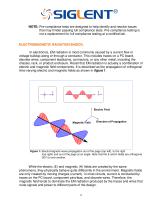
NOTE: Pre-compliance tests are designed to help identify and resolve issues that may hinder passing full compliance tests. Pre-compliance testing is not a replacement for full compliance testing at a certified lab. ELECTROMAGNETIC RADIATION BASICS: In electronics, EM radiation is most commonly caused by a current flow or voltage buildup along or through a conductor. This includes traces on a PC board, discrete wires, component leads/pins, connectors, or any other metal, including the chassis, rack, or product enclosure. Recall that EM radiation is actually a combination of electric and magnetic...
Open the catalog to page 2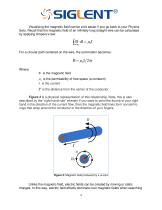
Visualizing the magnetic field can be a bit easier if you go back to your Physics texts. Recall that the magnetic field of an infinitely long straight wire can be calculated by applying Ampere’s law: For a circular path centered on the wire, the summation becomes: 0 is the permeability of free space (a constant) is the current is the distance from the center of the conductor Figure 2 is a physical representation of this relationship. Note, this is also described by the “right-hand-rule” wherein if you were to point the thumb of your right hand in the direction of the current flow, then the...
Open the catalog to page 3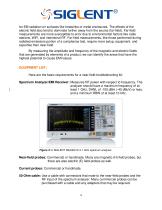
for EM radiation on surfaces like heatsinks or metal enclosures. The effects of the electric field also tend to dominate further away from the source (far-field). Far-field measurements are more susceptible to error due to environmental factors like radio stations, WiFi, and intentional RF. Far-field measurements, like those performed during radiated emissions portion of a compliance test, require more setup, equipment, and expertise than near-field. By measuring the amplitude and frequency of the magnetic and electric fields that are generated by elements of a product, we can identify the areas...
Open the catalog to page 4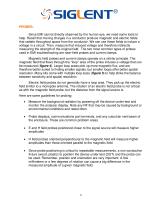
PROBES: Since EMI cannot directly observed by the human eye, we need some tools to help. Recall that moving charges in a conductor produce magnetic and electric fields that radiate throughout space from the conductor. We can use these fields to induce a voltage in a circuit. Then, measure that induced voltage and therefore indirectly measuring the strength of the original field. The two most common types of probes used in EMI troubleshooting are near-field probes and current clamps. Magnetic field probes and current clamps operate on a similar principle. The magnetic field that flows through...
Open the catalog to page 5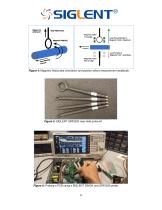
Figure 4: Magnetic field probe orientation and position affect measurement amplitude. Figure 5: SIGLENT SRF5030 near-field probe kit. Figure 6: Probing a PCB using a SIGLENT SSA3X and SRF5030 probe.
Open the catalog to page 6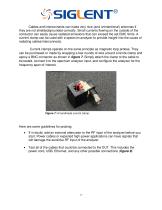
Cables and interconnects can make very nice (and unintentional) antennas if they are not shielded/grounded correctly. Small currents flowing on the outside of the conductor can easily cause radiated emissions that can exceed the set EMC limits. A current clamp can be used with a spectrum analyzer to provide insight into the cause of radiating cables/interconnects. Current clamps operate on the same principle as magnetic loop probes. They can be purchased or made by wrapping a few rounds of wire around a ferrite clamp and epoxy a BNC connector as shown in figure 7. Simply attach the clamp to the...
Open the catalog to page 7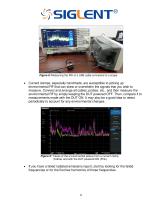
Figure 8: Measuring the RFI of a USB cable connected to a scope. Current clamps, especially handmade, are susceptible to picking up environmental RF that can skew or overwhelm the signals that you wish to measure. Connect and arrange all cables, probes, etc.. and then measure the environmental RF by simply keeping the DUT powered OFF. Then, compare it to measurements made with the DUT ON. It may also be a good idea to retest periodically to account for any environmental changes. Figure 9: Traces of the environmental pickup from a current clamp (Yellow) and with the DUT powered ON (Pink). If you...
Open the catalog to page 8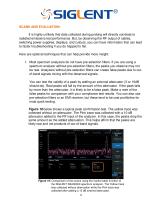
SCANS AND EVALUATION: It is highly unlikely that data collected during probing will directly correlate to radiated emissions test performance. But, by observing the RF output of cables, switching power supplies, displays, and cutouts, you can have information that can lead to faster troubleshooting if you do happed to fail. Here are optional techniques that can help provide more insight: 1. Most spectrum analyzers do not have pre-selection filters. If you are using a spectrum analyzer without pre-selection filters, the peaks you observe may not be real. Analyzers without pre-selection filters...
Open the catalog to page 9All Siglent Technologies Co., Ltd catalogs and technical brochures
 SDS6000A Series
21 Pages
 SDS 7000A Series
21 Pages
 SDL1000X Series
10 Pages
 SSM5000A Series
15 Pages
 Spectrum Analyzer Bandwidth
6 Pages
 Siglent_Product Catalog 2016
48 Pages
 Siglent Selection Guide 2016
10 Pages
 Benefits of deep memory
3 Pages
 SIGLENT Probes Datasheet
7 Pages
 Siglent SDS2000X User Manual
197 Pages
 Siglent SDS2000X Service Manual
59 Pages
 Probe Data Sheet + Siglent
7 Pages
 USB-GPIB User Manual_Siglent
13 Pages
 ISFE User Manual
12 Pages
 Siglent TrueArb Technology
9 Pages
 SDS2000 VS DS2000A_EN_Siglent
10 Pages
 SIGLENT SDS1000CFL
8 Pages
 SIGLENT SHS800 Data Sheet
10 Pages


- DC power supply
- AC/DC power supply
- Automation software solution
- Monitoring analyzer
- Analysis software solution
- Automatic analyser
- Windows software
- Computer-aided design software
- Cloud-based software
- Control software
- Benchtop analyser
- Design software solution
- Switched-mode power supply
- Portable analyzer
- Measurement software
- Interface software
- Real-time analyzer
- Tabletop power supply
- Laboratory analyzer