
- Catalogs
- Siemens Medium-voltage – Power distribution
- GEAFOL - cast-resin transformers


GEAFOL - cast-resin transformers

GEAFOL - cast-resin transformers
GEAFOL cast-resin dry-type transformers are designed for high load densities and can be installed close to the load without special rooms or precautions. They are environmentally friendly, safe, flame-retardant, self-extinguishing, humidity- and tropic-proof, and low-noise, making them suitable for various applications including commercial, residential, industrial, and public transport services.
GEAFOL transformers are suitable for installation in enclosed electrical operating areas with power ratings from 100 to 3,150 kVA and voltages up to 36 kV. They comply with various international standards, including IEC 60076-11 and DIN VDE 0532, and must adhere to the Ecodesign Directive 2009/125/EC within the EU.
Installation requirements are determined by fire protection and leakage loss regulations according to IEC 61936-1. Fire protection measures vary based on transformer type and installation location, with specific requirements for walls and doors to ensure safety.
Transformers are classified according to IEC 60076-11, considering environment, climate, and fire classes. GEAFOL transformers meet the highest classes: Environment class C2, Climate class E2, and Fire class F1, ensuring reliability even in harsh conditions.
Transformers are designed for specific cooling air temperatures, with maximum, monthly, and annual averages specified. Special installation conditions, such as high altitudes or extreme mechanical stresses, require additional design considerations.
GEAFOL transformers offer flexible connection options for both high-voltage (HV) and low-voltage (LV) sides, including plug-type connectors and various terminal configurations. Earthing and short-circuiting devices can be connected using fixed points at conductor connections.
Temperature monitoring is crucial for transformer operation, with options including PTC thermistor sensors, PT 100 resistance temperature detectors, or capillary tube thermometers. Monitoring systems can provide alarm signaling and tripping functions to prevent overheating.
Proper ventilation is essential for transformer rooms to manage heat dissipation through natural or forced-air circulation. Noise levels are addressed through measures for air-borne and structure-borne noise reduction, ensuring compliance with environmental standards.
The document discusses the enhancement of transformer power ratings through the use of forced-air cooling, specifically by attaching centrifugal-flow fans to transformers. This method allows for an increase in power capacity without exceeding permissible winding temperatures.
A 1,000 kVA transformer can be upgraded to 1,500 kVA using forced-air cooling (AF), compared to natural cooling (AN). This involves mounting 2 or 3 fans on each longitudinal side of the transformer.
The fans are single-phase AC induction motors with an external rotor (IP 00) and a sound pressure level of 71–74 dB(A). A control device is required to start the fans based on temperature, and they are switched off using an adjustable time relay.
Extra space is needed for fans (e.g., 200 mm length and 250 mm width for a 1,000 kVA transformer). LV connections must not interfere with airflow. Higher power losses occur, increasing room ventilation needs and operating costs.
Forced-air cooling is not economical for continuous operation but is beneficial for reserve capacity and handling load peaks. Maintenance costs may increase due to fan use.
Heat losses (Pv) are calculated using no-load losses (P0) and load losses at 120°C (PK120). Total heat losses in a room (Qv) are the sum of all transformer losses.
Natural air circulation (Qv1), heat dissipation through walls and ceiling (Qv2), and forced-air circulation (Qv3) are discussed.
Effective cooling involves admitting cold air at the bottom and exhausting it near the ceiling. If air is polluted, filtering is necessary. The document provides calculations and diagrams for designing ventilation systems.
Fans should be selected based on air delivery rate, speed, operating voltage, power rating, frequency, and sound pressure level. The drive rating of fans is calculated using total pressure difference and air flow rate.
The document includes a detailed example of forced-air circulation for four 1,000 kVA transformers, calculating total heat losses, air flow rate, and duct cross sections.
The document discusses the calculation of total pressure difference in ventilation systems, focusing on frictional losses and acceleration. The total pressure difference is calculated as 211 Pa, combining frictional losses (150 Pa) and acceleration pressure difference (61 Pa). A ventilation fan with an air delivery rate of 10,000 m3/h and a total pressure difference of 211 Pa is recommended.
Special design measures have reduced the noise levels of GEAFOL cast-resin dry-type transformers to those of oil-immersed transformers. Noise is primarily caused by magnetostriction and can be influenced by voltage harmonics. The document explains sound sensitivity, measurement, and the importance of frequency-dependent ear sensitivity in noise evaluation.
Noise from transformers propagates as airborne and structure-borne noise. Various measures, such as using mineral wool, can reduce airborne noise. Structure-borne noise insulation involves using anti-vibration mountings and elastic adapters to minimize noise transmission.
The sound power level is independent of measurement points and is determined by the sound pressure level on a defined surface. The document provides equations for calculating sound pressure levels at different distances and discusses noise amplification due to reflections.
Transformers generate electric and magnetic fields, with the latter potentially causing interference. The document provides guidelines for acceptable field strengths and emphasizes that transformers generally do not exceed these limits at safe distances.
Transformers are considered passive elements under IEC 60076-11 and are not subject to CE marking unless they fall under specific directives.
Catalog excerpts

GEAFOL-Cast-Resin Transformers Planning Guidelines
Open the catalog to page 1
Contents GEAFOL - for the highest requirements on location 4 Basic data for planning 5 Measures for fire protection according to DIN EN 61936-1 6 Classification according to the Ecodesign Directive 2009/125/EC 7 Special installation conditions 8 Protection against accidental contact 8 Connection of the high-voltage side 9 Connection of the HV side using plug-type connectors 9 High-voltage tappings 9 Connection of the low-voltage side 9 Connection of earthing and short-circuiting devices 9
Open the catalog to page 2
Temperature monitoring with PTC thermistor 10 Transformer: Additional air cooling Efficiency of additional forced-air cooling 11 Ventilation of the Transformer Room 12 Calculation the heat losses in the room 12 Calculation the heat dissipation 12 Qv1: Heat dissipation by natural air circulation 12 Qv2: Heat dissipation through the walls and ceiling 13 Qv3: Heat dissipation by forced-air circulation 14 Room ventilation fans 14 Criteria for choice of room ventilation fans 14 Rating of the room ventilation fan 14 pr: Pressure difference due to flow 15 pb: Pressure difference due to acceleration...
Open the catalog to page 3
GEAFOL – for the Most Stringent Local Conditions Easy to Integrate Anywhere GEAFOL® cast-resin dry-type transformers are the ideal solution wherever high load densities necessitate provision of power sources close to the load. They give designers the necessary freedom of action, since they facilitate the economic implementation of network concepts, because they are environmentally friendly and safe, and because they allow installation of power sources close to the load without the need for special rooms and precautions. These are aspects which predestinate these distribution transformers for...
Open the catalog to page 4
All the technical data apply to GEAFOL cast-resin dry-type transformers with the following features: ■ Installation in enclosed electrical operating area in accordance with IEC61936-1 (DIN EN 61936) The data also generally apply to ■ liquid-immersed transformers in terms of "water conservation and fire protection measures and measures for preservation of functional integrity" in addition to those for "Ventilation" and "Noise" Our GEAFOL transformers meet the requirements of all relevant national, European and international standards (order-related). ■ EN 50588-1 medium voltage transformators...
Open the catalog to page 5
InstallationRequirements GEAFOL transformers present the lowest requirements for the point of installation. These are determined by the regulations concerning fire protection and protection from leakage losses according to IEC 61936-1 (DIN EN 61936-1). The requirements of these regulations (from 2011) are compared below for transformers of different design. Measures for fire protection according to DIN EN 61936-1 (VDE 0101-1), simplified overview
Open the catalog to page 6
Classification according to IEC 60076-11 This standard defines environment, climate and fire classes and in consequence thereof takes into account varying operating conditions existing at the point of installation. The climate class takes the lowest ambient temperature into account. Class C1: Indoor installation not under -5 °C Class C2: Outdoor installation down to -25 °C The climate class is thus also a measure for the fracture toughness of the cast-resin compound. The environment class takes air humidity, condensation and pollution into account. Class E0: No condensation, negligible pollution...
Open the catalog to page 7
Minimum clearances around GEA-FOL transformers with safety edge (1) Temperature of the cooling air Transformers are designed in accordance with the applicable standards for the following cooling air values: ■ 30 °C monthly average of the hottest month If operated normally, the transformer should attain its expected lifetime consumption. In particular, the average annual temperature and the load significantly affect the lifetime consumption. Environment temperatures differing from the annual average have an effect on the system's load capacity. (Table 1). Extreme local conditions must be taken...
Open the catalog to page 8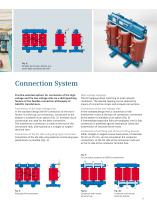
Fig. 3: Variable termination facility, e.g. at the delta-connected HV side Connection System Practice-oriented options for connection of the highvoltage and the low-voltage side are a distinguishing feature of the flexible connection philosophy of GEAFOL transformers. High-voltage tappings The HV tappings allow matching to local network conditions. The desired tapping can be selected by means of connection straps and screwed connections. Connection of the high-voltage side In the standard design the HV connection of the transformer is at the top coil connection, connection at the bottom is available...
Open the catalog to page 9
Temperature Monitoring The PTC thermistor sensors function as resistances. When the response temperature is reached, a step-change in resistance occurs and the changeover contact in the tripping device is operated. As soon as the temperature falls below the response temperature by approx. 3 K, the relay coil in the tripping device is once more fully energized and the changeover contact returns to its original position. When two systems are employed for temperature super vision, one is connected to provide alarm signalling and the other tripping. The rated response temperatures of both systems...
Open the catalog to page 10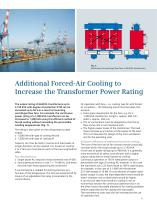
Fig. 7: Attachment of centrifugal flow fans to GEAFOL transformers Additional Forced-Air Cooling to Increase the Transformer Power Rating The output rating of GEAFOL transformers up to 3,150 kVA with degree of protection IP 00 can be increased up to 50 % as a result of mounting centrifugal-flow fans. For example, the continuous power rating of a 1,000 kVA transformer can be increased to 1,500 kVA using this efficient method of forced cooling without exceeding the permissible winding temperatures (Fig. 7). The rating is then given on the rating plate as rated output: 1,000 kVA with type of cooling...
Open the catalog to page 11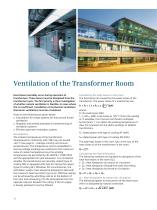
Ventilation of the Transformer Room Heat losses inevitably occur during operation of transformers. These losses must be dissipated from the transformer room. The first priority is thus investigation of whether natural ventilation is feasible. In cases where this is insufficient, installation of mechanical ventilation (forced-air ventilation) must be considered. Hints for the following are given below: Calculations for simple systems for natural and forced ventilation Diagrams and worked examples for dimensioning of ventilation systems Efficient specimen ventilation systems Assumptions The ambient...
Open the catalog to page 12All Siemens Medium-voltage – Power distribution catalogs and technical brochures
 Outdoor systems
15 Pages
 8DJH 12 – blue GIS
6 Pages
 Siemens Vacuum Recloser 3AD
56 Pages
 3AH4 Vacuum Circuit-Breakers
50 Pages


Archived catalogs
 3AH3 Vacuum Circuit-Breakers
58 Pages
 NXAIR C The Optimum
24 Pages
 E-House
22 Pages
 Distributing Power Economically
24 Pages


- Management software solution
- Automation software solution
- Analysis software solution
- Single-pole switch
- Real-time software
- Windows software
- Computer-aided design software
- Cloud-based software
- Control software
- Design software solution
- SIEMENS circuit breaker
- Isolator switch
- Motor controller
- Simulation software solution
- Automated software
- Network software
- EDM software
- Contactor
- Creation software
- Modeling software