
- Catalogs
- SIEMENS Energy automation and smart grid
- Power Quality and Measurements Product Catalog SR 10 V1.0


- Products
- Catalogs
- News & Trends
- Exhibitions
Power Quality and Measurements Product Catalog SR 10 V1.0

Power Quality and Measurements Product Catalog SR 10 V1.0
The document emphasizes the significance of power quality in modern electrical systems, especially within smart grids. It addresses the challenges posed by renewable energy sources, energy efficiency requirements, and market liberalization, suggesting solutions like power system automation, load control, fault detection, and power quality improvement through precise analysis and automated correction.
Power quality monitoring is crucial for maintaining equipment performance, involving the measurement and evaluation of electrical parameters to ensure compliance with standards like EN 50160. Poor power quality can cause system malfunctions, often due to large loads or external influences. Monitoring devices help visualize power quality and manage technical risks.
Power monitoring serves both operative and economical purposes. Operative monitoring focuses on system control parameters, while economical monitoring targets energy consumption and cost allocation. Siemens offers user-friendly, reliable power monitoring solutions compatible with modern communication standards.
The document provides an overview of SICAM products, including power meters, transducers, and power quality recorders, detailing their functions, dimensions, mounting options, protection degree, and communication capabilities. Key features include data analysis, reporting, and compliance with standards like IEC 61000-4-30 and EN 50160.
The products comply with European directives on electromagnetic compatibility and low-voltage equipment, designed for industrial use and conforming to standards like EN 60688. Legal notices regarding liability, copyright, and trademark information are included.
The document lists detailed specifications for each device, including housing dimensions, mounting options, protection degrees, measurement capabilities, accuracy, harmonics recording, power quality standards compliance, sampling rates, and storage capacities. Supported communication protocols include Modbus, Profibus, and IEC standards.
SICAM devices offer programmable limit values, waveform recording, transient capture, and time synchronization. They measure and record various electrical parameters and can be configured for different applications using SICAM P Manager software.
The devices are suitable for power monitoring systems at medium and low voltage levels, helping to log energy-related data and identify energy consumption patterns. They can be integrated into PLC systems and communication networks for centralized monitoring and control.
Configuration is user-friendly, either through the device display or software. Communication interfaces include RS485 ports with standard protocols like Profibus DP and Modbus RTU/ASCII, ensuring flexibility and universality in data transmission.
Siemens ensures high-quality standards in the development and production of SICAM devices, adhering to ISO certifications. The devices are designed for reliability, accuracy, and compliance with international standards, featuring powerful microprocessors for fast data processing.
The SICAM P device features a 1 Mbyte memory capacity, allowing flexible configuration for storing mean values, power recordings, oscilloscope data, limit value violations, and binary states. The device automatically calculates and displays the record time based on the assigned percentage of memory.
Data can be extracted using the SICAM P Manager software via the RS485 interface, requiring a specific cable and RS232/RS485 converter. The software provides tools for displaying and evaluating all recorded measurements and binary information.
The SICAM P allows up to 20 user-defined screens, which can be navigated manually or automatically. The screens can display various data types, including measured values, harmonics, and phasor diagrams. The display refreshes every second, and default settings are pre-programmed.
The document lists various measured values such as voltage, current, power, and energy, along with their tolerances. These values are transmitted via communication protocols like Profibus DP and Modbus.
The SICAM P can be equipped with different modules: analog input, binary input, analog output, binary output, and relay output modules. Each module has specific functions, such as signal acquisition, state registration, and impulse generation.
The SICAM P configuration software facilitates device settings and supports firmware updates. It allows parameter setting and storage without the physical unit and enables memory read-out for various data types.
The SICAM P monitoring system offers environmental, reliability, safety, and financial benefits by improving energy efficiency, identifying operational issues, and reducing personnel exposure to hazardous environments.
The document provides detailed technical specifications, including input voltage and current ratings, power consumption, communication interfaces, and environmental conditions. It also describes the housing design and connector elements.
- Analog Input Module: Rated input current is 0-20 mA DC with an output range of 0-24 mA DC. Input impedance is 50 Ω ± 0.1%, and accuracy is 0.5% of the measuring range limit.
- Binary Input Module: Maximum input voltage is 150 V DC, with a maximum current at high level of 53 mA. Time lag between low-high and high-low is a maximum of 3 ms.
- Analog Output Module: Rated output current is 0-20/4-20 mA DC with a maximum load impedance of 250 Ω. Typical accuracy is 0.2%, with a maximum of 0.5% of nominal.
- Binary Output Module: Permissible voltage is 150 V AC/DC, with a permissible current of 100 mA and impulse current of 300 mA for 100 ms.
- Relay Module: Permissible voltage is 150 V AC/120 V DC, with a permissible current of 5 A. Maximum reaction time is 10 ms.
- SICAM P50: Power meter with display, built-in device for control panel, standard protocols include Profibus DP and Modbus.
- SICAM P55: Power meter without display, snap-on rail mounting device, standard protocols include Profibus and Modbus.
- SICAM P850: Multifunctional device for measuring electrical variables, supports Ethernet communication via Modbus TCP or IEC 61850, and serial communication via Modbus RTU or IEC 60870-5-103.
SICAM P850 supports Ethernet and RS485 interfaces for communication with control centers and other systems. Time synchronization is achieved via NTP or field bus using Modbus RTU or IEC 60870-5-103 protocols.
SICAM P850 measures voltage quality according to IEC 61000-4-30 Ed. 2 and other parameters in single-phase or multi-phase systems. It is a Class S measuring device with a basic measuring interval of 10/12 periods for 50/60 Hz systems.
The document includes order numbers for various configurations of SICAM devices, including power meters with or without displays, I/O modules, and communication modules.
The SICAM P850 offers precise measurements with uncertainties as low as ±0.1% for voltage and current, and ±0.5% for power and energy metrics. It supports measurements up to the 40th harmonic and complies with IEC 61000-4-30, Class S standards.
The device can be connected in various configurations, including single-phase, three-conductor, and four-conductor systems, with options for balanced and unbalanced loads. Connection examples illustrate setups with different numbers of voltage and current converters.
The SICAM P850 supports a wide range of input voltages (24 V to 250 V DC and 110 V to 230 V AC) and currents (1 A and 5 A). It features robust EMC immunity and interference compliance, adhering to standards like IEC 61000-6-2 and IEC 61000-6-4. The device is designed for harsh environments, withstanding temperatures from -25 °C to +55 °C and altitudes up to 2000 m.
The device includes Ethernet and optional RS485 interfaces, supporting protocols such as Modbus TCP, IEC 61850, and Modbus RTU. It offers a web server for parameterization and data management.
The SICAM P850 is available in panel flush and DIN rail mounting options, with IP20 to IP51 protection levels. It is designed to endure mechanical stresses like vibration and shock, as per IEC 60068 standards.
The SICAM MMU (Measurement and Monitoring Unit) is a power monitoring device designed for measuring electrical quantities in networks. It is used in industries, power plants, and substations to measure parameters such as current, voltage, power, phase angle, harmonics, unbalance, energy, and frequency. The device supports communication with control centers via IEC 60870-5-104 or Modbus TCP protocols.
- Mounting: Top-hat rail
- Case Dimensions: 96 mm × 96 mm × 100 mm
- Protection: IP20
- Supply Voltage: DC 24-250 V, AC 110-230 V
- Inputs: 4 voltage, 3 current (up to 10 A continuous)
- Outputs: 2 binary, expandable with SICAM I/O Unit
- Communication: Ethernet with IEC 60870-5-104 or Modbus TCP
The device records or calculates various measurands including unbalance, TRMS, power (active, reactive, apparent), energy, frequency, phase angle, and power factor. It supports time synchronization via Ethernet NTP or internal RTC.
- Integration into control centers and substation automation
- Monitoring transformers and decentralized power generation
- Alarming and notification of limit violations
- Basic power quality profile monitoring
- Compact and robust design
- Supports 1-phase, 3-wire, and 4-wire systems
- Temperature range: -25°C to +55°C
- High measuring accuracy and EMC immunity
- UL and KEMA certified
The SICAM MMU GUI allows for device configuration and monitoring without additional software. It provides access to device status, communication settings, parameterization, and maintenance functions.
The device supports various connection types and has specific electrical input ratings. It is designed for flexible application in different network configurations.
The document provides detailed technical specifications for the SICAM MMU and SICAM T devices, focusing on power quality and measurement capabilities. Key specifications include:
- Voltage and Current Measurements: Rated input voltages range from 110 V AC to 230 V AC, with a permissible power frequency of 45 Hz to 65 Hz. The devices support various voltage and current measurement configurations, including phase-to-phase and phase-to-neutral measurements.
- Power Consumption and Overload Capacities: Power consumption per input is specified, with continuous and surge overload capacities detailed according to IEC standards.
- Measurement Accuracy: The devices offer high measurement accuracy, typically 0.2% for voltage and current at rated conditions, with specific tolerances outlined for various parameters.
- Environmental and Mechanical Specifications: Operating temperature ranges from -25 °C to +55 °C, with specific humidity and condensation conditions. The devices are designed for industrial use with IP20 protection.
The devices support multiple communication protocols and interfaces:
- Ethernet and Modbus: Communication is facilitated via Ethernet using protocols such as IEC 60870-5-104 and Modbus TCP, with specific transmission rates and cable requirements.
- Binary Outputs: The devices include binary outputs with specified maximum switching voltages and currents, supporting various operational needs.
The devices comply with several international standards, ensuring reliability and safety:
- CE Conformity: Compliance with EMC and low-voltage directives is established through rigorous testing.
- Environmental Standards: The devices meet standards for cold, dry heat, damp heat, and mechanical vibrations, ensuring robust performance in diverse conditions.
The SICAM devices are versatile, suitable for various industrial applications:
- Measurement and Monitoring: They provide comprehensive measurement capabilities, including active, reactive, and apparent power, energy, and power factor measurements.
- Integration and Control: The devices can be integrated into SCADA systems and support real-time monitoring and control through fast response times and flexible output configurations.
The document provides a detailed technical description of the SICAM T device, focusing on its specifications, functionalities, and applications in power quality and measurement systems. It includes information on communication protocols, time synchronization, electrical assembly, mechanical design, and user interface.
- The device features 4 LEDs for status visualization, Ethernet communications via IEC 61850 and Modbus TCP, and serial interface via Modbus RTU or IEC 60870-5-103.
- It includes an internal battery for real-time clock and energy counter value retention during power outages.
- Rated input voltages are up to 690 V AC (phase-phase) and 400 V AC (phase-neutral), with current inputs up to 5 A AC.
- DC analog outputs support current ranges from 0 mA to 20 mA and voltage ranges from 0 V to 10 V.
- Response time for analog outputs is 120 ms at 50 Hz and 100 ms at 60 Hz.
- The device is applicable in various areas such as generation substations, transmission substations, transformer substations, process SCADA/EMS/DMS, energy management, and commercial applications like air conditioning.
- Supports Ethernet and RS485 interfaces for communication, with protocols including HTTP, IEC 61850, Modbus TCP, Modbus RTU, and IEC 60870-5-103.
- Time synchronization can be external via Ethernet NTP or field bus, or internal via RTC with a quartz oscillator.
- Electrical modules include digital signal processor, inputs for AC voltage and current measurements, DC analog outputs, binary outputs, and interfaces.
- The device is housed in a plastic case with dimensions suitable for top-hat rail mounting.
- The SICAM T GUI allows for device configuration and monitoring without additional software, accessible via Microsoft Internet Explorer.
- Features include parameterization, value view, and maintenance tabs for firmware updates, calibration, and log management.
- Electrical data includes rated input voltages, power consumption, permissible frequencies, and measuring errors.
- General electrical data covers supply voltage ranges, system frequency, and protection degrees.
The document provides detailed technical specifications for the SICAM T power quality and measurement devices by Siemens. Key specifications include:
- Communication Data: Ethernet with IEC 61850 Server or Modbus TCP protocols, transmission rates of 10/100 MBit/s, and a maximum cable length of 100 meters for 100Base-T connections.
- Serial RS485 Interface: Supports Modbus RTU and IEC 60870-5-103 protocols with various baud rates and a maximum cable length of 1,000 meters.
- Environmental Data: Operating temperature ranges from -25°C to +55°C, with specific humidity and condensation conditions.
The product complies with several international standards, including IEC 60688 for climate and mechanical tests, and is UL-certified to Standard UL 61010-1. It also meets CE conformity for electromagnetic compatibility and low-voltage directives.
Power quality is crucial for electricity supply services, affecting both reliability and the ability of equipment to function properly. The document outlines various power quality issues such as frequency distortions, supply interruptions, voltage dips, and transients, along with their causes and effects.
Common power quality problems include frequency distortions, supply interruptions, voltage dips, and transients. These issues can lead to equipment malfunction, data loss, and production downtime. The document emphasizes the importance of monitoring power quality to prevent severe consequences.
The document discusses the shared responsibility between utilities and consumers for maintaining power quality. It highlights the interaction between voltage and current quality and the role of standards like EN 50160 in regulating voltage quality.
This document provides a comprehensive guide on power quality monitoring and measurement using SICAM devices, particularly focusing on the SICAM Q80 and P855 models. It outlines the procedures, standards, and applications related to power quality (PQ) monitoring, emphasizing the importance of understanding PQ applications for successful system profiling.
The document describes the phases of a power quality project, including defining PQ objectives, measuring, evaluation, system installation, configuration, and improvement. It highlights the importance of defining measurement points and installing devices and systems for reliable measurement and automatic evaluation.
Two main applications are discussed: regulatory and explanatory. Regulatory applications focus on compliance with standards like EN 50160, using Power Quality Recorders to monitor voltage quality parameters. Explanatory applications aim to understand specific cases, such as fault analysis, using various recorders to document and analyze power quality issues.
The document details standards like EN 50160 and IEC 61000-4-30, which define voltage characteristics and measurement methodologies, respectively. It explains the importance of these standards in ensuring accurate and compliant power quality measurements.
Identifying and defining measurement points is crucial for effective power quality monitoring. The document provides a table of potential measurement points across different system locations, emphasizing the need for strategic placement to optimize data collection.
The SICAM P855 is a multifunctional device used for collecting, displaying, and transmitting electrical variables. It supports various communication protocols and offers features like robust design, external time synchronization, and data export in formats like PQDIF and COMTRADE. The device is suitable for use in different power systems and provides comprehensive monitoring and evaluation functions.
The document serves as a detailed guide for implementing power quality monitoring systems using SICAM devices, providing insights into project planning, application understanding, and adherence to international standards.
The ICAM P855 device includes various electrical modules depending on the variant, such as a digital signal processor (DSP), display and softkeys, inputs for AC voltage and current measurements, binary outputs, power supply, Ethernet and RS485 interfaces.
The device collects and calculates several measurands including true RMS AC voltage and current, effective value measurement up to the 100th harmonic, line frequency, power factors, and harmonics up to the 40th order. It also measures THD, phase angle, and flicker.
The SICAM P855 records measurands and events at various intervals. It includes a measurand recorder for power quality and non-PQ measurands, a trend recorder for long-term monitoring, a fault recorder for voltage/current dips and swells, and an event recorder for voltage and frequency events. Data is stored in a 2-GB memory and can be exported in COMTRADE or PQDIF formats.
The device supports communication via Ethernet and optional RS485 interfaces, using protocols like Modbus RTU, IEC 60870-5-103, Modbus TCP, and IEC 61850. It allows for device parameterization, data transmission, and time synchronization using NTP.
Time synchronization is crucial for operation, achieved via Ethernet NTP, external field bus, or an internal real-time clock.
The device features LED indicators for status monitoring and can be operated via HTML pages or function keys on the display. Parameter settings and measured values are shown on the screen.
Devices are operated from a connected PC using an internal web browser. Measured values, harmonics, power, and energy are visualized, and alerts can be set for limit value violations.
The device provides data availability for various measurands and supports multiple communication interfaces for data transmission.
The SICAM P855 measures voltage quality according to IEC 61000-4-30 Ed. 2, with a 10/12-period measurement interval. It evaluates voltage quality through various measurands like voltage level, events, unbalance, harmonics, and flicker.
The device offers multiple recording options for monitoring voltage quality, including measurand, trend, event, and fault recorders. Data can be transmitted or exported in specific formats.
The document provides detailed technical specifications and functionalities of the SICAM P855, a device used for power quality monitoring and measurement. It includes information on recorder functions, voltage quality evaluation, measurement accuracy, connection types, and technical data.
The SICAM P855 offers various recording functions such as measurand recorder, event recorder, trend recorder, and fault recorder. These functions are used for long-term monitoring of power quality, classification of voltage events, and analysis of power quality problems.
The device evaluates recorded voltage events and prepares power quality reports according to EN 50160 standards. It allows customization of PQ threshold values and report configurations, enabling the creation of standardized or user-defined reports.
The SICAM P855 adheres to standards such as IEC 61000-4-30 and IEC 61557-12, ensuring high accuracy in measuring various electrical parameters. The document details the operating measurement uncertainties for different measurands.
The document outlines various connection types for the SICAM P855, including single-phase, three-conductor, and four-conductor systems. It provides examples of connection setups for different load conditions.
The SICAM P855 supports multiple power supply inputs, communication interfaces, and has specific mechanical and EMC test standards. It includes details on power consumption, input voltages, and communication protocols like Modbus TCP and IEC 61850.
The device undergoes rigorous mechanical tests for vibration and shock stress, as well as EMC tests for immunity and electromagnetic interference, ensuring reliability and compliance with international standards.
Vibration and shock stress tests are conducted according to IEC 60068 standards. The tests include oscillation and shock tests with specific parameters for frequency, amplitude, and acceleration. For oscillation, the frequency ranges from 5 Hz to 150 Hz with varying amplitudes and accelerations. Shock tests involve semi-sinusoidal shocks with specified acceleration and duration. Continuous shock tests are also performed with a higher number of shocks. Free fall tests are conducted from a height of 0.5 meters.
Reference conditions for testing include an ambient temperature of 23°C ± 2°C, relative humidity between 40% and 60%, and specific supply voltage conditions. The document outlines the operating, transport, and storage temperature ranges, as well as humidity conditions. Electrical tests are conducted according to IEC standards, with specific insulation and surge voltage requirements for various inputs and outputs.
The SICAM P855 is a multifunctional power meter and power quality recorder. It features multiple inputs for voltage and current measurements, binary outputs, and galvanic isolated voltage measurement inputs. The device supports web server functionalities for parameterization and data management. It complies with IEC 61000-4-30 standards for power quality measurements and offers various measurement functions, including basic and advanced measurements, harmonic analysis, and event detection.
The SICAM Q80 is a power quality recorder designed for continuous monitoring of power quality across the electrical supply chain. It supports regulatory and explanatory power quality applications, providing benefits such as customer satisfaction, asset protection, and evidence for negotiations. The device measures continuous phenomena and disturbances, records events, and evaluates power quality according to IEC standards. It features high local storage, automatic data transfer, and various communication interfaces for remote monitoring and synchronization.
The SICAM Q80 implements a "complete recording" philosophy, ensuring all measured quantities are available for analysis. It continuously monitors r.m.s. values for current and voltage, records events, and calculates harmonics and flicker. The device supports flexible parameterization for event detection and offers enhanced monitoring functions for voltage events and harmonics recognition. It provides comprehensive power quality monitoring and reporting capabilities.
The document provides a detailed description of the SICAM Q80 system, focusing on its capabilities for power quality monitoring, data recording, and analysis. It outlines the system's specifications, functionalities, and software tools designed to enhance power quality management.
The SICAM Q80 system can capture signal deviations due to harmonics or voltage fluctuations with configurable recording durations ranging from 10 ms to 60 s. It supports high-resolution data recording at 100 μs and includes triggers for signal frequencies and external binaries. Network triggers allow for synchronized event analysis across multiple devices.
The system supports automatic notifications via email, SMS, or fax in response to specific events. It uses a compact flash card for data storage, with capacities ranging from 2 GB to 16 GB, allowing for up to 130 weeks of data storage.
SICAM Q80 units can be networked for centralized parameter setting and event recording. Time synchronization is achieved through NTP, IRIG-B, DCF77, or GPS, ensuring accurate chronological data plotting.
The SICAM Q80 Manager software facilitates parameterization, system overview, and data analysis. It supports over 500 data sets and offers user-friendly operation similar to Microsoft Explorer. The software includes features for online measurement visualization, data evaluation, and automatic data transfer.
The system includes a report generator for creating graphical reports, supporting automation of documentation and template creation. It allows for detailed measurement and analysis according to international standards like EN 50160 and IEC 61000.
The document details measurement intervals, standards, and specifications for voltage, current, frequency, harmonics, and symmetry. It highlights the system's capability to monitor and evaluate power quality attributes with various time resolutions.
The document provides detailed technical specifications and operational guidelines for the SICAM Q80 Power Quality Recorder by Siemens. It includes measurement capabilities, connection configurations, technical data, and ordering information.
The SICAM Q80 supports various measurement intervals ranging from 3 seconds to 2 hours, with specific intervals highlighted for compliance with the EN 50160 standard. It measures active, reactive, and apparent power for both the overall system and individual channels, including harmonic analysis up to the 50th harmonic.
The document outlines multiple connection setups, including four-wire, eight-voltage, three-wire (delta), and single-phase connections. Each configuration specifies the lines and neutral connections, with optional measurements for certain lines.
The SICAM Q80 operates under ambient conditions specified by EN 61010-1, with power consumption under 12 W. It supports a wide range of power supply inputs and includes features like UPS capacitor backup, EMC compliance, and IP20 protection. The device is equipped with Ethernet and modem interfaces for communication.
Current and voltage inputs are detailed, including sampling rates, bandwidth, and safety ratings. The device supports differential and isolated inputs with specific impedance and overload resistance characteristics.
The recorder includes four digital inputs and outputs, each isolated and rated for 250 V/CAT III. The document specifies switching levels, current input, and circuit times for these digital interfaces.
Calibration conditions are provided, with evaluations according to standards like EN 50160 and IEC 61000 series. The device supports synchronization via GPS, DCF77, IRIG-B, and NTP, with precision and jitter specifications.
The document lists the order numbers for the SICAM Q80 and its accessories, including GPS synchronization devices and software for device management and reporting.
SICAM Q100 is a Class A multifunctional measuring device designed for monitoring power quality and energy management. It adheres to IEC 62586-1 standards and is capable of acquiring, visualizing, analyzing, and transmitting electrical variables such as AC current, voltage, frequency, and harmonics. The device supports long-term data evaluation and reporting in compliance with power quality standards like EN 50160.
The SICAM Q100 features include:
- Power Monitoring and Power Quality Recorder with Class A measurement accuracy.
- Integrated web server for parameterization and data management.
- Galvanically separated voltage measurement inputs.
- Multiple communication protocols including Modbus TCP and IEC 61850.
- 4 inputs each for AC voltage and current measurements.
- Binary inputs and outputs for load profile synchronization and external triggers.
The device is suitable for single-phase, three-wire, and four-wire systems. It is ideal for applications requiring uninterrupted power quality data acquisition, such as industrial plants, energy management, building automation, and power company networks. It supports integration with peripheral devices for comprehensive data processing.
- Early detection of power quality issues through continuous monitoring.
- Standardized measurement methods ensure manufacturer-independent evaluations.
- Flexible power quality logging and energy management functions.
- High precision measurements for energy management tasks.
- Modbus Gateway and Master functions for easy data integration.
- Interoperability with standard interfaces and protocols.
The SICAM Q100 supports Ethernet and optional RS485 interfaces for data transmission and time synchronization. It uses protocols like HTTP, Modbus TCP, and IEC 61850, with an integrated Ethernet switch for network integration. Time synchronization can be external via Ethernet NTP or internal if necessary.
The device supports continuous and event-specific data acquisition, including:
- Voltage, current, power frequency, and harmonics measurements.
- Event recording for voltage dips, overvoltages, and interruptions.
- Load profile acquisition using fixed and rolling block methods.
Parameterization is done via a web browser or device function keys. Evaluations include operational values, event analysis, and power quality reports. Data can be exported in CSV, PQDIF, and COMTRADE formats.
Up to 16 measured values can have parameterized limit values, with warnings for violations. Outputs are available via binary outputs and LEDs.
The document provides a detailed technical description of the SICAM Q100, a device used for power quality measurement and management. It includes specifications, data availability, power quality acquisition, recording methods, and evaluation processes.
The SICAM Q100 features an embedded Ethernet switch for integrating additional Ethernet-compatible devices without needing a supplemental network switch. It supports various communication interfaces such as Modbus TCP, Modbus RTU, and IEC 61850.
The document outlines the types of data available, including operational measured values, event analysis information, COMTRADE fault recorder files, trend recorder data, and measurand recorder data. It specifies the interfaces and formats for data export, such as PQDIF and CSV.
The SICAM Q100 measures voltage quality according to IEC 61000-4-30 Ed. 2 standards. It operates in single-phase and multi-phase systems, with a basic measuring interval of 10 periods for 50-Hz systems and 12 periods for 60-Hz systems. The device uses a flagging concept to prevent multiple recordings of the same event.
The document describes various recorders available in the SICAM Q100, including measurand, trend, event, fault, and load profile recorders. Each recorder serves specific functions, such as long-term monitoring, event classification, and load profile analysis.
The SICAM Q100 supports fixed block and rolling block methods for load profile recording. Data is stored in a ring buffer and can be accessed via communication interfaces or exported as CSV files. The document emphasizes the importance of accurate power flow analysis for efficient energy management.
The SICAM Q100 provides comprehensive power quality monitoring, supports multiple communication protocols, and offers flexible data recording and analysis options. It is designed to meet Class A measurement standards, ensuring high accuracy and reliability.
The document provides a detailed technical description of the SICAM Q100, a device used for power quality measurement and management. It covers specifications, procedures, standards, and recommendations for its operation and integration into power systems.
The SICAM Q100 can store up to 4000 data records, each containing power demand values, timestamps, and status information. It supports up to four power meter tariffs and records historic load profile data using fixed and rolling block methods.
Device parameterization is done via a web browser. The device displays operational measured values, voltage and current harmonics, power and energy data, and more. It supports visualization of voltage quality events and generates PQ reports according to EN 50160 standards.
SICAM Q100 supports data transmission via Ethernet and RS485 interfaces, using protocols like Modbus TCP, IEC 61850, and HTTP. It allows for flexible data download and integration with other devices.
The device can be used standalone for power quality monitoring or integrated with additional SICAM I/O units for expanded functionality. It supports Modbus Gateway and Master functions for integrating other devices into networks.
The device complies with IEC standards for voltage quality measurements, offering high accuracy and a wide measuring range for various parameters like frequency, voltage, flicker, and harmonics.
SICAM Q100 can be connected in various power system configurations, including IT, TT, and TN systems, with examples provided for different connection setups.
The document mentions the availability of different variants of the SICAM Q100, including those with standard Ethernet interfaces.
The document provides detailed technical specifications and functionalities of the Siemens SICAM Q100 Power Quality and Measurements device. It includes information on communication protocols, housing, dimensions, technical data, environmental conditions, and ordering information.
The device supports Modbus TCP and optionally IEC 61850 Server protocol. With an optional RS485 interface, it can handle Modbus RTU and Modbus RTU Master protocols, along with gateway functions.
The device is a panel flush-mounted unit with a full graphical display and front protection class IP40. It includes various connectors for measurements, power supply, and communication interfaces.
The device measures 95.5 mm x 96 mm x 102.9 mm and weighs approximately 0.55 kg.
The document details the supply voltage, input and output specifications, including rated input voltage ranges, power consumption, and maximum inrush current for both direct and alternating voltage. It also covers input impedance, power consumption per input, and sampling rates.
The device operates within a temperature range of -25 °C to +55 °C and can be stored or transported between -40 °C to +70 °C. It is designed for indoor installation at altitudes up to 2000 meters.
The device complies with various IEC standards for electrical and mechanical tests, including EMC tests for immunity and emitted interference. It also meets safety standards IEC EN 61010-1 and IEC EN 61010-2-030.
The document provides order numbers and descriptions for different configurations of the SICAM Q100, including options for serial interfaces and communication protocols.
The document briefly describes the SICAM PQS system, which allows for the analysis and archiving of power quality data. It highlights the benefits of secured voltage quality, efficient troubleshooting, compliance with standards, and structured data access.
The document provides a comprehensive overview of the SICAM PQS system, focusing on its functionalities, configuration, and applications. It highlights the system's ability to process data through Ethernet TCP/IP and serial interfaces, import third-party devices in PQDIF and COMTRADE formats, monitor Ethernet networks, and exchange data via OPC. The system ensures secured data access, redundancy, and includes test and diagnostic functions.
The SICAM PQS system serves as a central archive for fault records, PQ data, and reports. It supports various protocols such as IEC 61850 and IEC 60870-5-103, and allows for the connection of third-party devices. The system can evaluate grid codes online, generate automatic PQ reports, and operates on a server/client structure for centralized evaluation.
The SICAM PQS UI – Configuration component aids in configuring and parameterizing stations, defining communication links, and specifying connected devices. It allows for the assignment of grid codes and measuring channels, and supports the configuration of line parameters for fault location. The system's components are represented in a tree structure, with parameters displayed for each selected component.
The system supports various applications, including PQ Archive, SIMEAS R, SICAM Q80, and automatic fault location. It provides tools for configuration, testing, commissioning, and operation, with features like the SICAM PQS Value Viewer for visualizing process and system information.
The system allows for the creation of scheduled reports, which can be configured to include various diagrams and measured data. The PQ Analyzer offers evaluation options for archived PQ data and fault records, with tools like the Incident Explorer and PQ Inspector providing insights into network quality and discrepancies.
The system includes a User Administration tool for assigning access roles and a Feature Enabler for activating necessary components. The PQ index provides a simple way to monitor power quality, calculated based on operational and time range limits of assigned grid codes.
The document provides a comprehensive guide on SICAM Power Quality (PQ) devices and their applications, focusing on data collection, analysis, and system configuration. It includes detailed specifications, procedures, and ordering information for various SICAM PQ products.
The SICAM PQ Analyzer is designed to collect and evaluate power quality data from multiple devices. It supports configurations with full servers and archive computers, allowing for centralized data collection and analysis. The system is modular, suitable for use in power supply utilities and industrial facilities, and supports various operating systems including Windows XP, Windows 7, and Windows Server editions.
The document outlines the use of tables and diagrams to represent measured and evaluated characteristics. Key types include time characteristics for minimum, maximum, and average values, bar graphs for static outlier detection, and fingerprint diagrams for harmonic overvoltage distribution. These tools are essential for generating monthly reports and monitoring power quality indices over time.
SICAM PQS can be configured in multiple ways, depending on the number of devices and system requirements. It includes options for full servers with source archives and archive computers with collector archives. The architecture supports redundancy and efficient data retrieval from connected devices.
The system requires a computer with at least an Intel Pentium Celeron 1.86 GHz processor, 2 GB RAM, and a 2 GB hard disk capacity. Recommended specifications include an Intel Core Duo 2 GHz processor and 4 GB RAM for larger installations. The system supports multi-core processors but not multi-processor mainboards.
The document provides detailed ordering information for SICAM PQS V8.0 bundles, upgrades, and add-ons. It includes options for supporting different numbers of devices and functional upgrades for enhanced power quality analysis. The SICAM PQ Analyzer can be extended with additional applications for automatic data import/export, fault location, and grid code evaluation.
SICAM PQ devices are used for monitoring power flows, detecting power swings, and evaluating fault records. The SIGUARD PDP system is highlighted for its ability to analyze power flows using synchrophasor technology and PMUs, providing real-time monitoring without requiring detailed network topology knowledge.
The document discusses the SIGUARD Phasor Data Processor (PDP) system, which is designed for wide area monitoring of power systems using synchrophasor technology. It highlights the system's ability to detect power swings, monitor load on transmission corridors, and provide real-time data for system stability analysis.
- Power Swing Recognition: Detects incipient power swings and determines appropriate damping using angle differences or active power recognition.
- Wide Area Monitoring: SIGUARD PDP helps manage increased loads and unfamiliar load flows due to factors like cross-border trading and renewable energy inputs.
- Monitoring and Analysis: Provides tools for monitoring transmission corridor loads, island state detection, line thermal estimation, and retrospective event analysis.
- Synchrophasor Technology: Utilizes precise time-stamped vector measurements for real-time dynamic network views.
- Modular Design: The system can be distributed over multiple computers, with a central server acting as the communication hub.
- Redundancy: High availability is ensured through redundant server configurations.
- User Interface: Offers online and offline modes for real-time monitoring and event replay, with customizable views and geographic overviews.
- Power System Status Curve: Displays a weighted average of measured values to assess system stability.
- Phase Angle Display: Shows voltage phase angles between PMUs to assess system stability.
- Event-Triggered Archiving: Automatically saves recordings of abnormal events for analysis.
The document provides details on different SIGUARD PDP versions, including Substation PDC, Enhanced PDC, and upgrade options, along with their respective order numbers.
This document provides detailed information on the licensing and functionality of SIGUARD PDP (Phasor Data Concentrator) products, including basic and enhanced versions, as well as various function upgrades and software updates.
- Basic License: Substation PDC with no UI and no application, supporting up to 200 channels and 2 PDC connections.
- Enhanced License: Enhanced PDC with 2 UIs, supporting up to 200 channels and 2 PDC connections.
- Pre-defined Combinations: Options for Substation and Enhanced PDCs with varying channel capacities (up to unlimited) and PDC connections (up to 5), including applications like island state detection and power swing recognition.
- Channel capacity upgrades ranging from 600 to unlimited channels.
- PDC connection upgrades from 3 to 5 PDCs.
- UI connection upgrades from 3 to unlimited UIs.
- Application releases for island state detection, power swing recognition, line thermal estimation, and communication protocols (OPC and ICCP).
Version V3.20 available on DVD without a license requirement.
- Licensing is now based on the number of channels instead of PMUs, reflecting the relevant variable for PDC loading.
- Order numbers for unlimited channels and UIs have been introduced to leverage advancements in computer hardware for larger configurations.
Catalog excerpts

SICAM – Power Quality and Measurements Published by and copyright © 2014: SIEMENS AG Energy Management Energy Automation Products Humboldtstr.59 90459 Nuremberg, Germany www.siemens.com/powerquality All rights reserved. If not stated otherwise on the individual pages of this catalog, we reserve the right to include modifications, especially regarding the stated values, dimensions and weights. Drawings are not binding. All product designations used are trademarks or product names of Siemens AG or other suppliers. lf not stated otherwise, all dimensions in this catalog are given in mm / inch. Subject to change without prior notice. The information in this document contains general descriptions of the technical options available, which may not apply in all cases. The required technical options should therefore be specified in the contract. For all products using security features of OpenSSL the following shall apply: This product includes software developed by the OpenSSL Project for use in the OpenSSL Toolkit (www.openssl.org). This product includes cryptographic software written by Eric Young ([email protected]). Power Quality devices for all applications For more information, please contact our Customer Support Center. (Charges depending on the provider) E-mail: [email protected] SICAM – Power Quality and Measurements Printed on elementary chlorine-free bleached paper.
Open the catalog to page 1
Legal Notice CE conformity This product complies with the directive of the Council of the European Communities on the approximation of the laws of the Member States relating to electromagnetic compatibility (EMC Council Directive 2004 / 108 / EC) and concerning electrical equipment for use within specified voltage limits (Low-Voltage Directive 2006 / 95 / EC). This conformity has been established by means of tests conducted by Siemens AG according to the Council Directive in agreement with the generic standards EN 61000-6-2 and EN 61000-6-4 for the EMC directives, and with the standard EN 61010-1...
Open the catalog to page 2
Contents SICAM – Power Quality and Measurements Power quality – Smart Grids Product overview: Devices, applications, products Energy Automation Catalog SR 10 · Edition 4 Products 2. Power Meter Invalid: Previous documents 3. Digital Measurement Transducer 3/1 to 3/8 4. Power Quality Recorder 4/1 to 4/8 5. Fault Recorder SIPROTEC – see SIPROTEC 5 Catalog 6. Fault Record and Power Quality Analysis System SICAM PQS and SICAM PQ Analyzer 7. Wide Area Monitoring with PMU SIGUARD PDP The products and systems described in this catalog are manufactured and sold according to a certified management system...
Open the catalog to page 3
Introduction Power quality – Smart Grids Make power quality visible – Smart grids always with power quality Electrical power is becoming more important as an energy resource. The global demand for electrical energy is increasing day per day in the same time electrical power supply systems are facing new challenges. The increasing infeed of renewable energy resources such as wind, solar, hydro, and increasing demand of energy efficiency actions in order to meet environmental protection regulations, e.g. CO2 reduction, in combination with regional power supply systems of different utilities and...
Open the catalog to page 4
Introduction Power quality – Smart Grids of the electrical power by influencing the waveform, the frequency or the voltage magnitude, which has subsequently an impact on the connected equipment. In worst case, a poor power quality can lead to a system malfunction. Power quality effects are mainly common or mainly produced through large loads (e.g. industrial applications) and / or changings of actual power system status (e.g. switching operations) as well as due to external influences (e.g. lightning). Power quality standards (e.g. EN 50160) are used to define the limits of the electrical quantities...
Open the catalog to page 5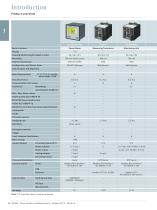
Introduction Product overview Configuration and Online View Data Analysis and Reporting Monitoring Unit Basic Measurement Measuring Transducer Power Meter Main Functions V, I, f, P, Q, S, energy, phase angle, cosφ Accuracy % (V, I) Programmable limit values Harmonics Min-, Max, Mean values Power Quality IEC 61000-4-30 EN 50160 Power Quality Data Waveform recording (see device specifications) Loud profile Transient capture Mean values Averaging intervals Sampling rate Recorders Limit Violation / Notification Mass storage 1 MB AC analog inputs (V / I) Binary outputs 2 + 6 (opt. with SICAM I / O...
Open the catalog to page 6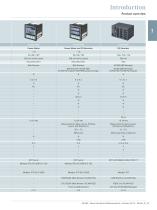
Introduction Product overview Power Meter Power Meter and PQ Recorder Web Browser / SICAM PQS / SICAM PQ Analyzer / SENTRON powermanager SICAM Q80 Manager / SICAM PQS / SICAM PQ Analyzer Measurements, Mean values, PQ Data, Events and Waveforms Measurements, Mean values, PQ Data and Waveforms SICAM – Power Quality and Measurements · Siemens SR 10 · Edition 4 1/7
Open the catalog to page 7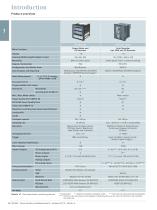
Introduction Product overview 1 SICAM Q100 Power Meter and PQ Recorder Main Functions SIPROTEC 7KE85 Fault Recorder opt. PMU and PQ Recorder switch panel, flush-, surface mounting Degree of protection Configuration and Online View Web Browser / SICAM PQS / SICAM PQ Analyzer / SENTRON powermanager* DIGSI 5 / SICAM PQS / SICAM PQ Analyzer Data Analysis and Reporting Basic Measurement V, I, f, P, Q, S, energy, phase angle, cosφ Accuracy % (V, I) Programmable limit values Harmonics Mean values EN 50160 Power Quality Data Flicker IEC 61000-4-15 Waveform recording (see device specifications) Loud profile...
Open the catalog to page 8
Power Quality devices for all applications SICAM P50 / P55 Power Meter
Open the catalog to page 9
Contents – SICAM P50 / P55 Page Function overview Measured values and tolerances Description of I / O modules Configuration software Typical terminal assignments Technical data Dimension drawings Selection and ordering data 7 The products and systems described in this catalog are manufactured and sold according to a certified management system (acc. to ISO 9001, ISO 14001 and BS OHSAS 18001). 8 2/2 SICAM – Power Quality and Measurements · Siemens SR 10 · Edition 4
Open the catalog to page 10All SIEMENS Energy automation and smart grid catalogs and technical brochures
 SIPROTEC Compact
220 Pages
 SICAM Q100
28 Pages
 Reyrolle 7SR51
2 Pages
 Reyrolle 7SR54
2 Pages
 7SR5 Platform
86 Pages
 Catalog - Bay Controller
8 Pages
 7SR17 Rho Motor Protection Relay
20 Pages
 7SR21 & 7SR22 Argus
2 Pages
 SIPROTEC 7SA86
2 Pages
 SIPROTEC 7SA87
2 Pages
 SIPROTEC 7SA82
2 Pages


Archived catalogs
 SICAM A8000 Series
11 Pages
 SICAM Substation Automation
190 Pages
 Reyrolle Product Catalogue
346 Pages
 Reyrolle 5 Platform
52 Pages
 Catalog SICAM CMIC
8 Pages
 7SC80 Brochure
8 Pages


- Measuring device
- Automation software solution
- Control software
- Switching relay
- Digital indicator
- Panel panel meter
- SIEMENS protection relay
- Interface software
- HMI
- HMI with touch screen
- Digital gauge
- Electromechanical relay
- Panel-mount HMI
- DC electromechanical relay
- Engineering software
- Manual test equipment
- Industrial test kit
- Ethernet programmable logic controller