

- Products
- Catalogs
- News & Trends
- Exhibitions
Distance Sensors

Distance Sensors
SICK displacement sensors utilize triangulation technology to measure small, millimeter-sized objects with high accuracy and speed. A laser diode projects a light spot onto the object, and the reflection is captured by a CMOS sensor to determine the distance based on the known geometry.
Applications
- Surface Analysis: Ensures quality standards for die-cast, drilled metal parts, and electronic components by checking surface quality and dimensional stability.
- Precise Positioning: Non-contact sensors position grippers and cutter heads with high repeatability, crucial for applications like thin-film solar cells and linear actuators.
- Process Regulation: Maintains correct distances in critical processes, such as soldering and measuring material thickness.
- Classification: Identifies and allocates components to specific models, important in assembly processes.
Product Comparison
The document compares various models like OD Value, OD Hi, OD Max, and OD Precision, highlighting their performance, interfaces, housing, and sensor head capabilities. Each model is designed for specific applications, offering different measurement ranges, resolutions, and repeatability.
Technical Specifications
- OD Value: Suitable for classifying components by dimensions, offering a compact stand-alone solution.
- OD Precision: Ideal for measuring surface planarity with high-end sensor systems.
- OD Max: Monitors manufacturing tolerances dynamically with high precision.
- OD Hi: Controls assembly processes with maximum precision.
Measuring Ranges and Interfaces
The sensors cover various measuring ranges from 24 mm to 1,000 mm, with repeatability as fine as 0.06 µm. They support multiple interfaces, including RS-422, RS-232, and USB, and are equipped with analog outputs for versatile applications.
Conclusion
SICK's displacement sensors offer a range of solutions for precise measurement and control in industrial applications, leveraging advanced laser and CMOS technology for high accuracy and reliability.
- Operating Conditions: The sensors operate between -20°C to +55°C and can be stored between -40°C to +60°C.
- Measurement Ranges: Available ranges from 24 mm to 700 mm, with specific models covering 26 mm to 400 mm.
- Laser Class: Utilizes Class 1 and Class 2 red lasers for measurement.
- Output: Offers analog outputs (4-20 mA, 0-10 V) and RS-422 for stand-alone use.
- Accuracy: High linearity up to ±0.5 mm and repeatability depending on the model.
- CMOS Technology: Ensures measurement accuracy independent of surface color or shininess.
- Compact Design: Stand-alone device with minimal space requirements and easy integration into production environments.
- User-Friendly Interface: LED-based setup and teach-in concept for quick installation.
- Advanced Settings: Includes averaging functions, external laser-off, and automatic sensitivity adjustment.
- Reliability: Non-contact measurement minimizes machine downtime and wear.
- Cost-Effective: Low investment costs enable regular quality inspections directly in the production process.
- Versatility: Multiple models and interfaces allow for flexible integration into various applications.
- Power Supply: Operates on DC 12 V to 24 V with a power consumption of ≤ 2.88 W.
- Environmental Resistance: Rated IP67 for enclosure protection, withstanding vibrations and shocks.
- Ambient Conditions: Operates effectively under artificial light up to 3,000 lx and sunlight up to 10,000 lx.
The OD Max is a highly accurate optical measuring system designed to connect two separate sensors into a single controller, allowing for precise measurement calculations. It is ideal for determining properties such as thickness or height differences of objects, even with fluctuating positions.
Key Features
- Measurement ranges from 24-26 mm to 250-450 mm.
- CMOS receiving element for surface-independent measurement.
- High measurement frequency and linearity.
- Laser technology for detecting small objects.
- Multiple output options.
Benefits
- Reliable on any surface, reducing machine downtime.
- Ensures high product quality with accurate measurements during production.
- High measuring frequency increases processing speeds and reduces cycle times.
- Cost-effective for challenging measuring tasks.
- Easy setup and servicing with an LC display and push-button keypad.
Technical Specifications
OD Max Sensor Head
- Response time: 0.5 ms.
- Measuring frequency: 10 kHz.
- Laser light source.
- Aluminum housing with glass lens.
- IP67 enclosure rating.
- Operating temperature: -10°C to +45°C.
OD Max Controller Unit
- Response time: 0.5 ms.
- Output rate: 0.1 ms.
- Arithmetic calculations and averaging settings available.
- RS-232 data interface.
- Polycarbonate and nylon 66 housing.
- IP20 enclosure rating.
Ordering Information
- OD25-01T1: Measuring range 24-26 mm, resolution 0.1 µm.
- OD30-05T1: Measuring range 25-35 mm, resolution 1 µm.
- OD85-20T1: Measuring range 65-105 mm, resolution 5 µm.
- OD350-100T1: Measuring range 250-450 mm, resolution 50 µm.
Dimensional Drawings
Detailed dimensional drawings are provided for each sensor model, illustrating the optical axis and connection ports.
Recommended Accessories
- Connection cables and terminal blocks for various configurations.
Additional Information
For further details, including technical data and dimensional drawings, refer to the specified pages in the document.
The document provides detailed information on the DT50 and DT50 Hi distance sensors from the Dx50 product family, designed for mid-range distance measurement. These sensors utilize HDDM technology for reliable performance and are suitable for various applications due to their measurement range and integration capabilities.
DT50 Sensor Specifications
The DT50 sensor offers a measurement range of up to 10 meters with analog and switching outputs. Key features include high switching repeatability, a tough die-cast zinc housing, and a wide operating temperature range from -30°C to +65°C. The sensor is immune to ambient light, making it suitable for challenging environments.
DT50 Hi Sensor Specifications
The DT50 Hi sensor provides enhanced precision and a longer measurement range of up to 20 meters. It features a compact design, fast measurement frequency, and high repeatability. The sensor is equipped with a red laser for precise alignment and is housed in a durable metal casing.
Technical Data
Both sensors have a resolution of 1 mm and offer various output options, including 4-20 mA analog output and PNP/NPN switching outputs. They are designed to withstand harsh environments with an IP65 enclosure rating and are protected against vibration and shock according to EN standards.
Installation and Setup
The sensors feature an intuitive setup process via display or remote teach, reducing installation time and costs. They also offer multifunctional inputs for laser control and external teaching.
Accessories
Recommended accessories include mounting brackets and various plug connectors and cables to facilitate installation and connectivity.
Conclusion
The DT50 and DT50 Hi sensors provide versatile and reliable solutions for distance measurement in industrial applications, offering a balance of performance, durability, and ease of integration.
- Precise detection at distances up to 10 meters for DS50 and up to 50 meters for DL50 using Time of Flight technology.
- Immune to ambient light, suitable for optically challenging environments.
- Wide operating temperature range (-30°C to +65°C) for outdoor use without additional cooling or heating.
- Intuitive setup via display or remote teach, reducing installation time and costs.
- Metal housing for durability in harsh environments, reducing replacement costs.
- Low investment costs with high performance for a quick return on investment.
- Resolution: 1 mm for both DS50 and DL50.
- Repeatability: 3 mm for DS50 and 2 mm for DL50.
- Accuracy: ±10 mm for DS50 and ±7 mm for DL50.
- Light Source: Red laser with typical light spot size of 15 mm x 15 mm at 10 m.
- Interfaces: Includes multifunctional input for laser off, external teach, and inactive modes.
- Enclosure Rating: IP 65 with protection class III.
- Power Supply: DC 10 V to 30 V with power consumption ≤ 1.85 W for DS50 and ≤ 2.1 W for DL50.
- DS50 features OBSB mode for detecting objects between the sensor and a taught background.
- DL50 offers analog output scaling and fast RS-422 output rate for high precision positioning.
- Mounting brackets and plates, plug connectors, and cables are available for both sensor models.
- Reflector plates and diamond grade reflective tape for enhanced performance.
The DL50 Hi mid-range distance sensor offers a resolution of 0.1 mm and repeatability of 0.5 mm, 0.3 mm, or 0.25 mm depending on settings. It has an accuracy of ±3 mm and a response time of 10 ms, 40 ms, or 160 ms. The sensor uses a red laser light source with a typical light spot size of 15 mm x 15 mm at 10 m. It features a multifunctional input/output, serial data output, and various switching modes.
Mechanical and Electrical Details:
The sensor operates on a supply voltage of 10 V to 30 V DC with a power consumption of ≤ 2.1 W. It has a die-cast zinc housing and an IP65 enclosure rating, suitable for operation in temperatures from -30°C to +65°C. The connection type is an M12, 8-pin connector.
Recommended Accessories:
Accessories include mounting brackets, reflector plates, and plug connectors. Specific models and part numbers are provided for each accessory type.
Setup and Configuration:
The DL50 Hi can be set up to activate continuous data output through a series of menu selections or via a serial command. The setup process involves switching to teach mode, selecting parameters, and activating the desired output.
Long Range Distance Sensors:
Long range sensors from SICK use time-of-flight technology for precise measurement over large distances, up to 1.2 km. They are designed for challenging environments and offer benefits such as high precision, speed, and reliability. Applications include positioning high-bay stacker cranes, container profiling, and slab measurement in the steel industry.
Applications and Benefits:
These sensors are suitable for various industries, providing precise measurement even in extreme conditions. They offer easy integration with multiple interfaces and robust housings for durability. The sensors are ideal for applications requiring long-range measurement and high accuracy.
- DME4000 Series:
- Measuring range: 0.15 m to 220 m
- Accuracy: ±5 mm to ±6 mm
- Repeatability: 2 mm to 3 mm
- Operating temperature: -10°C to +55°C
- Storage temperature: -25°C to +75°C
- Power consumption: <250 mA at 24 V DC
- Interface connections: SSI, PROFIBUS, RS-422, DeviceNet, HIPERFACE, CANopen
- DME5000 Series:
- Measuring range: 0.15 m to 300 m
- Accuracy: ±2 mm to ±5 mm
- Repeatability: 0.5 mm to 2 mm
- Operating temperature: -10°C to +55°C
- Storage temperature: -25°C to +75°C
- Power consumption: <250 mA at 24 V DC
- Interface connections: SSI, PROFIBUS, RS-422, HIPERFACE, DeviceNet
- High accuracy and repeatability
- Fast measurement cycles
- Multiple interface options for flexible integration
- Robust design with metal housing and optional heating/cooling accessories
- User-friendly display and menu for easy setup
- DME5000 Series: Offers a measuring range of 0.15 m to 300 m with accuracy varying from ±3 mm to ±5 mm depending on the model. The sensors operate at temperatures between -10°C to +55°C and can be stored at -25°C to +75°C. Power consumption is less than 250 mA at 24 V DC.
- DL100 Hi Series: Features a measurement range up to 300 m with accuracy from ±2 mm to ±3 mm. It operates in temperatures from -20°C to +55°C, with storage capabilities down to -40°C. The sensors are equipped with a laser light source and offer various fieldbus interfaces.
- Multiple connector types are available, including M12 and M16 configurations, supporting interfaces like SSI, PROFIBUS, RS-422, DeviceNet, and HIPERFACE.
- Special features include connectors with special frequencies for parallel mounting and options for high output rates through interpolation of measurement data.
- For optimal performance, a minimum warm-up time of 10 minutes is recommended.
- Operation with heating is supported for temperatures as low as -40°C.
- The DL100 Hi series offers enhanced closed-loop behavior, pre-failure diagnostics, and a rugged metal housing for reliable operation in harsh environments.
- SpeedCon™ compatible connectors ensure quick and easy installation.
The document provides detailed specifications and descriptions of various long-range distance sensors, specifically the DS500, DMT10-2, and DML40-2 models. These sensors are designed for use in challenging environments and offer a range of features to enhance performance and flexibility.
Specifications:
- DS500 Series: Operates in temperatures from -10°C to +50°C, with storage capabilities from -25°C to +75°C. Power consumption varies between 3W and 22W depending on the model. The sensors support PNP and NPN outputs with a range of up to 70 meters.
- DMT10-2 Series: Offers a measurement range from 0.5m to 155m on natural targets. Features include time-of-flight measurement, pilot laser for alignment, and various interfaces such as RS-422, RS-232, and PROFIBUS.
- DML40-2 Series: Capable of measuring up to 1,200m with a reflector. It includes similar features to the DMT10-2 but is designed for even longer distances.
Procedures and Adjustments:
The document outlines the procedures for sensor alignment and parameter programming. It includes details on the multifunctional input for teaching outputs and laser control.
Standards and Compliance:
The sensors comply with various standards, including laser protection class 1 and EMC standards. They are designed to operate in a wide range of environmental conditions, with IP65 enclosure ratings for protection.
Recommendations:
Recommended accessories include plug connectors, cables, and alignment brackets to facilitate installation and operation. The document suggests using specific models for different environmental challenges.
Key Diagrams and Tables:
Dimensional drawings and connection diagrams are provided for each sensor model, detailing the physical layout and electrical connections. Tables summarize technical data such as resolution, repeatability, and accuracy.
The document details the specifications of long-range distance sensors, specifically the DML40-2 series. These sensors support interfaces like RS-422, RS-232, and PROFIBUS DP, with switchable options. The alignment laser is always on for model DML40-2-1111S01.
Dimensional Drawings:
Dimensional drawings for models DML40-2-x1xx and DML40-2-x2xx are provided, with all measurements in millimeters and inches. Key components include a dust protection tube, laser pointer pilot light, alignment sight, and function indicator.
Connection Types and Diagrams:
The document includes connection diagrams for RS-232/RS-422 and RS-232/PROFIBUS configurations, detailing pin assignments and connector types.
Recommended Accessories:
Accessories such as reflector plates, serial RS-232 cables, and alignment brackets are recommended for optimal sensor performance.
Linear Measurement Sensors:
The OLM linear measurement sensor uses a barcode tape for positioning over distances up to 10 km. It offers high repeatability and resistance to shock and vibration, ensuring reliable operation without wheel slippage or recalibration.
Applications:
The OLM sensor is suitable for overhead conveyors, rotating rings, tables, and shuttles, providing precise positioning and flexibility in various industrial applications.
Product Family Overview:
The OLM series includes models OLM100, OLM100 Hi, and OLM200, each offering different performance levels and interface options. They support a wide temperature range and high-speed operations.
Benefits:
The sensors offer precise positioning, high throughput, and easy integration with various interfaces, making them cost-effective and reliable for industrial use.
The document provides detailed technical specifications and information for the OLM100 and OLM200 linear measurement sensors by SICK. These sensors are designed for precise positioning and measurement over long distances, with applications in various industrial settings.
Specifications
- OLM100: Features a measurement range of up to 10,000 meters, repeatability of 1 mm, and a maximum speed of 4 m/s. It operates with a red LED light source and has a service life of 100,000 hours. The sensor is housed in aluminum and zinc, with an IP65 enclosure rating.
- OLM100 Hi: An enhanced version with a repeatability of 0.15 mm and a maximum speed of 10 m/s. It also features a red LED light source and a similar service life. The sensor supports SSI interface for direct feedback into the drive.
- OLM200: Offers high precision with a repeatability of 0.15 mm and a maximum speed of 10 m/s. It includes a PROFIBUS interface for outputting position and speed data, and is designed for robust performance in challenging conditions.
Procedures and Installation
The document includes dimensional drawings and connection diagrams for proper installation. It emphasizes the importance of correct pin-to-wire color assignments when using non-standard cables.
Standards and Compliance
The sensors comply with EMC standards EN 61000-6-2 and EN 61000-6-4, and are designed to withstand vibration and shock as per DIN/EN standards.
Recommendations
Recommended accessories include bar code tapes, sliding nuts, and various connectors and cables for different configurations. The document suggests using specific accessories for optimal performance and compatibility.
Benefits
The sensors offer precise positioning, high-speed operation, and robust design for increased machine availability and reduced maintenance costs. They are suitable for use in a wide temperature range, enhancing their applicability in diverse environments.
1. Response Time: Dependent on resolution and transfer protocol.
2. LED MTTF: Typical at 25°C.
3. Interfaces: Maximum baud rate of 12 MBaud. Switching outputs include MF1 (PNP) and MF2 (NPN) with functions such as position, speed, and control mark.
4. Mechanics/Electronics: Supply voltage is DC 18 V to 30 V with a ripple ≤ 5 Vpp. Power consumption is less than 5.5 W. Initialization time is 3 seconds. Housing is made of aluminum and zinc, weighing approximately 510 g.
5. Ambient Data: Enclosure rating is IP 65. Operating temperature ranges from -30°C to +60°C, and storage from -40°C to +75°C. Vibration and shock resistance are compliant with DIN/EN standards.
1. Sensing Distance: Models include OLM200-1002 and OLM200-1052 with varying sensing distances and resolutions.
2. Connection Types: Includes Ethernet and Fieldbus connections with M12 connectors.
1. Bar Code Tapes: Available in various lengths for different sensing ranges.
2. Connectors and Cables: Various M12 connectors and Ethernet cables are available for different applications.
1. Technology: Uses ultrasonic time-of-flight measurement for detecting objects and measuring distances.
2. Applications: Suitable for detecting objects in challenging environments, including dusty or foggy conditions.
3. Product Family Overview: Includes models like UM30-2, UM18-2 Hi, UC12, and UC4, each with specific features and applications.
- Adjustable sensitivity and three operation modes: Distance to Object (DtO), Window (Wnd), and Object between sensor and background (OBSB).
- Reliable measurement independent of material color, transparency, gloss, and ambient light.
- Four sensing ranges up to 8,000 mm with high immunity to dirt, dust, humidity, and fog.
- Compact M18 metal housing with options for straight or right-angle versions.
- Analog voltage, analog current, or push-pull (PNP/NPN) switching output with IO-Link available.
- Fast and easy setup via IO-Link and/or teach-in via multifunction input.
- Integrated time-of-flight technology for detecting objects like glass, liquids, and transparent foils.
- Resolution: 0.18 mm with repeatability of ±0.15% and accuracy of ±1%.
- Response time/output rate varies from 50 ms/8 ms to 240 ms/60 ms depending on the model.
- Supply voltage: DC 9 V to 30 V with power consumption ≤ 2.4 W.
- Enclosure rating: IP 67 with an operational temperature range of -25°C to +70°C.
- UM30-211: Working range 30 mm to 250 mm, output rate 8 ms, weight 150 g.
- UM30-212: Working range 65 mm to 350 mm, output rate 16 ms, weight 150 g.
- UM30-213: Working range 200 mm to 1,300 mm, output rate 23 ms, weight 150 g.
- UM30-214: Working range 350 mm to 3,400 mm, output rate 43 ms, weight 210 g.
- UM30-215: Working range 600 mm to 6,000 mm, output rate 60 ms, weight 270 g.
- Easy machine integration due to compact size and various setup options.
- Multiplex mode eliminates cross-talk interference for consistent detection.
- Synchronization mode allows multiple sensors to work as one large sensor.
- Integrated temperature compensation ensures high measurement accuracy.
- UM30-2 Series: Features include multiple connection types with M12, 5-pin connectors, and various detection areas ranging from 100 mm to 2,400 mm. The sensors are suitable for different working ranges and limiting ranges, with specific configurations for aligned plates and pipe diameters.
- UM18-2 Hi Series: Offers a compact design with a short M18 metal housing. It supports four measuring ranges up to 1,300 mm and provides options for straight or right-angle versions. The series includes analog voltage, current outputs, and IO-Link capabilities.
- High measurement accuracy with integrated temperature compensation.
- Robust metal housing for enhanced durability and machine availability.
- Synchronization and multiplexing capabilities for using up to 10 sensors simultaneously.
- High immunity to environmental factors such as dirt, dust, humidity, and fog.
- Mounting brackets and plates for secure installation.
- Various plug connectors and cables, including straight and angled female connectors with different lengths.
- Resolution of 0.069 mm and repeatability of ±0.15%.
- Supply voltage range of 10 V to 30 V DC, with power consumption ≤ 1.2 W.
- Enclosure rating of IP 67, suitable for operation in temperatures from -25°C to +70°C.
- Double Sheet Detection: Utilizes ultrasonic technology to detect single, double, or missing sheets in printing applications. It offers color-independent detection and plug-and-play operation, enhancing quality and productivity.
- UM18 Sensor: Designed for easy installation with a short mounting distance of 40 mm. It reliably detects various materials, including transparent foils and thin metal sheets, without requiring configuration.
- Technical Specifications: The UM18 sensor operates with a typical ultrasonic frequency of 400 kHz, has a response time of 2.5 ms or 6.5 ms, and supports materials like paper, metal-laminated sheets, and corrugated cardboard.
- ISD System: Provides wireless communication via infrared data transmission, eliminating the need for trailing cables. It is suitable for storage and retrieval systems, offering a wear-free and cost-effective solution.
- Features: Includes adjustable carrier frequencies, PROFIBUS/Ethernet interfaces, and a transmission range of up to 300 meters. The system supports high data transmission rates and offers excellent ambient light safety and electromagnetic compatibility.
- Product Variants: The ISD300 and ISD400 models cater to different transmission range requirements, with integrated alignment aids and multiple fieldbus interfaces for flexible operation.
The ISD300 and ISD400 are infrared data transmission systems designed for wireless communication between vehicles and fixed stations. These systems offer a wear-free and flexible solution with bidirectional communication over long distances.
Specifications
- Transmission Range: Up to 300 m for ISD300 and 180 m for ISD400.
- Data Transmission Rate: Up to 2 Mbit/s for ISD300 and 3 Mbit/s for ISD400.
- Interfaces: Includes RS-485/PROFIBUS DP, Ethernet, RS-422/Interbus, Interbus fiber-optic, DH+/RIO, DeviceNet/CANopen.
- Enclosure Rating: IP 65.
- Operating Temperature: ISD300: –30 °C to +50 °C; ISD400: –40 °C to +55 °C.
- Light Source: LED, infrared (880 nm).
Features and Benefits
- Non-contact system eliminates wear and tear, ensuring high machine uptime and reduced maintenance costs.
- Wireless data transmission reduces installation times and costs by eliminating cables.
- High gain reserve and excellent ambient light safety ensure reliable data transmission.
- Fast and easy assembly with integrated 3-point mounting bracket.
- ISD400 offers an integrated optical and electronic alignment aid for fast installation.
Technical Data
- Supply Voltage: DC 18 V to 30 V.
- Housing Material: Metal.
- Weight: Approx. 1.2 kg for ISD300 and 0.9 kg for ISD400.
- EMC Compliance: EN 61000-6-2, EN 61000-6-4.
Ordering Information
Various models are available based on transmission range, ambient temperature, and power consumption. Each model requires a pair of devices for data transfer.
Accessories
Includes plug connectors and cables, such as M12 connectors and Ethernet patch cables, for various connection needs.
- DMP3: Designed for high-precision applications requiring relative positioning on a taught-in hole. It offers a sensing distance of 200 mm to 350 mm, repeatability of 0.15 mm, and operates at temperatures as low as -40°C. It features four switching outputs and a field of view of ±10°.
- DMP2: Utilizes a reflector for positioning with a sensing range of 200 mm to 2,000 mm. It also has a repeatability of 0.15 mm and provides both switching and analog outputs. The DMP2 is suitable for high-bay warehouses and operates within -25°C to +55°C.
- Increased productivity and reliability in storage and retrieval applications.
- Compensation for mechanical rack deviations and temperature-dependent variations.
- Fast commissioning and setup with easy teach-in procedures.
- Flexible use in various environmental conditions, including cold storage.
- DMP3: Operating mode is continuous, with a switching frequency of 20 Hz. It has an enclosure rating of IP54 and a protection class of III.
- DMP2: Offers a choice of continuous or triggered operating modes, with a switching frequency of 250 Hz. It has an enclosure rating of IP67 and a protection class of II.
The document outlines the connection types for DMP2 position finders, specifically using M12, 8-pin connectors. It emphasizes the importance of verifying pin to wire color assignments when using non-standard cables.
Details are provided on the detection area and sensing distances, with measurements ranging from 100x100 mm to 1000x1000 mm, and sensing distances from 0 to 2000 mm.
The operation principles are explained with specific tolerance values for different configurations of Q-X and Q-Y signals.
Includes mounting brackets, reflectors, and plug connectors. Specific models and part numbers are listed, such as the BEF-GH-DMH2 alignment unit and various reflectors like PL22-2 and PL80A.
The document highlights the importance of using compatible accessories for optimal sensor integration. It lists various connectors, cables, and mounting solutions tailored for different sensor applications.
For further accessories and dimensional drawings, references are made to additional pages and online resources.
This document provides a comprehensive overview of various technical aspects related to distance sensors, focusing on technologies such as CAN, CANopen, CMOS receivers, and more. It includes specifications, procedures, standards, and recommendations for the use and implementation of these technologies in different environments.
CAN and CANopen
CAN (Controller Area Network) is an asynchronous, serial bus system that connects devices like sensors and actuators. It is known for its real-time capabilities and cost-effectiveness, making it popular in automotive and automation sectors. CANopen is a protocol based on CAN, enhancing it with a structured communication protocol.
CMOS Receivers
CMOS receivers utilize the light-sensitivity of complementary Metal-oxide Semiconductors for precise distance measurements. They are typically used in short-range distance sensors based on triangulation.
Conformity and Standards
Conformity involves compliance with EU directives like EMC Directive 89/336/EEC and Low Voltage Directive 73/23/EEC. In the USA, compliance with OSH Act and NEC is required, with testing by Underwriters Laboratories.
Connection Diagrams
The document provides a detailed explanation of wire color abbreviations and their assignments in sensor connection diagrams.
Data Interfaces and Transmission
Distance sensors from SICK support various data interfaces such as SSI, PROFIBUS, CANopen, and more. The data transmission rate is measured in baud or bits/s.
Double Sheet Detection
SICK's double sheet detection sensors use ultrasonic technology to differentiate between single or double sheets of materials, offering advantages like insensitivity to color.
Electromagnetic Compatibility (EMC)
EMC describes a device's immunity to electromagnetic interference. SICK sensors adhere to strict in-house standards to ensure functionality under critical conditions.
Enclosure Rating
The IP rating indicates a device's protection against dust and water, with specific codes denoting the level of protection.
Frequency Filters
Frequency filters in SICK's sensors suppress certain frequency ranges to filter out interference, allowing accurate measurements.
HDDM Technology
HDDM (High Definition Distance Measurement) is used for precise pulse time-of-flight measurements in mid-range distance sensors.
IO-Link
IO-Link is a communication standard for automation technology, enabling effective machine operation through centralized control and monitoring.
Laser and LED Technologies
Lasers and LEDs are used in distance sensors for emitting light. Lasers provide precise, focused light spots, while LEDs offer cost-effectiveness and larger light spots.
Measuring Range and Frequency
The measuring range defines the operational distance of sensors, while the measuring frequency indicates the number of measurements per second.
Multiplexing and Mutual Interference
Multiplexing prevents interference between sensors by alternating measurements. Synchronization can also be used to avoid mutual interference.
- Operating Range: The distance within which stable sensor operation is guaranteed, between sender and receiver or sensor and object.
- Output Current: Maximum permissible current at a switching output.
- Output Rate: The update rate of the output signal, independent of moving averaging functions.
- Parity: A bit used in serial data transmission to detect errors, with options for even, odd, or no parity.
- Phase Correlation Measurement: Uses amplitude-modulated light to measure distance by phase shift, employing multiple frequencies for accuracy.
- Power Consumption: The electrical energy used by the sensor.
- PROFIBUS: A fieldbus for fast, time-critical applications, allowing control of sensors and actuators.
- Protection Class: Defined by DIN EN 61140, indicating safety measures against electric shocks.
- Pulse Time-of-Flight Measurement: Measures distance by timing light or ultrasonic pulses, using deterministic or statistical methods.
- Range: Maximum permissible distance between sender and receiver in certain applications.
- Real Time: System's ability to provide data within a determined time frame.
- Reflector: Used for measuring large distances by reflecting light from a mounted reflector.
- Remission: Diffuse reflection of light, measured as a degree of remission.
- Repeatability: Deviation between multiple measurements under identical conditions.
- Resolution: Smallest detectable change in object distance, relevant for vibration detection.
- Response Time: Maximum time for a sensor to react to a distance change, affected by averaging depth.
- Shock Resistance: Ensures sensor functionality after mechanical testing.
- Short-Circuit Protection: Prevents sensor damage from excessive output current.
- Speed Monitoring: Control function to detect if a defined speed is exceeded.
- Storage Banks: Allow storage of different parameter settings for various applications.
- Switching Frequency: Number of switching operations a sensor can perform in a time interval.
- Switching Modes: Different modes like DtO, OBSB, and Window for sensor operation.
- Switching Output: Differentiates between ON or OFF states, with normally open or closed configurations.
- Synchronization Function: Ensures simultaneous measurement by multiple sensors to avoid errors.
- Teach-in: Process to define a switching point using a reference object.
- Temperature Compensation: Measures to counteract temperature effects on distance measurement.
- Time-of-Flight Measurement: Measures distance by timing the travel of a laser pulse or light wave.
- Time-of-Flight: Utilizes phase correlation, single-pulse, or statistical pulse measurement to determine distance, minimally affected by surface properties.
- Triangulation: Projects a light spot onto a target, using the reflection to calculate distance based on known geometry.
- Ultrasonic Damping: Employs ultrasonic pulses to detect single or double sheets by analyzing signal damping.
- ON Delay: Suppresses short signals.
- OFF Delay: Extends signal duration for slower systems.
- One Shot Delay: Maintains signal for a fixed period regardless of input duration.
- Transmission: Describes light transparency, including scattered and mixed transmission.
- Trigger: Updates measured values at specific times, with options for sample-and-hold functionality.
- Vibration Resistance: Sensors are tested for reliable operation under mechanical stress.
- Warm-up Time: Necessary for achieving optimal sensor performance, typically 5 to 30 minutes.
- Enclosure Rating: IP ratings indicate protection against dust and water, with practical considerations for outdoor use.
- Analog Output Optimization: Adjusting 4-20 mA outputs can reduce control system costs.
- Current to Voltage Conversion: Achieved using resistors, providing a range of ~2 to 20 volts.
- Wiring Considerations: Proper use of PNP and NPN outputs, including pull-down and pull-up resistors.
- Response Time Calculation: Critical for dynamic processes, dependent on object size and speed.
- Hysteresis for Level Control: Allows single sensor use for maintaining levels by configuring hysteresis values.
- MTTFd and PFHd Values: Indicators of component reliability, with PFHd being the inverse of MTTFd.
- Optical Sensor Considerations: Differences between infrared and red light, and laser class distinctions.
A Class 1M laser is safe under normal conditions with a maximum power of less than 25 µW and a wavelength between 302.5 nm and 4,000 nm. Class 2 lasers, with a maximum power of less than 1 mW and wavelengths between 400 nm and 700 nm, are not dangerous for short exposure periods due to the eye's blink reflex.
Triangulation and Sensor Alignment
Triangulation requires both the laser beam and receiver to be aligned at the same level. For accurate measurements on reflective surfaces, sensors or objects should be tilted by approximately 3° to 5°.
Reflective Surfaces and Sensor Logic
Highly reflective surfaces can cause measurement errors. Adjusting the sensor or using control system logic can mitigate these issues. In OBSB mode, sensors can detect objects between the sensor and background.
Reflector Size Determination
The size of the reflector depends on the maximum measurement distance and sensor installation. Calculations for light spot size and reflector size are provided for various distances.
Optical Measurements Through Transparent Materials
Distance sensors can measure through transparent materials if certain conditions are met, such as the material being outside the measuring range and inclined away from the receiver.
Avoiding Sensor Interference
To prevent interference between optical sensors, they should be mounted parallel with sufficient distance or inclined away from each other. Some sensors have algorithms to prevent interference.
Refractive Index and Light Speed
The refractive index affects triangulation measurements. Typical indices for various media are provided. The speed of light varies by medium, and sensors are calibrated for air.
Laser Service Life and Temperature
Laser service life decreases with higher ambient temperatures. Cooling systems and switching off the laser can extend service life.
Preventing Lens Misting
Heating sensors in cold areas can prevent misting when moved to warmer areas.
Outdoor Use and Ultrasonic Sensors
Infrared light offers advantages in foggy or dusty conditions. Ultrasonic sensors have specific working and limiting ranges, and their performance is affected by environmental conditions.
Ultrasonic Sensor Interference
Minimum distances between ultrasonic sensors are necessary to prevent interference. Synchronization and multiplexing can help manage multiple sensors.
Sound Velocity and Temperature
The velocity of sound in air depends on temperature, with a formula provided for calculation.
Ultrasonic sensors require temperature compensation to maintain accuracy amidst ambient temperature changes. Sudden fluctuations can lead to incorrect measurements as the sensor takes time to detect internal temperature changes. Effective compensation requires the fluctuation to reach the sensor, not just the measuring area.
Ultrasonic Sensors in Gases:
Operating ultrasonic sensors in gases can result in significant measurement errors due to varying sound wave velocities and damping effects, particularly in gases like carbon dioxide. These sensors are optimized for use in normal atmospheric air.
Outdoor Use of Ultrasonic Sensors:
Ultrasonic sensors are resilient to outdoor conditions, withstanding wind speeds up to 160 km/h and minor effects from fog, dirt, dust, and light rain. For optimal performance, sensors should be mounted horizontally or slightly inclined downwards to prevent moisture accumulation.
Conversion Tables:
The document provides conversion tables for distance, area, and temperature units, facilitating accurate measurement conversions. It also includes reflectance values for different materials, indicating the intensity of light reflection, which is crucial for optical sensor measurements.
SICK AG Overview:
SICK AG is a leading manufacturer of sensor technology, with over 5,000 employees and a global presence. The company offers a wide range of products and services, including non-contact detection, safety solutions, automatic identification, and laser measurement technology. SICK provides comprehensive services through its LifeTime Services and application centers worldwide.
Global Presence:
SICK has subsidiaries in numerous countries, ensuring a strong global presence and accessibility to its products and services. Detailed addresses and additional representatives are available on their website.
Catalog excerpts

Distance Sensors Short range (displacement)/mid range/long range distance sensors, linear measurement sensors, ultrasonic sensors, double sheet detector, optical data transmission, position finders
Open the catalog to page 1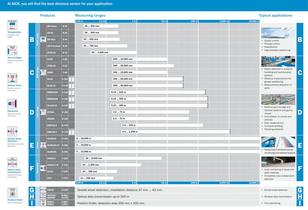
At SICK, you will find the best distance sensor for your application Precision with CMOS Short range Damping makes the difference Mid range Long range Double sheet detection Measure flexibly with sonic Optical data transmission Position finder 2-axis positioning •• Level monitoring of liquid and solid materials •• Completely color-independent detection Position Finder Double sheet detection, installation distance 37 mm ... 43 mm •• Double sheet detection Optical data transmission up to 300 m •• Wireless data transmission Position finder, detection area 300 mm x 300 mm •• Fine positioning •• Positioning...
Open the catalog to page 2
General information About SICK Short range distance sensors (displacement) Mid range distance sensors Long range distance sensors Linear measurement s ensors OLM100, OLM100 Hi, OLM200 Ultrasonic sensors Double sheet detector UM18 Optical data transmission Data Transmission Position finders Position Finder Glossary, tips & tricks Accuracy
Open the catalog to page 3
We deliver Sensor Intelligence. SICK sensor solutions for industrial automation are the result of exceptional edication d and experience. From development all the way to service: The people at SICK are c ommitted to investing all their expertise in providing with the very best sensors and system solutions possible. A company with a culture of success Approximately 5,000 people are on staff, with products and s ervices available to help SICK sensor technology users increase their productivity and reduce their costs. Founded in 1946 and headquartered in Waldkirch, Germany, SICK is a global...
Open the catalog to page 4
A B Innovation for the leading edge A corporate culture for sustainable excellence SICK sensor systems simplify and optimize processes and allow for sustainable production. SICK operates thirteen research and development centers all over the world. Co-designed with customers and universities, our innovative sensor products and solutions are made to give a decisive edge. With an impressive track record of innovation, we take the key parameters of modern production to new levels: reliable process control, safety of people and environmental protection. SICK is backed by a holistic, homogeneous corporate...
Open the catalog to page 5
Sensor Intelligence for all requirements SICK is a renowned expert in many industries, and is entirely familiar with the critical challenges they face. While speed, accuracy and availability take center stage in all industries, technical implementations vary greatly. SICK puts its vast experience to use to provide with precisely the solution you need. Hundreds of thousands of installations and applications go to prove that SICK knows the different industries and their processes inside out. This tradition of uncompromising expertise is ongoing: As we move into the future, we will continue to design,...
Open the catalog to page 6
For your specific industry For performance across the board With a track record of proven expertise in a great variety of industries, SICK has taken quality and productivity to new heights. The automotive, pharmaceutical, electronics and solar industries are just a few examples of sectors that benefit from our know-how. In addition to increasing speed and improving traceability in warehouses and distribution centers, SICK solutions provide accident protection for automated guided vehicles. SICK system solutions for analysis and flow measurement of gases and liquids enable environmental protection...
Open the catalog to page 7
SICK LifeTime Services For safety and productivity: SICK LifeTime Services SICK LifeTime Services is a comprehensive set of high-quality services provided to support the entire life cycle of products and applications from system design all the way to upgrades. These services increase the safety of people, boost the productivity of machines and serve as the basis for our customers’ sustainable business success. Benefit from an array of services Each of our products and solutions is accompanied by a comprehensive range of services tuned precisely to the requirements of the product or solution –...
Open the catalog to page 8
SICK LifeTime Services Training & Education Product & System Support •• User training •• Seminars •• WebTraining Consulting & Design Upgrade & Retrofits Verification & Optimization •• Barcode checks •• Consulting/Engineering service •• Inspection •• Maintenance •• Accident analysis •• Stop time measurement •• Noise measurement System inspection Risk assessment Safety concepts Feasibility studies Software and hardware design Commissioning Spare parts and repairs Remote support Hotline Machine conversion Sensor upgrades Sensor replacements Retrofitting of technology www.sick.com/service 8014441/2012-03-30...
Open the catalog to page 9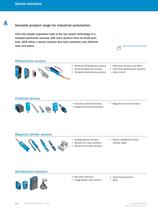
Sensor solutions Versatile product range for industrial automation From the simple acquisition task to the key sensor technology in a complex production process: with every product from its broad portfolio, SICK offers a sensor solution that best combines cost effectiveness and safety. Photoelectric sensors •• Miniature photoelectric sensors •• Small photoelectric sensors •• Compact photoelectric sensors •• Analog position sensors •• Sensors for T-slot cylinders •• Sensors for C-slot cylinders •• Bar code scanners •• Image-based code readers •• Hand-held scanners •• RFID Identification solutions...
Open the catalog to page 10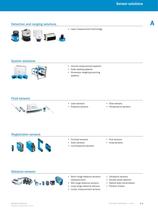
Sensor solutions Detection and ranging solutions •• Laser measurement technology System solutions •• Volume measurement systems •• Code reading systems •• Dimension weighing scanning systems Fluid sensors •• Level sensors •• Pressure sensors •• Flow sensors •• Temperature sensors Registration sensors •• Contrast sensors •• Color sensors •• Luminescence sensors •• Fork sensors •• Array sensors Distance sensors •• Short range distance sensors (displacement) •• Mid range distance sensors •• Long range distance sensors •• Linear measurement sensors 8014441/2012-03-30 Subject to change without notice...
Open the catalog to page 11All SICK catalogs and technical brochures
 W4F en
17 Pages
 IMS en
12 Pages
 SLG-2 en
14 Pages
 T-Easic® FTS
4 Pages
 IO-Link Supplement
5 Pages
 T-Easic FTS
56 Pages
 T-Easic® FTS
12 Pages
 FLOWSIC100 PROCESS
134 Pages
 SPEETEC 1D
6 Pages
 SPEETEC
2 Pages
 midiCam
5 Pages
 W4-3 PTFE
4 Pages
 Photoelectric laser sensors
20 Pages
 SMART SENSORS
48 Pages
 Photoelectric sensors_2019
20 Pages
 AHS/AHM36 SSI Inox
29 Pages
 STEEL INDUSTRY
8 Pages
 MultiPulse
37 Pages
 Safe Robotics Area Protection
32 Pages
 ENCODERS AND INCLINATION SENSORS
40 Pages
 EDS/EDM35
12 Pages
 G2F Photoelectric sensors
20 Pages
 TR110 Lock
20 Pages
 24-hour helpdesk
8 Pages
 outdoorScan3
20 Pages
 EnforceKey Single Door
84 Pages
 WTB16 Bluetooth®
135 Pages
 PET Pressure transmitter
44 Pages
 LFV 310/330
48 Pages
 WT18X-3P930
2 Pages
 T-Verteiler mit Taster
8 Pages
 Proximity Sensors
20 Pages
 Registration Sensors
24 Pages
 Top Products from SICK
486 Pages
 Advanced Automation Light Grids
92 Pages
 QAL3 Master
4 Pages
 MCS100FT FTIR Analysis System
12 Pages
 GM960 Boiler Wall Monitor
8 Pages
 Dust measuring devices
171 Pages
 Automation Light Grids
228 Pages
 Raw Gas Measurement
2 Pages
 TranspaTect product information
16 Pages
 GR18 product information
56 Pages
 SICK Essentials
118 Pages
 Magnetic Cylinder Sensors
164 Pages
 Presence Detection
170 Pages
 Industrial Safety Systems
1054 Pages
 Identification Solutions
308 Pages
 Fluid Sensors
174 Pages
 Encoders
388 Pages
 Detection and Ranging Solutions
124 Pages
 Zone control
5 Pages
 fiber-optic sensors
5 Pages
 PACKAGING2009/10
20 Pages


Archived catalogs
 Inductive proximity sensors
5 Pages
 Photoelectric sensors_2012
5 Pages
 W9-2 Small photoelectric sensors
7 Pages
 GM32 In-situ gas analyzer
8 Pages
 FLOWSIC 600
4 Pages
 MKAS Compact Analysis system
2 Pages
 MCS300P Superior in front
4 Pages
 Miniature photoelectric sensors
5 Pages
 3D cameras
6 Pages
 safety laser scanners
5 Pages
 Product overview Industrial Sensors
100 Pages
 News Factory Automation
8 Pages


