
- Catalogs
- Shimadzu France
- Quality Control of Hydrogen


Quality Control of Hydrogen
Quality Control of Hydrogen
The document discusses the growing importance of hydrogen energy, particularly in fuel cells for domestic use and fuel cell vehicles (FCVs). It emphasizes the need for strict purity standards, such as ISO 14687-2023, to prevent damage to fuel cell catalysts from impurities in hydrogen.
Shimadzu provides analytical instruments like gas chromatographs and mass spectrometers to detect trace impurities such as carbon monoxide and sulfur compounds, which are crucial for maintaining fuel cell efficiency.
Hydrogen carriers, including organic hydrides and ammonia, are essential for efficient hydrogen storage and transport, allowing hydrogen to be stored in liquid form or as a hydrogenated compound.
This phenomenon occurs when hydrogen atoms are absorbed by metals, reducing their ductility and strength. Shimadzu's instruments help test material strength and analyze corrosion and plating processes to prevent embrittlement.
Catalysts play a vital role in hydrogen production, improving efficiency and reducing costs. Shimadzu offers portable gas analyzers and electron probe micro-analyzers to evaluate catalyst performance and deterioration.
Hydrogen tanks in FCVs require high gas tightness, heat resistance, and pressure resistance. Materials like carbon fiber reinforced plastics are used to meet these requirements, with Shimadzu providing testing machines and analyzers to assess material characteristics and detect flaws.
Shimadzu's comprehensive solutions for hydrogen quality control ensure compliance with international standards and support the development of a sustainable hydrogen energy society.
The document details the use of a Micropacked ST column and a barrier discharge ionization detector (BID) with a gas chromatograph for high-sensitivity detection of carbon monoxide in hydrogen. It also describes methods for storing and transporting hydrogen efficiently.
Fourier Transform Infrared Spectrophotometer (FTIR) and Gas Chromatograph Mass Spectrometer (GC-MS) are used for real-time gas analysis and analyzing inorganic gases and hydrocarbons in hydrogen.
The document highlights the use of a barrier discharge ionization detector (BID) for analyzing ammonia in water, emphasizing its importance as a hydrogen carrier due to its energy density and ease of storage.
The TOC analyzer measures organic carbon in water using combustion catalytic oxidation, applicable in various fields including water quality control.
The document describes the use of a gas chromatograph with a BID for high-sensitivity analysis of ammonia and methylamine, suitable for monitoring impurities in ammonia used as a hydrogen carrier.
Ammonia's potential as a hydrogen carrier is highlighted due to its energy density and storage ease, with emphasis on impurity analysis to ensure high purity levels required for hydrogen applications.
The GC-MS system is used for analyzing organic solvents like toluene and methylcyclohexane (MCH) in solutions, crucial when MCH is used as a hydrogen carrier.
The document details the use of dual BID systems for high-sensitivity analysis of hydrogen in solutions and gases, allowing for quick and sensitive detection of inorganic gases and low-level hydrocarbons.
The document discusses the evaluation of fatigue life and mechanical characteristics of gaskets using a Servopulser dynamic and fatigue testing machine, highlighting the ease of operation and wide test space.
Displacement gauges were used to measure changes in the distance between compression plates, providing accurate measurements of specimen deformation. The document also details the use of a microfocus X-ray CT system to observe corrosion in copper pipes.
The document describes several products, including the EHF-E Series Servopulser Fatigue and Endurance Testing Machine, the inspeXio SMX-225CT FPD HR Plus Microfocus X-ray CT System, and the CGT-7100 Transportable Gas Analyzer.
The document emphasizes the importance of evaluating mechanical characteristics of gaskets and the deterioration of metals due to hydrogen embrittlement, highlighting the benefits of using advanced imaging and analysis systems.
Tables and figures provide detailed measurement results, including peak values of stroke and displacement gauge waveforms, corrosion state comparisons, and quantitative analysis of plating thickness.
The CGT-7100 transportable gas analyzer measures concentrations of CO and CO2 in exhaust gas samples, crucial for evaluating the reforming capacity of catalysts used in steam reforming processes.
The EDX-7200 spectrometer analyzes the elemental composition of samples, providing rapid measurements and determining deposition and plating thickness in multilayer samples.
The EPMA-8050G is used for high-sensitivity analysis of solid samples, evaluating the distribution of elements in membrane electrode assemblies (MEA) and automotive three-way catalysts.
The document highlights the importance of advanced analytical techniques in assessing catalyst performance and material composition, providing valuable insights into the efficiency and longevity of catalysts used in various industrial applications.
The CFRTP sample was analyzed using a microfocus X-ray CT system, revealing fiber orientation crucial for understanding the mechanical properties of the material.
Using X-ray photoelectron spectroscopy (XPS), differences in the chemical state of platinum in electrode catalyst layers were observed, indicating deterioration over time.
Ultrasonic optical flaw detection was used to inspect adhesive surface delamination between CFRP and stainless steel.
Numerical material testing (NMT) was conducted using structural data from X-ray CT measurements, improving the reliability of structural analysis models for composite materials.
The document emphasizes the importance of advanced imaging and spectroscopic techniques in analyzing the structural and chemical properties of materials, enhancing the understanding of material behavior.
The document presents a comprehensive analysis of the modulus of longitudinal elasticity for composite materials, focusing on Carbon Fiber Reinforced Plastics (CFRP).
Two models were compared, with Model 2 incorporating structural data from microfocus X-ray CT achieving a higher agreement with actual measurements.
Ultrasonic Optical Flaw Detection and X-ray Fluoroscopy were used to detect defects in CFRP and stainless steel materials.
Inspection of adhesive surface delamination and evaluation of fracture toughness in CFRP laminates were conducted.
The TMA-60 measures thermal expansion and shrinkage of polymer materials, crucial for evaluating materials used in hydrogen tanks.
The document emphasizes the importance of accurate structural analysis models for composite materials, highlighting the benefits of using advanced imaging and testing techniques.
Various high-polymer materials were analyzed for thermal expansion and shrinkage, focusing on their linear expansion coefficients.
Two separator films were evaluated, with Film A exhibiting higher heat resistance and Film B showing less shrinkage.
The TMA is capable of evaluating materials with various shapes and can perform measurements from temperatures as low as -150 °C.
Figures illustrate measurement results for polyethylene sheets and separator films, as well as test specimens and results related to delamination.
The document includes a disclaimer regarding the availability of products and trademarks, emphasizing that the information is provided "as is" without warranty.
Catalog excerpts
Quality Control of Hydrogen
Open the catalog to page 1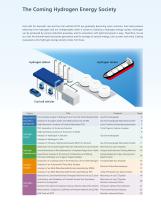
The Coming Hydrogen Energy Society Fuel cells for domestic use and fuel cell vehicles (FCV) are gradually becoming more common. Fuel cells produce electricity from hydrogen and are indispensable when it comes to realizing a hydrogen energy society. Hydrogen can be produced by various industrial processes, and its conversion with electrical power is easy. Therefore, its use as a fuel for thermal electrical power generation and for storage of natural energy, such as solar and wind, is being evaluated as the hydrogen energy society comes into focus. Measurement of Trace Impurity Analysis of Hydrogen...
Open the catalog to page 2
Analysis of Impurities in Hydrogen Impurities in hydrogen production affect subsequent industrial processes. Consequently, strict purity standards have been defined for hydrogen used in fuel cells (ISO 14687-2023). This is because if hydrogen contains carbon monoxide, sulfur components, etc., the catalyst of the fuel cell will be damaged. The hydrogen fuel standard for FCVs (ISO 14687 Type II Grade D) defines many items to be controlled, and Shimadzu analytical instruments can play a role in analyzing these items. Total Hydrocarbons (except CH4) Total sulfur compounds Halogen compounds ISO14687-2023...
Open the catalog to page 3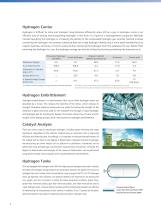
Hydrogen Carrier Hydrogen is difficult to store and transport long distances efficiently when left as a gas. A hydrogen carrier is an efficient way of storing and transporting hydrogen in the form of a liquid or a hydrogenated compound. Methods include liquefying the hydrogen or increasing the density of the compressed hydrogen gas. Another method involves converting the hydrogen into another substance that has a high hydrogen density and is more easily handled (such as organic hydrides, ammonia, or formic acid) and then removing the hydrogen from this substance for use. Rather than removing...
Open the catalog to page 4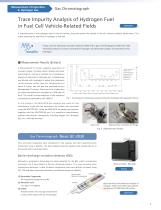
Measurement of Impurities in Hydrogen Gas Trace Impurity Analysis of Hydrogen Fuel in Fuel Cell Vehicle-Related Fields If impurities exist in the hydrogen used in fuel cell vehicles, they may poison the catalyst in the cell, reducing catalytic performance. This makes analyzing for impurities in hydrogen a vital task. Using a barrier discharge ionization detector (BID) with a gas chromatograph enables the highsensitivity analysis of carbon monoxide in hydrogen and the batch analysis of impurities in the ■ Measurement Results (Extract) A Micropacked ST column supports separation of inorganic gasses,...
Open the catalog to page 5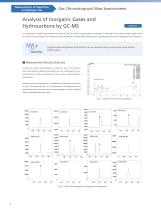
Measurement of Impurities in Hydrogen Gas Gas Chromatograph Mass Spectrometer Analysis of Inorganic Gases and Hydrocarbons by GC-MS It is important to measure hydrocarbons as well as N2, N2O and other inorganic gases in hydrogen. If hydrogen fuel contains inorganic gases such as N2 and N2O or hydrocarbons, the internal fuel cell mechanism will deteriorate. Measurement of both gases contained in hydrogen is also important. Inorganic gases and gaseous hydrocarbons can be measured using a porous layer open tubular (PLOT) column. ■ Measurement Results (Extract) A total ion current chromatogram is...
Open the catalog to page 6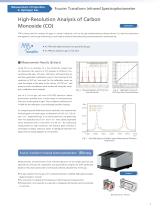
Measurement of Impurities in Hydrogen Gas Fourier Transform Infrared Spectrophotometer High-Resolution Analysis of Carbon Monoxide (CO) FTIR is being used for analysis of gases in various industries, such as the gas manufacturing industry where it is used for production management, and for gas monitoring in such fields as chemical manufacturing and semiconductor manufacturing. • An FTIR with high-resolution can quantify the gas. • An FTIR can analyze a gas in real time. ■ Measurement Results (Extract) Correction Height Using CO as an example of a low-molecular weight gas, we measured the spectra...
Open the catalog to page 7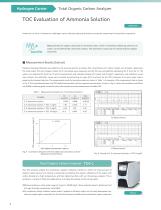
Hydrogen Carrier Total Organic Carbon Analyzer TOC Evaluation of Ammonia Solution Application Ammonia is a focus of interest as a hydrogen carrier. Because high-purity levels are required, measuring for impurities is important. Measurements of organic impurities in ammonia water, which is formed by dissolving ammonia in water, can be performed using TOC analysis. This provides an easy way of monitoring the organic ■ Measurement Results (Extract) Potassium hydrogen phthalate was added to a 2% ammonia solution to achieve TOC concentrations of 1 mgC/L, 5 mgC/L, and 10 mgC/L, respectively. The total...
Open the catalog to page 8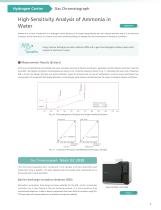
Hydrogen Carrier High-Sensitivity Analysis of Ammonia in Water Ammonia is a focus of attention as a hydrogen carrier because of its large energy density per unit volume and how easy it is to store and transport. At the same time, it is known to be toxic and bad smelling, so leakage into the environment is viewed as a problem. Using a barrier discharge ionization detector (BID) with a gas chromatograph enables a ppm-order analysis of ammonia in water. ■ Measurement Results (Extract) Ammonia and methylamine were diluted with water to prepare solutions at 4.8 ppm and 24 ppm, respectively, and the...
Open the catalog to page 9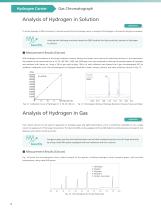
Hydrogen Carrier Analysis of Hydrogen in Solution Application To use the hydrogen in MCH or ammonia, it must be removed from the hydrogen carrier, so analyses of the hydrogen in the solution and gas are necessary. Using barrier discharge ionization detectors (BID) enables the high-sensitivity analysis of hydrogen ■ Measurement Results (Extract) With hydrogen and methane as the target analytes, hexanes, toluene and water were used as the dissolving solutions in this experiment. Gas samples at the concentrations of 10, 50, 100, 500, 1,000, and 5,000 ppm (v/v) were prepared by diluting the standard...
Open the catalog to page 10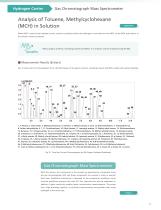
Hydrogen Carrier Gas Chromatograph Mass Spectrometer Analysis of Toluene, Methylcyclohexane (MCH) in Solution When MCH is used as the hydrogen carrier, toluene is produced when the hydrogen is removed from the MCH, so the MCH and toluene in the solution must be analyzed. Many organic solvents, including toluene and MCH, in a solution can be analyzed using GC-MS. benefits ■ Measurement Results (Extract) Fig. 15 shows the TIC chromatogram from a GC-MS analysis of 56 organic solvents, including toluene and MCH, eluted with carbon disulfide. 1. n-Hexane, 2. Ethyl ether, 3. Methylcyclohexane, 4. Acetone,...
Open the catalog to page 11All Shimadzu France catalogs and technical brochures
 Manual Non-Shift Wedge Grips
3 Pages
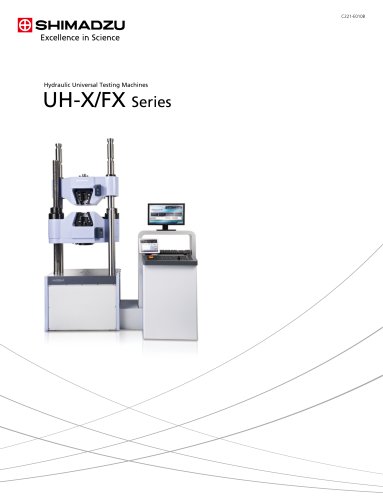 UH-X/FX
20 Pages
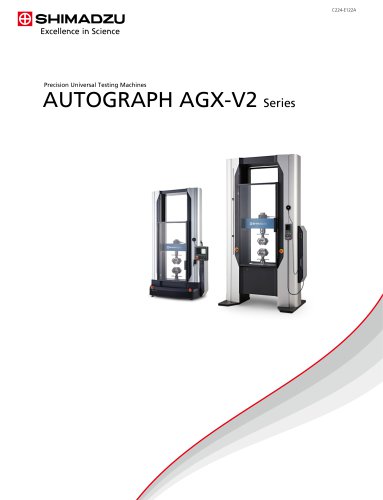 AUTOGRAPH AGX-V2
28 Pages
Archived catalogs
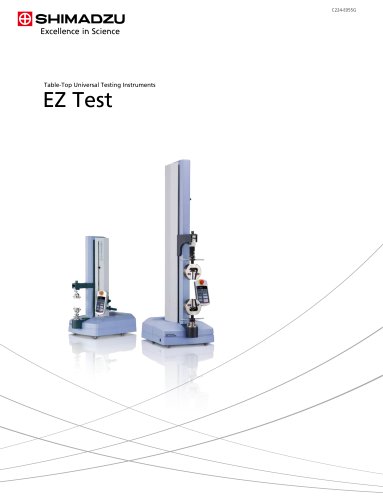 EZ Test
20 Pages
- Test cabinet
- Industrial camera module
- Concentration analyzer
- Monitoring analyzer
- Analysis software solution
- Liquids analyzer
- Infrared imager
- Windows software
- Microscope
- Shimadzu automatic testing machine
- Shimadzu material testing machine
- Temperature test chamber
- Indentation hardness tester
- Solids analyser
- Quality control test cell
- Shimadzu digital scale
- Computer-controlled test machine