
- Catalogs
- Shimadzu France
- Lipid and Fatty Acid Analysis Solutions


Lipid and Fatty Acid Analysis Solutions
Lipid and Fatty Acid Analysis Solutions
This document provides an overview of lipid and fatty acid analysis techniques, focusing on LC-MS/MS and GC-MS methods. These techniques are crucial for analyzing cell membrane structures, energy storage, and signaling processes.
Lipids Overview
Lipids, soluble in nonpolar solvents, are categorized into eight classes, including fatty acyls and phospholipids. They play significant roles in biological systems.
Fatty Acids Analysis
Fatty acid analysis is vital in food, clinical, and chemical industries. LC-MS/MS is sensitive for trace analysis but cannot distinguish isomers, while GC-MS is effective for analyzing fatty acid esters and separating isomers.
Instrument Comparison
LC-MS is preferred for short-chain fatty acids and phospholipid headgroups, whereas GC-MS excels in separating isomers and analyzing fatty acid compositions.
LC/MS/MS Method Package for Bile Acids
This package offers optimized conditions for analyzing 49 bile acids, enabling high throughput and sensitivity without additional method development.
LC/MS/MS MRM Library for Triglycerides
The method analyzes 47 triglycerides in blood within 11 minutes, aiding in biomarker discovery and inter-sample differences detection.
Conclusion
The document emphasizes selecting appropriate analytical techniques for lipid and fatty acid analysis, highlighting the strengths and limitations of LC-MS/MS and GC-MS methods.
Quantitative Analysis of Bile Acids
The document discusses the LC/MS/MS Method Package for Bile Acids Ver. 2, which includes optimized conditions for high throughput and sensitivity in bile acid separation.
Methodology
Using 10 internal standards and optimized HPLC conditions, the method achieves high sensitivity and throughput, particularly for colanic acid structure.
Results
The method allows rapid profiling of 39 bile acids, with data on accuracy and MRM chromatograms included.
Triglyceride Analysis
The document details a method for analyzing triglycerides in blood, providing quantitative information useful for biomarker discovery.
Phospholipid Profiling
The LC/MS/MS MRM Library analyzes phospholipids, employing an omics approach to evaluate metabolic changes.
Glucosylceramide Analysis
Using SFC and ELSD, glucosylceramides in supplements are analyzed safely and efficiently, with carbon dioxide as a mobile phase.
Conclusion
The document presents advanced methods for analyzing bile acids, triglycerides, phospholipids, and glucosylceramides, highlighting their applications in research.
Quantification of Glucosylceramides in Supplements
Glucosylceramides in supplements are quantified using SFC and ELSD, improving safety and efficiency.
Sample and Instrument Configuration
Over-the-counter supplements are analyzed using the Nexera UC SFC System.
Fatty Acids Analysis Using GC-MS
PCI-MRM is more sensitive than EI-MRM for fatty acid analysis in foods, with the Smart EI/CI ion source allowing mode switching.
Short-Chain Fatty Acids Analysis in Plasma
Derivatization with DMT-MM and n-octylamine allows GC-MS analysis of short-chain fatty acids.
LC/MS/MS Method for Primary Metabolites
The LCMS-8060NX system analyzes hydrophilic metabolites in saliva, with protocols for sample preparation included.
Short-Chain Fatty Acids in Feces
LC-MS evaluates the effects of gut microbiota on short-chain fatty acids in feces.
Introduction
The document discusses the analysis of short-chain fatty acids and organic acids in fecal samples and hydrophilic metabolites in saliva using LC/MS techniques.
Short-Chain Fatty Acids Analysis
Derivatization with 3-NPH enhances retention and sensitivity in LC/MS analysis of volatile and hydrophilic compounds.
Hydrophilic Metabolites in Saliva
The LCMS-8060NX system analyzes hydrophilic metabolites, using derivatization for improved detection.
Lipid Mediators Analysis
A metabolic map of eicosanoid metabolites aids in comparative analysis in human plasma and serum.
Instrumentation and Methodology
Analyses are conducted using LCMS-8060 and LCMS-8060NX systems, with sample preparation protocols included.
Conclusion
The document provides comprehensive methodologies for metabolite analysis using LC/MS techniques, emphasizing derivatization for improved sensitivity and retention.
Catalog excerpts
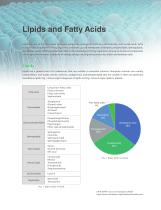
Lipids and Fatty Acids Lipids are one of the four major biological substances, along with proteins, carbohydrates, and nucleic acids. Fatty acids are also important in living organisms and make up cell membranes (examples: phospholipids, sphingolipids, cholesterol esters). Both play essential roles in the physiology of living organisms, serving as structural components of biological membranes, mediators of energy storage, and signaling molecules within and between cells. Lipids are a general term for substances that are soluble in nonpolar solvents. Nonpolar solvents are usually hydrocarbons,...
Open the catalog to page 2
Fatty Acids Fatty acid analysis is used in a variety of fields, including food, clinical, and chemical. LC-MS/MS or GC-FID (or GC-MS) is commonly used in fatty acid analysis, and instruments are selected based on analytical purposes and target species. A simple comparison is shown in Fig. 3 and 4. Fig. 4 Instrument comparison based on fatty acid types, sensitivity, and sample preparation • GC-MS is suitable for analyzing the constituent fatty acids in fatty acid esters (e.g., wax, glycerides, and phospholipids), a form in which fatty acids are abundant in the body, as well as free fatty acids,...
Open the catalog to page 3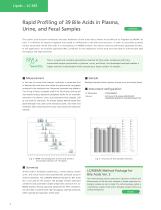
Lipids - LC-MS The colanic acid structure constitutes the basic backbone of bile acids and is known to be difficult to fragment by MS/MS. As such, it is difficult to measure fragment ions based on differences in the bile acid structure. In order to accurately quantify various structurally similar bile acids in a simultaneous LC-MS/MS analysis, the isomers must be sufficiently separated by HPLC. In this application, we carefully optimized HPLC conditions for the separation of bile acids and were able to achieve both high throughput and high sensitivity. This is a rapid and versatile quantitative...
Open the catalog to page 4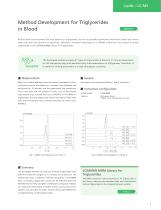
Lipids - LC-MS Routine blood tests estimate the total amount of triglycerides, but do not provide quantitative information about the various fatty acids that are bound to triglycerides. Therefore, Shimadzu developed an LC-MS/MS method for the analysis of blood triglycerides as the LC/MS/MS MRM Library for Triglycerides. The developed method analyzes 47 types of triglycerides in blood in 11 minutes (equivalent to 130 analyses per day) and identifies fatty acid combinations in triglycerides. Therefore, it is useful for finding biomarkers in a high-throughput screening. Two types of human plasma...
Open the catalog to page 5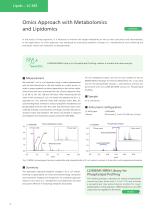
Lipids – LC-MS Omics Approach with Metabolomics and Lipidomics In the study of living organisms, it is necessary to monitor the target metabolites as well as their precursors and intermediates. In this application, an omics approach was employed by evaluating metabolic changes (i.e., metabolomics) and combining the evaluation results with lipidomics on phospholipids. LC/MS/MS MRM Library for Phospholipid Profiling realizes a trouble-free data analysis. For the metabolite analysis, the non-ion pair method of the LC/ We cultured E. coli in a jar fermenter using a media supplemented with 50 mM thiosulfate...
Open the catalog to page 6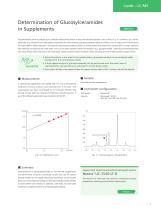
Lipids – LC-MS Determination of Glucosylceramides in Supplements Glucosylceramides cannot be analyzed by an ultraviolet-visible (UV-VIS) detector as they have little light absorption. Also, in terms of LC, It is common to use a normalphase mode (e.g., chloroform as a mobile phase) and determine the total content because glucosylceramide species vary widely. In such an analysis, the molecular species are eluted together without separation. The Evaporative Light Scattering Detector (ELSD) is a versatile detector that measures the scattered light of a target component after atomizing and vaporizing...
Open the catalog to page 7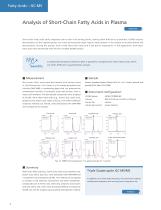
Fatty Acids – GC-MS Analysis of Short-Chain Fatty Acids in Plasma Application Short-chain fatty acids easily evaporate due to their low boiling points, making them difficult to quantitate. GC/MS requires derivatization of the hydroxyl group, but many derivatization steps require water present in the sample to be dried before the derivatization. During this process, much of the short-chain fatty acid is lost due to evaporation. In this application, short-chain fatty acids were derivatized with amines to enable GC/MS analysis. A simple derivatization method makes it possible to analyze short-chain...
Open the catalog to page 8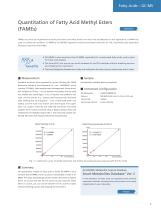
Fatty Acids – GC-MS Quantitation of Fatty Acid Methyl Esters (FAMEs) FAMEs are prone to fragmentation during ionization and many similar low mass ions are detected. In this application, CI-MRM was used to combat this problem. CI-MRM by GC-MS/MS fragments ionized protonated molecules by CID, improving mass separation between impurities and FAMEs. • PCI-MRM is more sensitive than EI-MRM, especially for unsaturated fatty acids, and is ideal for fatty acid analysis. • The Smart EI/CI ion source can switch between EI and PCI methods without breaking vacuum • The Smart Metabolites Database and a fatty...
Open the catalog to page 9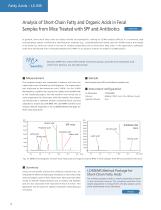
Fatty Acids – LC-MS Analysis of Short-Chain Fatty and Organic Acids in Fecal Samples from Mice Treated with SPF and Antibiotics In general, short-chain fatty acids are highly volatile and hydrophilic, making an LC/MS analysis difficult in a commonly used reversed-phase system. Furthermore, derivatization methods (e.g., trimethylsilylation) widely used for GC/MS require the sample to be dried out, which can result in the loss of volatile components such as short-chain fatty acids. In this application, carboxylic acids were derivatized with 3-nitrophenylhydrazine (3-NPH) in an aqueous solution...
Open the catalog to page 10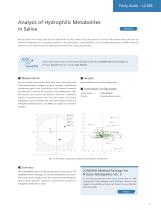
Fatty Acids – LC-MS Analysis of Hydrophilic Metabolites in Saliva Because short-chain fatty acids are not retained on an ODS column, they are prone to co-elute with sample matrix and are less sensitive to detection by a mass spectrometer. In this application, a derivatization with 3-nitrophenylhydrazine (3-NPH) enhanced retention on an ODS column and improved sensitivity with a mass spectrometer. Short-chain fatty acids can be easily analyzed using the LC/MS/MS Method Package for Primary Metabolites Ver. 3 and LCMS-8060NX. For the analysis of short-chain fatty acids, saliva was mixed with Saliva...
Open the catalog to page 11All Shimadzu France catalogs and technical brochures
 LCMS-2050
16 Pages
 MCT Series
12 Pages
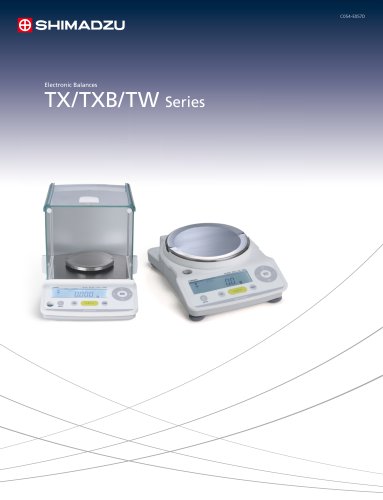 TX/TXB/TW Series
8 Pages
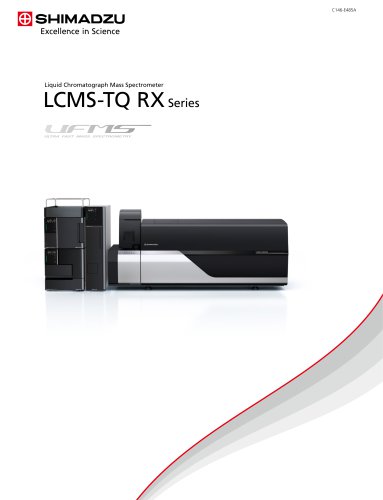 LCMS-TQ RX Series
16 Pages
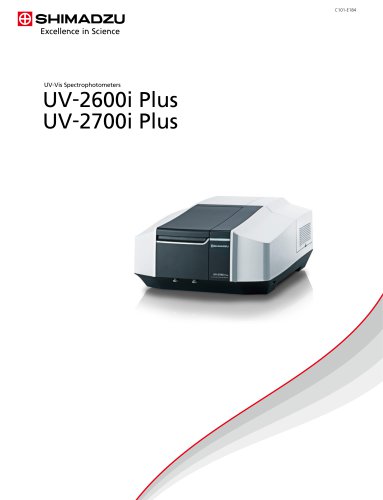 UV-2600i Plus /UV-2700i Plus
20 Pages
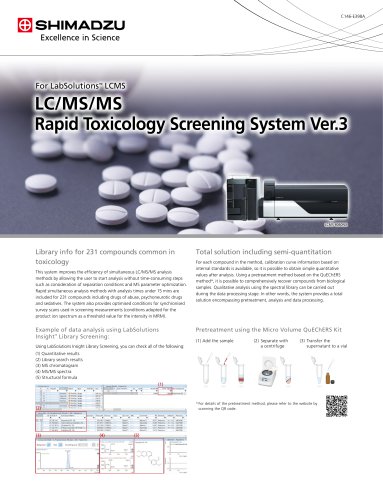 LC/MS/MS
2 Pages
 AUTOGRAPH AGX-V2 Series
28 Pages
 Metabolomics Product Portfolio
24 Pages
 Nexera UC/Nexera UC Prep
20 Pages
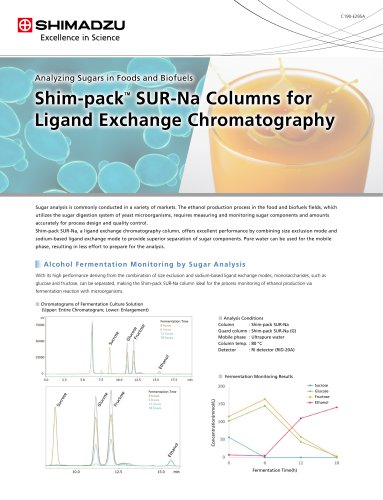 Shim-pack ™ SUR-Na Columns
2 Pages
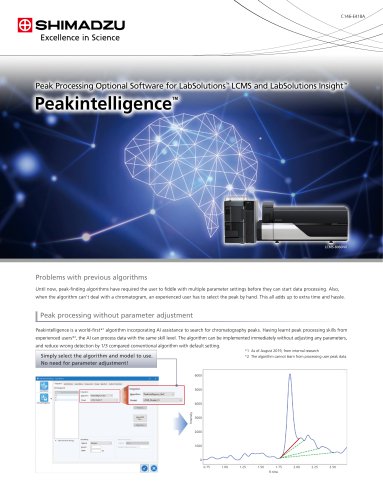 Peakintelligence
2 Pages
 Servo Controller 4830
12 Pages
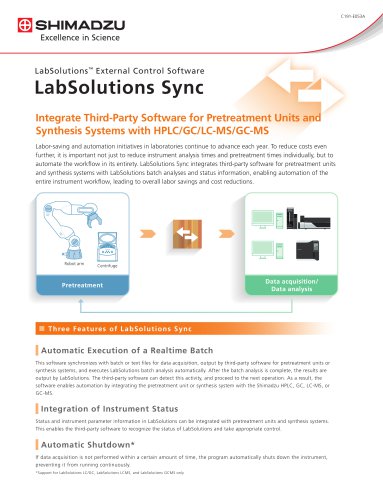 LabSolutions Sync
2 Pages
 LabSolutions Detect
8 Pages
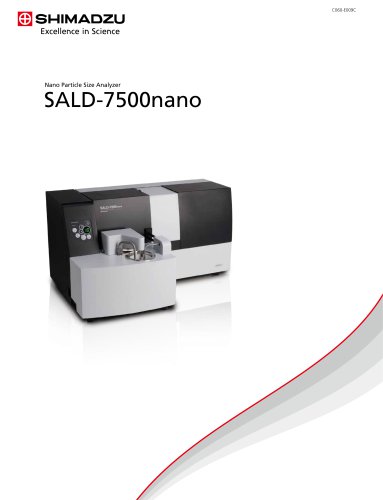 SALD-7500nano
16 Pages
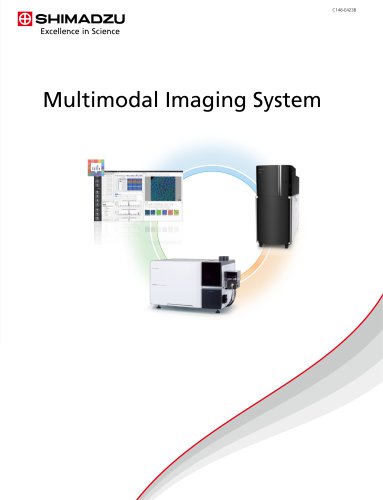 Multimodal Imaging System
4 Pages
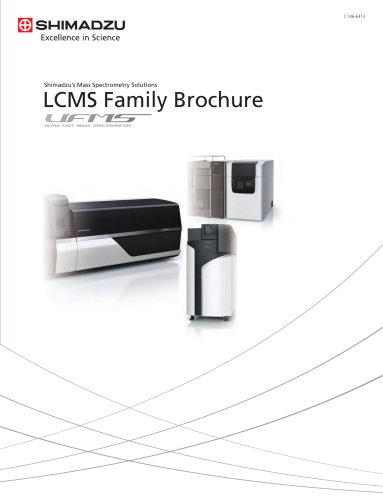 LCMS Family Brochure
12 Pages
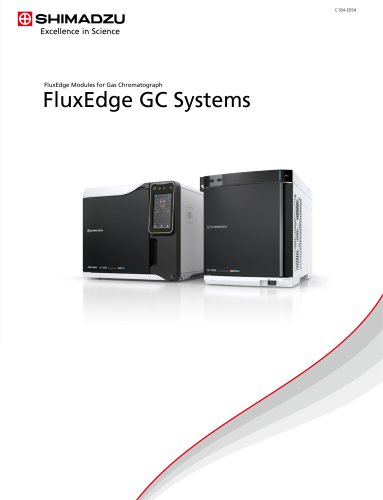 FluxEdge GC Systems
8 Pages
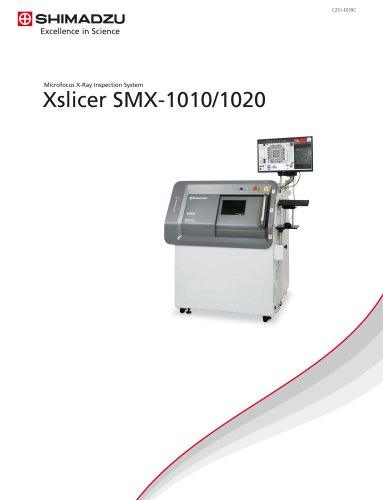 Xslicer SMX-1010/1020
16 Pages
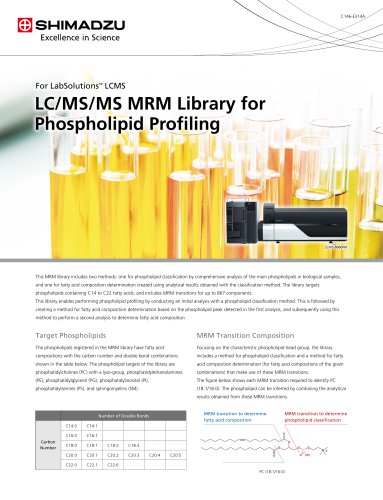 LC/MS/MS MRM
2 Pages
 LC/MS/MS
2 Pages
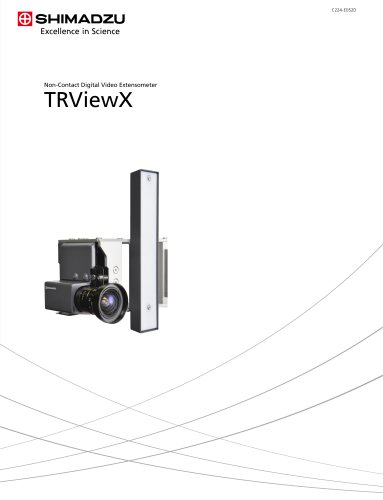 TRViewX
8 Pages
 UW/UX Series
4 Pages
 LCMS-8060
20 Pages
 QC Reporter
6 Pages
 OneSight
4 Pages
 TD-30 Series
12 Pages
 Nexis GC-2030
20 Pages
 ATX/ATY series
4 Pages
 MOC63u
6 Pages
 UHPLC Nexera X2
20 Pages
 TOC-L
TOC-L16 Pages
 RF-6000
24 Pages
 iMScope Trio
28 Pages
 ICPE-9800 series
20 Pages
 UV-3600 Plus
26 Pages
 EDX-7000/8000
24 Pages
 Capillary GC-2010 Plus
24 Pages
 GCMS QP2010 Ultra
24 Pages
 LCMS-IT-TOF
16 Pages
 Headspace Sampler HS-20
8 Pages
 BW-K/BX-K Series
2 Pages
 Catalog MOC 120H
4 Pages
 ELB SERIES
2 Pages
 TW TWC SERIES
8 Pages
 AUW-D/AUW/AUX/AUY Series
8 Pages
 Catalog UW-Series
6 Pages
 Catalog AU-Series
8 Pages
 MDGC-2010 system
1 Page


Archived catalogs
 TOC-4110
1 Page
 Catalogue HMV-2 Series
8 Pages
 Shimadzu FTIR Overview
4 Pages
 Shimadzu Software Overview
8 Pages
 Shimadzu GC/GCMS Overview
6 Pages
 Shimadzu LC/LCMS Overview
12 Pages
 Shimadzu X-ray Fluorescence
2 Pages


- Shimadzu testing machine
- Digital imager
- Visible imager
- Test cabinet
- CMOS camera module
- Industrial camera module
- Concentration analyzer
- Management software solution
- Monitoring analyzer
- Shimadzu analysis software
- Infrared imager
- Automatic analyser
- Temperature test chamber
- Real-time software
- Microscope
- Shimadzu material testing machine
- Shimadzu automatic testing machine
- Indentation hardness tester
- Solids analyser