
- Catalogs
- Shibaura Machine
- Integrated Report 2024


Integrated Report 2024
Integrated Report 2024
- Foundation and Evolution: Founded by Kametaro Fujishima, SHIBAURA MACHINE initially focused on producing high-quality machine tools for Japan's shipbuilding industry. Over time, the company diversified into molding machines and expanded globally, adapting to economic and technological changes.
- Current Operations: As of March 31, 2024, the company operates in three main segments: Metal & Plastics Industrial Machine, Machine Tools, and Control Systems, with a strong global presence.
- President's Message: The company is committed to innovation and customer satisfaction, aiming to exceed expectations and contribute to societal infrastructure.
- Strategic Plans: The Long-Term Vision 2030 and Medium-Term Management Plan 2026 focus on sustainability and technological advancement.
- Human Resource Strategy: Emphasizes developing responsible and skilled employees for future challenges.
- Environmental Initiatives: Commitment to sustainability through innovative solutions and efficient resource management.
- Corporate Governance: Ensures transparency and accountability with a robust governance framework.
- Financial Highlights: Overview of financial performance over the past decade.
- Corporate Information: Details the company's structure and operational scope.
The report aims to enhance stakeholder understanding of SHIBAURA MACHINE's initiatives for long-term corporate value creation, adhering to international reporting standards.
Shibaura Machine specializes in manufacturing, selling, and servicing industrial robots and electronic controls, used in industries like smartphone manufacturing and automotive component assembly. Founded in December 1938, it has a global network of sales, service, and production bases.
Main Products
- Industrial robots (SCARA, cartesian coordinate, painting, vertical multi-articulated, dual-arm collaborative robots)
- Servo systems and linear motors
- FA controllers
- Engineering solutions
Financials
- Operating profit: ¥13.6 billion
- Net sales: ¥160.6 billion
- Employees: 3,057
Manufacturing Locations
- Japan: 42.2 billion yen
- Asia: 96.4 billion yen
- North America: 20.7 billion yen
- Other: 1.1 billion yen
Technological Capabilities
Focus on innovation and customization to meet customer needs, with eight technological platforms supporting advanced machine manufacturing.
Solution Capabilities
Provides unique solutions by leveraging strong customer relationships and technological expertise, addressing social issues by detecting trends and developing countermeasures.
Customer Relationships
Long-term relationships with customers through customized machines and close collaboration.
Technological Platforms
Eight platforms support production of next-generation batteries, high-precision machines, and advanced industrial equipment.
Industry Applications
Products used in automotive, renewable energy, medical, and food packaging industries, focusing on reducing emissions and improving energy efficiency.
Conclusion
Shibaura Machine enhances technological and solution capabilities to meet evolving industry needs, contributing to societal development.
SHIBAURA MACHINE partners with customers worldwide to address global societal issues through technological capabilities and high-value-added solutions, aiming to sustain corporate value growth.
Focuses on issue detection, leveraging technological capabilities, resolving customer issues, and building deeper customer relationships, exemplified by lithium-ion battery separator film production lines for EVs.
Provides full production lines for separator films, ensuring high-quality and uniformity, with unique strengths in designing and manufacturing all equipment in-house.
Offers comprehensive solutions for lithium-ion battery production, aiding in EV adoption and CO2 emission reduction.
Focus on developing technologies for a decarbonized society, including lightweight automotive components and high-precision optical components.
Aims to enhance corporate value through structural reforms and strategic investments in R&D and talent development, aligning with Long-Term Vision 2030.
Aims to resolve social issues and enhance corporate value through a strategic business portfolio, improving profitability with new business combinations, expanding overseas sales, and supporting technological platforms with a robust human resource strategy.
Specializes in manufacturing equipment for high-value-added products, leveraging technical expertise and problem-solving capabilities.
Launched in 2020, focusing on optimizing operations and improving production efficiency, exceeding sales and profit targets despite challenges.
Targets ¥300 billion in sales by 2026, focusing on adapting to manufacturing megatrends with a flexible business portfolio.
Efficient resource allocation, focusing on growth areas like LiB separator film production lines, expanding "offensive" businesses, and improving profitability in "defensive" segments.
Reinforce service business, enhance engineering solutions, and develop equipment for next-generation batteries.
Incorporates ESG into management strategy, focusing on transparent disclosure and addressing societal issues through high-value-added equipment.
Emphasizes adapting to demographic changes by providing opportunities for women and securing talent, aiming for consistent profitability and efficient investment.
Aims to address social issues and enhance corporate value through technological innovations, with strategies for business portfolio evolution, new business development, overseas sales growth, and personnel fostering.
Plans to increase profitability by creating businesses that combine products and services to solve customer issues, including digital transformation and active investments in growth markets.
Clarifies priority fields, reduces or withdraws from less profitable areas, and invests in high-value-added fields.
Consolidates basic technologies and trains specialists, forming industry-academia collaborations and hiring skilled professionals.
Aims to increase overseas sales, focusing on competitive fields like large machines and high-precision tools.
Concluded in fiscal 2023, transforming the company into a highly profitable entity through restructuring and investments.
Focuses on continuing transformation into a highly profitable company, with strategies for business restructuring and HR system reform.
- Business Focus: Manufacturing, selling, servicing, and retrofitting high-precision machine tools across various industries.
- Main Products: Specialty and ultra-large machine tools, high-precision aspheric surface grinders, optical glass molding press machines, and slicing machines for semiconductor wafers.
- Strategic Goals: Emphasize high-precision machine tools as an offensive business and large-scale machine tools as a defensive business.
- Challenges: Geopolitical risks, U.S.–China trade tensions, and material cost increases.
- Business Focus: Development of industrial robots and servo systems to enhance automation and efficiency.
- Main Products: Industrial robots, servo systems, linear motors, and engineering solutions.
- Strategic Goals: Transition towards providing system solutions and expand the solutions business using control technology.
- Opportunities: Increasing demand for automation in automotive and medical manufacturing.
Focuses on integrating a domestic subsidiary's engineering solutions business and establishing a production facility in China to enhance competitiveness in SCARA robots.
Plans to expand sales of SCARA robots, centralize operations, and develop new business pillars in servos and programmable logic controllers.
Anticipates increased demand for automation and aims to boost labor productivity using control technology and robotics.
Expanding engineering solutions business by integrating teams and acquiring TECHNOLINK Co., Ltd.
Launched project team to promote dual-arm collaborative robots, integrating models into various industries.
Committed to addressing social issues and enhancing corporate value through technological innovations.
Details initiatives across various themes, including customer service, supplier relations, investor engagement, employee development, community support, environmental management, and governance.
Emphasizes periodic reviews and portfolio reconfiguration to align with technological advancements.
Focuses on CSR procurement, emphasizing environmental preservation, procurement standards, and compliance.
Educates employees on compliance and conducts internal audits and external workshops.
Committed to sustainability, complying with environmental laws, and reducing environmental impact.
Significant reductions in CO2 emissions intensity, waste emissions, and chemical emissions achieved in fiscal 2023.
Engages in conservation activities to ensure sustainable water resources.
Efforts to improve energy-saving performance and reduce CO2 emissions during product use.
Supports Task Force on Climate-related Financial Disclosures (TCFD) and commits to disclosing information based on governance, strategy, risk management, and metrics and targets.
Emphasizes sustainability through Sustainability Advancement System, led by Sustainability Committee chaired by the president.
Conducted scenario analysis to identify climate-related risks and opportunities across value chain.
Targets to reduce Scope 1 and 2 CO2 emissions by 50% from 2013 levels by 2030.
Risk Management Committee identifies and manages climate-related risks.
Includes detailed environmental data, with targets set for future reductions.
Plans to install solar panels and utilize renewable energy sources to reduce emissions.
Aims to create a "Virtual Lab" to eliminate need for prototyping and testing, reducing CO2 emissions.
Discusses corporate culture, strengths, and new Medium-Term Management Plan 2026.
Emphasizes strengthening governance to improve corporate value, with focus on diversity and global talent acquisition.
Plans under Medium-Term Management Plan 2026 include significant investments in R&D and human resources.
Focuses on investing in talent and enhancing employee engagement through development programs.
Encourages stakeholders to engage with the company beyond formal disclosures.
Operates in three segments: molding machines, machine tools, and control systems.
Adopted "company with committees" governance structure, including Audit and Supervisory Committee.
Board includes nine directors, with a majority being outside directors.
Strengthened governance by increasing outside directors and establishing advisory committees.
Consists of three members, including two outside directors, who audit and supervise directors' duties.
Verifies business activities' legality and appropriateness.
Appointed based on character and expertise, expected to provide recommendations and proposals.
Outlines attendance of committee meetings by directors during fiscal 2023.
Provides training programs to enhance directors' knowledge and abilities.
Holds shares deemed strategically necessary for business expansion and development.
Handles personnel matters related to directors and executive officers.
Stock compensation plan aims to align directors' interests with shareholders.
Includes Continuous Service-Type Restricted Share-Based Remuneration Plan and Performance-linked and Restricted Share-based Remuneration Plan.
Catalog excerpts
Integrated Report 2024 For the Fiscal Year Ended March 31, 2024 2-2, Uchisaiwaicho 2-Chome, Chiyoda-ku, Tokyo 100-8503, Japan TEL: 81-(0)3-3509-0200 URL https://www.shibaura-machine.co.jp/en/
Open the catalog to page 1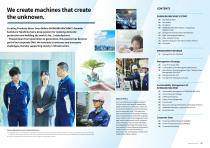
We create machines that create the unknown. CONTENTS SHIBAURA MACHINE’S STORY 02 Creating Products Never Seen Before SHIBAURA MACHINE’s founder Kametaro Fujishima had a deep passion for realizing domestic production and building the world’s No. 1 manufacturer. Passed down from generation to generation, this passion has become part of our corporate DNA. We continue to welcome and overcome challenges, thereby supporting society’s infrastructure. S HIBAURA MACHINE Products —Supporting Manufacturing Strengths Honed Over More Than 80 Years Eight Technological Platforms Value Creation Process Specific...
Open the catalog to page 2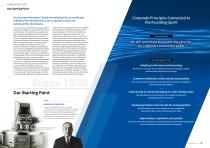
SHIBAURA MACHINE’S STORY Our Starting Point Our founder Kametaro Fujishima embarked on an ambitious initiative that led directly to the corporate culture we subsequently developed. In 1913, prior to the Company’s founding, Japan’s first turbine ship became stranded off the coast of South America. The accident was caused by the ship’s imperfectly manufactured reduction gears. When the high speed rotation of the steam turbine was reduced to match the rotational speed of the screw, the load concentrated on one tooth, which consequently broke. Upon learning that the poor quality of the gears was...
Open the catalog to page 3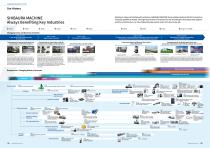
SHIBAURA MACHINE’S STORY SHIBAURA MACHINE Always Benefiting Key Industries 1940 Changing Times and Business Evolution From military demand to postwar reconstruction Development of large machine tools and concentration on the textile industry A double-column type planing machine As a company aligned with national policy, we manufactured numerous large machine tools. In the post-war period, the textile industry helped drive the recovery of Japan’s economy. Catering to this industry, we focused on applying core technologies for machine tools to the manufacture of such textile machinery as raw nylon...
Open the catalog to page 4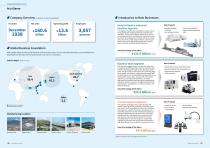
SHIBAURA MACHINE’S STORY Company Overview Introduction to Main Businesses Operating profit Global Business Foundation With a global network of around 30 domestic and 40 overseas sales, service, and production bases, we contribute to the development of key industries everywhere and in all manner of situations. Sales by Region (Billions of yen) Metal & Plastics Industrial Machine Segment This segment handles the manufacture, sales, and servicing of injection molding machines and extrusion machines, which process plastic materials, as well as die casting machines, which process materials such as...
Open the catalog to page 5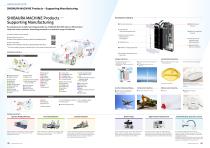
SHIBAURA MACHINE’S STORY SHIBAURA MACHINE Products —Supporting Manufacturing SHIBAURA MACHINE Products — Supporting Manufacturing Smartphone Industry Camera module lens By capitalizing on its eight technological platforms, SHIBAURA MACHINE delivers differentiated value that meets customers’ demanding standards in an extensive range of industries. apacitor film / C Oriented polypropylene film For details, please visit our website. Shibaura Machine near You https://www.shibaura-machine.co.jp/en/technology/familiar/ https://www.shibaura-machine.co.jp/en/product/index.html * The color-coding of numbers...
Open the catalog to page 6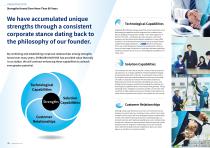
SHIBAURA MACHINE’S STORY Strengths Honed Over More Than 80 Years We have accumulated unique strengths through a consistent corporate stance dating back to the philosophy of our founder. By combining and establishing reciprocal relationships among strengths honed over many years, SHIBAURA MACHINE has provided value that only it can realize. We will continue enhancing these capabilities to unleash even greater potential. Technological Capabilities Solution Strengths Capabilities Customer Relationships Technological Capabilities SHIBAURA MACHINE has always placed the utmost importance on its technological...
Open the catalog to page 7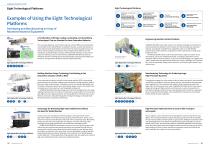
SHIBAURA MACHINE’S STORY Eight Technological Platforms Examples of Using the Eight Technological Platforms Developing and Manufacturing an Array of Advanced Industrial Equipment M High-precision coating machines Twin-screw extruders Engineering solutions Eight Technological Platforms Realizing one-step advanced accuracy Professional manufacturing, assembly, and measuring technologies Optimized for each machine group Control, mechatronics, and IoT technology A Combination of Mixing, Coating, Laminating, and Assembling Technologies That are Essential for Next-Generation Batteries The secondary...
Open the catalog to page 8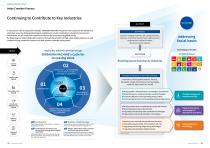
SHIBAURA MACHINE’S STORY Value Creation Process Continuing to Contribute to Key Industries OUTPUT In accordance with its Corporate Principles, SHIBAURA MACHINE will partner with customers worldwide and solve their issues by utilizing technological capabilities to create combinations of products and services. Furthermore, we will work with customers to address the issues faced by global society. By deepening our relationships with customers through the provision of high-value-added solutions, we will continue driving a powerful virtuous cycle that sustains corporate value growth. Helping Key Industries...
Open the catalog to page 9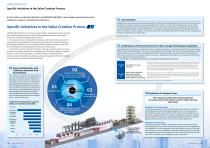
SHIBAURA MACHINE’S STORY Specific Initiatives in the Value Creation Process In this section, we describe the history of SHIBAURA MACHINE’s value creation practices and current initiatives, as well as its initiatives for the future. Specific Initiatives in the Value Creation Process SHIBAURA MACHINE views its mission as supporting the development of key industries and contributing to future society. We have developed and manufactured various products to meet the changing needs of each era. The Company strives to anticipate the challenges customers will face and works to resolve those issues through...
Open the catalog to page 10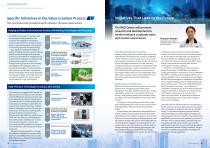
SHIBAURA MACHINE’S STORY Specific Initiatives in the Value Creation Process Specific Initiatives in the Value Creation Process Here, we introduce other examples of specific initiatives in the value creation process Helping to Realize a Decarbonized Society with Molding Technologies and Recycling Even before the concept of a decarbonized society began attracting attention, the Company was engaging in collaborative research with customers and research institutions, in Japan and overseas, in the interests of conserving resources and saving energy. By using foam molding technologies in injection...
Open the catalog to page 11All Shibaura Machine catalogs and technical brochures
 TMD series
10 Pages
 KWA series
3 Pages
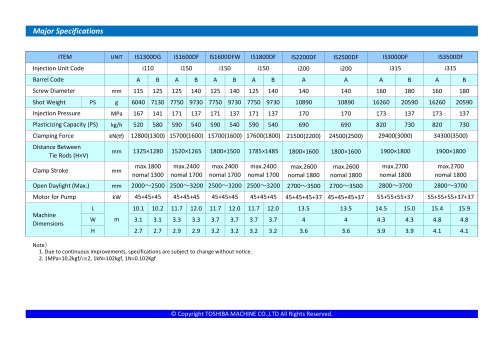 IS series
1 Page
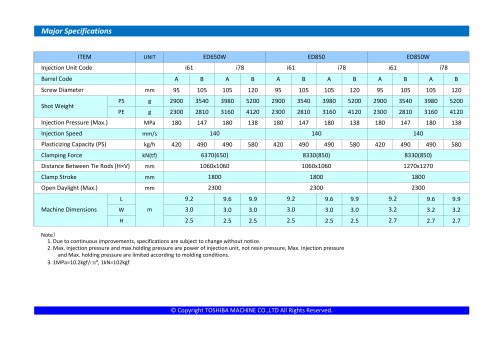 ED series
1 Page
Archived catalogs
 SCARA Robot THL Series
20 Pages
 EC-P Ultra
1 Page
 IS-GS
IS-GS1 Page
 IS-GT
IS-GT1 Page
 IS DG DF
1 Page
 EC5
EC51 Page
 ED 650 850
1 Page
 EC5P
EC5P1 Page
 EC-NII
1 Page
 ED1300, ED1800
1 Page
 EC 30
EC 302 Pages
 ED2500
1 Page
 EC 450-1800sx
3 Pages
 EC 50-350s
3 Pages
 BTD-100.R12
8 Pages


- CNC machining center
- Turning center
- Vertical CNC milling center
- CNC turning machine
- Grinding machine
- 3-axis CNC milling center
- Articulated robot
- 2-axis turning machine
- 6-axis robot
- Precision CNC milling center
- 5-axis CNC milling center
- CNC grinding machine
- Handling robot
- Precision grinding machine
- Extrusion line
- High-precision CNC milling center
- Thermoplastic extrusion line
- Workpiece grinding machine