
- Catalogs
- Shenzhen Ruicom Technology Co., Ltd.
- STSL Low-Power Tilt Sensor

STSL Low-Power Tilt Sensor
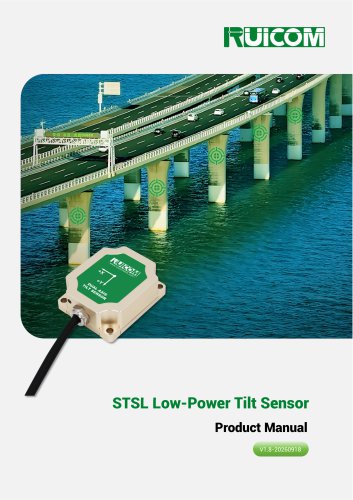
STSL Low-Power Tilt Sensor
The STSL inclinometer by RUICOM Technology is a compact, low-power dual-axis sensor designed for industrial applications such as tower and bridge monitoring. It offers high accuracy in measuring tilt angle, oscillation frequency, amplitude, and center offset. Key features include excellent angular stability, precision, thermal drift characteristics, and long-term stability better than 0.02°. It employs a fifth-order filtering algorithm and cross-axis error calibration, with communication options via RS485 or TTL interfaces.
The sensor is suitable for foundation pit monitoring, industrial automation, construction machinery leveling, photovoltaic tracking mounts, aerospace systems, and precision instrument leveling.
- Tri-axial measurement
- Measurement range: ±30°
- Resolution: 0.001°
- Accuracy: <±15°: 0.01°, <±30°: 0.05°
- IP67 protection rating
It features a measurement range of ±30°, resolution of 0.001°, and long-term stability of <0.02°. The operating temperature range is -40 to +85°C, with a response time of <0.1s. It supports RS485/TTL output and MODBUS RTU protocol, compliant with EN 61000 and GB/T 17626 standards.
Models vary by encapsulation and signal output, such as the STSL6-485 with RS485 output.
The sensor operates on a supply voltage of 9-36V (standard) or 5V (customized), with an operating current of 6.5mA at 12V, and includes an operation status indicator light.
Defines wire colors and functions for housing and PCBA, including power supply and data transmission lines.
Dimensions for housing and PCBA are provided, with recommended screw sizes for installation.
Details default communication parameters and protocol type, including command message formats and error handling. Instructions for reading and writing data, setting addresses, and performing password authentication are included.
This document provides technical specifications and command instructions for interacting with the sensor module using specific command frames. It includes instructions for querying and setting parameters such as zero points, communication settings, and alarm thresholds.
Outlines the structure of command frames sent by the host and data frames returned by the module, specifying function codes, register addresses, and CRC checks for data integrity.
Commands for querying and setting the zero-point status of the XY and Z-axis angles are provided, with examples of command frames for both querying and setting these points.
Instructions for setting the communication baud rate and parity bit are given, with examples of command frames. Changes take effect after power cycling.
Details commands for querying and setting alarm thresholds, including tilt, swing amplitude, oscillation frequency, and horizontal offset, with register addresses and examples of command frames.
Describes the method for calculating the CRC code, including initialization, XOR operations, and bit shifting, with lookup tables for high and low CRC bytes and a function for generating the CRC16 code.
Concludes with contact details for technical support and sales inquiries.
Catalog excerpts

STSL Low-Power Tilt Sensor Product Manual V1.8-20260918
Open the catalog to page 1
£vf Technical Highlights ❖ Tri-axial measurement; The STSL is a compact, low-power, multi-parameter dual-axis inclinometer launched by RUICOM Technology for industrial field control applications. Offering high measurement accuracy, it enables simultaneous monitoring of a target's tilt angle, oscillation frequency, oscillation amplitude, and center offset, making it suitable for industrial engineering scenarios such as the monitoring of towers and bridges. The product features excellent angular output stability, superior measurement precision, and outstanding thermal drift characteristics, with...
Open the catalog to page 2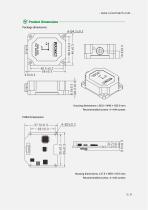
Product Dimensions Package dimensions: Housing dimensions: L60.6 × W46 × H20.5 mm Recommended screws: 4 × M4 screws PCBA Dimensions: Housing dimensions: L37.5 × W39 × H9.5 mm Recommended screws: 4 × M2 screws
Open the catalog to page 5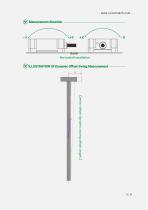
Measurement direction ILLUSTRATION Of Dynamic Offset Swing Measurement
Open the catalog to page 6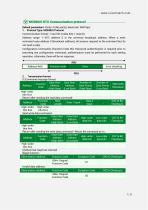
Default parameters: Parity: N (No parity), Baud rate: 9600 bps. 1. Protocol Type: MODBUS Protocol Communication format: 1 start bit, 8 data bits, 1 stop bit. Address range: 1-247; address 0 is the universal broadcast address. When a write command uses address 0 (broadcast address), all sensors respond to the command but do not send a reply. Configuration commands (Function Code 06): Password authentication is required prior to executing any configuration command; authentication must be performed for each setting operation; otherwise, there will be no response.
Open the catalog to page 7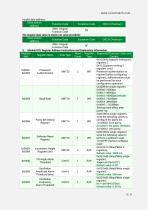
The request data value is empty (no value provided):
Open the catalog to page 8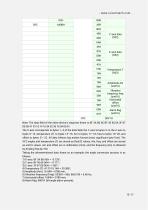
The X-axis corresponds to bytes 1 -4 of the data field, the Y-axis to bytes 5-8, the Z-axis to bytes 9-12, temperature (T) to bytes 13-16, Am to bytes 17-18, freq to bytes 19-20, and offset to bytes 21-22. All data follows big-endian format (most significant byte first). The XYZ angles and temperature (T) are stored as float32 values; Am, freq, and offset are stored as uint16 values. Am and offset are in millimeters (mm), and the frequency (Hz) is obtained by dividing freq by 100. Taking the aforementioned data frame as an example, the angle conversion process is as follows: 6) Vibration frequency...
Open the catalog to page 10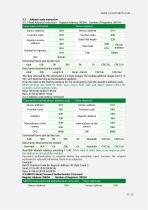
3.2.1 Read Address Instruction Register Address: 0030H Number of Registers: 0001H Register Address: 0002H Number of Registers: 0002H_
Open the catalog to page 11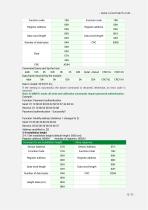
Register address: 0008H Number of registers: 0002H_
Open the catalog to page 12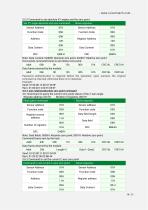
3.5.2 Command to set absolute XY angles and the zero point
Open the catalog to page 14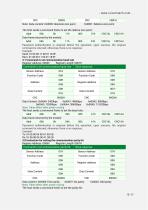
Note: Data content: 0x0000: Absolute zero point 0x0001: Relative zero point The host sends a command frame to set the relative zero point: Password authentication is required before the operation; upon success, the original command is returned; otherwise, there is no response. Register Address: 0006h Register Length: 0001H_ Command to set communication parity bit: Data content: 0x0000: Even parity 0x0001: No parity 0x0002: Odd parity Note: Takes effect after power cycling. The host sends a command frame to set the parity bit:
Open the catalog to page 15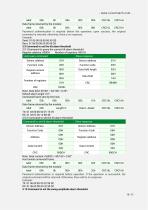
Password authentication is required before the operation; upon success, the original command is returned; otherwise, there is no response. 3.9 Command to set the tilt alarm threshold 3.9.1Command to query the current tilt alarm threshold Register address: 000DH Number of registers: 0001H_ Data frame returned by the module: Password authentication is required before operation. If the operation is successful, the original command will be returned. Otherwise, there will be no response. 3.10 Command to set the swing amplitude alarm threshold
Open the catalog to page 16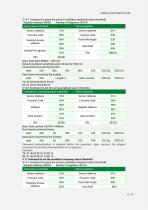
3.10.1 Command to query the current oscillation amplitude alarm threshold Register Address: 000EH Number of Registers: 0001H_ 3.11.1 Command to query the current oscillation frequency alarm threshold Register address: 000FH Number of registers: 0001H_
Open the catalog to page 17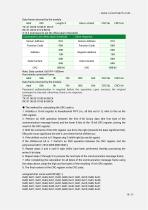
Data frame returned by the module: Password authentication is required before the operation; upon success, the original command is returned; otherwise, there is no response. • The method for calculating the CRC code is: 1. Initialize a 16-bit register to hexadecimal FFFF (i.e., all bits set to 1); refer to this as the CRC register; 2. Perform an XOR operation between the first 8-bit binary data (the first byte of the communication message frame) and the lower 8 bits of the 16-bit CRC register, storing the result in the CRC register; 3. Shift the contents of the CRC register one bit to the right...
Open the catalog to page 19
unsigned char uchCRCHi = 0xFF; unsigned char uchCRCLo = 0xFF; unsigned uIndex; while (usDataLen--) uIndex = uchCRCLoA*puchMsg++; uchCRCLo = uchCRCHiAauchCRCHi[uIndexj; uchCRCHi = auchCRCLo[uIndex]; Web: www.ruicomtech.com E-mail: [email protected] — ■ - - --y- Add:Building 1, Lixin Lake Creative Park, 1 Furui Fid, Fuhai St, Bao'an, Shenzhen, China m ^ k ^ ^ 11
Open the catalog to page 21All Shenzhen Ruicom Technology Co., Ltd. catalogs and technical brochures
 STS STANDARD OUTPUT TILT SENSOR
13 Pages
 HTS3D High-Precision Tilt Sensor
15 Pages
 GDS8 Series Digital inclinometer
13 Pages
















- Display module
- Industrial display panel
- Color display panel
- Digital inclination sensor
- Built-in display
- 2-axis tilt sensor
- MEMS inclination sensor
- Multi-axis tilt sensor
- Analog inclination sensor
- RS-485 display panel
- High-precision tiltmeter
- IP67 inclination sensor
- 1-axis tilt sensor
- Vibration sensor
- Rugged inclination sensor
- High-resolution inclinometer
- 2" display
- Angle measurement inclination sensor
- RS-485 inclinometer