
- Catalogs
- Shenzhen Ruicom Technology Co., Ltd.
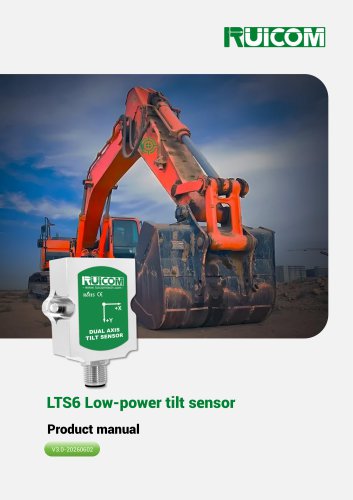
- RUICOM LTS6 CAN2.0B low-power tilt sensor


- Company
- Products
- Catalogs
- News & Trends
- Exhibitions
RUICOM LTS6 CAN2.0B low-power tilt sensor
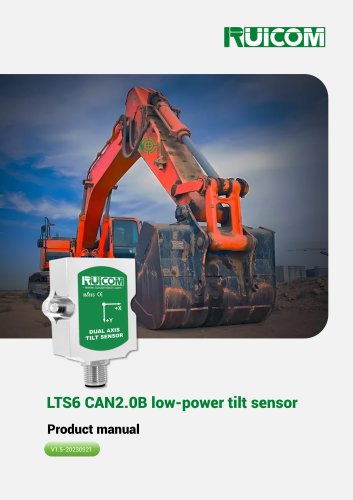
RUICOM LTS6 CAN2.0B low-power tilt sensor
The LTS6 series by RUICOM Technology is a dynamic measurement-type MEMS tilt sensor designed for stable attitude measurement of moving vehicles. It features a dual-channel gravity tilt unit that measures static gravitational acceleration and converts it into tilt angle changes. The sensor outputs tilt and pitch angles relative to the horizontal plane via a CAN2.0B interface. It includes a built-in MCU control system for double-corrected output linearity, compensating for accuracy loss in analog products. The sensor is suitable for both static and dynamic measurement scenarios, offering strong resistance to electromagnetic interference and stable operation in harsh environments.
Application Scope
The sensor is applicable in various fields including agricultural machinery, construction hoisting equipment, aerial work platforms, medical equipment leveling, electric vehicle control systems, and woodworking machinery.
Technical Highlights
- Six installation methods
- Resolution of 0.1°
- Output method: CAN 2.0B
- High vibration resistance >2000g
Performance Parameters
- Measurement range: ±90°
- Measuring axis: X/Y axis
- Resolution: 0.1°
- Static temperature accuracy: ±0.3° at 25℃
- Dynamic temperature accuracy: ±0.8° at 25℃
- Zero-point temp coefficient: ±0.01°/℃
- Sensitivity temp coefficient: ≤100 ppm/℃
- Power-on startup time: 1.5 seconds
- Response frequency: 0.05 seconds
- Output signal: CAN2.0B
- EMC compliance: EN 61000 and GBT 17626
- Insulation resistance: ≥100 megohms
- Impact resistance: 100g@11ms
- Vibration resistance: 10grms 10~1000 Hz
- Protection level: IP67
- Size: L64.5×W50×H18.5mm
- Weight: ≤100g (excluding cable)
Electrical Parameters
- Power supply voltage: 9-36V
- Operating current: 40mA (no-load)
- Operating temperature: -40 to +85℃
- Storage temperature: -40 to +85℃
Ordering Selection
Models are selected based on axis, range, signal output, and installation direction. Example: LTS6X-10-C3-H indicates X-axis, ±10° range, CAN2.0B output, horizontal installation.
Product Dimensions and Installation
The sensor should be mounted with its sensing axis parallel to the target tilt axis. It is IP67 rated but should not be submerged long-term. Signal wires should be isolated from power to avoid short circuits.
Interface Definition
Pin definitions include power supply terminals, CAN_H for low-level signals, and CAN_L for high-level signals.
Communication Protocol
- Node number modification: Default node number is 0x05.
- CAN baud rate setting: Options range from 1000K bps to 100K bps, with a default of 125K bps.
- Angle data analysis: Outputs angle data in a specific CAN-ID format.
- Output frequency setting: Factory default is 25Hz, with options from 1Hz to 100Hz.
Catalog excerpts

LTS6 CAN2.0B low-power tilt sensor Product manual V1.5-20230921
Open the catalog to page 1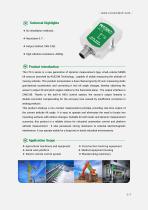
Technical Highlights ❖ Six installation methods ; ❖ High vibration resistance >2000g. The LTS 6 series is a new generation of dynamic measurement-type, small-volume MEMS tilt sensors launched by RUICOM Technology , capable of stably measuring the attitude of moving vehicles. This product incorporates a dual-channel gravity tilt unit, measuring static gravitational acceleration and converting it into tilt angle changes, thereby obtaining the sensor's output tilt and pitch angles relative to the horizontal plane . The output interface is CAN2.0B. Thanks to the built-in MCU control system, the sensor's...
Open the catalog to page 2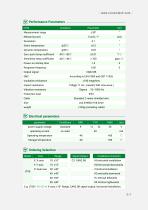
Performance Parameters E.g: LTS6X-10-C3-H: X-axis, ±10° Range, CAN2.0B signal output, horizontal installation.
Open the catalog to page 3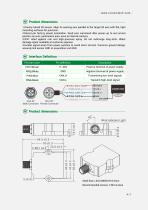
1. Gravity-based tilt sensor. Align its sensing axis parallel to the target tilt axis with flat, tight mounting surfaces for precision. 2. Mount per factory preset orientation. Send zero command after power-up to set current position as zero; parameters auto-save to internal memory. 3.IP67 rated against rain and high-pressure spray. Do not submerge long-term. Water damage repair available at customer expense. 4.Isolate signal wires from power positive to avoid short circuits. Common ground design: securely link sensor GND to acquisition unit GND.
Open the catalog to page 4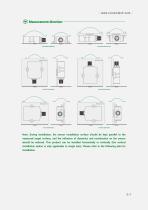
Measurement direction Horizonta installation Mounting surface vertical installation Mounting surface Mounting surface Horizontal downwards Mounting surface vertically downward Mourning surface Vertica eftwards Vertical rightwards Note: During installation, the sensor installation surface should be kept parallel to the measured target surface, and the influence of dynamics and acceleration on the sensor should be reduced. This product can be installed horizontally or vertically (the vertical installation option is only applicable to single axis). Please refer to the following plan for installation....
Open the catalog to page 5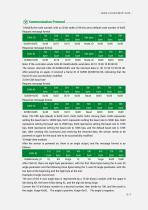
1) Modify the node number, with an ID bit width of 29 bits and a default node number of 0x05 Request message format After CAN-ID, there are eight byte parameters, with the first three bytes being the X-axis tilt angle parameter and the following three bytes being the Y-axis tilt angle parameter, with the low byte at the beginning and the high byte at the end. Example of angle conversion: The size of the X-axis angle data is represented by a 16 bit binary number, with the upper 8 bits being XH, the lower 8 bits being XL, and the sign bit being Xsign. Convert the 16 bit binary number to a decimal...
Open the catalog to page 6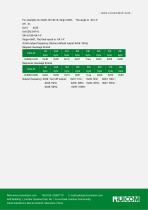
4) Set output frequency (factory default output 0x06: 25Hz) Request message format Output frequency: 0x00: Turn off output; Web:www.ruicomtech.com Tel:0755-23087719 E-mail:[email protected] Add:Building 1, Lixinhu Creative Park, No. 1 Furui Road, Qiaotou Community, Fuhai Subdistrict, Bao'an District, Shenzhen, China
Open the catalog to page 7All Shenzhen Ruicom Technology Co., Ltd. catalogs and technical brochures





- Display module
- Industrial display panel
- Acceleration sensor
- Color display panel
- Tilt sensor
- Digital inclination sensor
- Triaxial acceleration sensor
- Built-in display
- 2-axis tilt sensor
- MEMS inclination sensor
- Multi-axis tilt sensor
- High-precision tiltmeter
- Analog inclination sensor
- IP67 inclination sensor
- Industrial accelerometer
- 1-axis tilt sensor
- MEMS accelerometer
- RS-485 display panel
- Accelerometer with built-in electronics
- Vibration sensor