
- Catalogs
- Shenzhen Ruicom Technology Co., Ltd.
- HTS6 High-Precision CAN2.0A Output Tilt Sensor

HTS6 High-Precision CAN2.0A Output Tilt Sensor
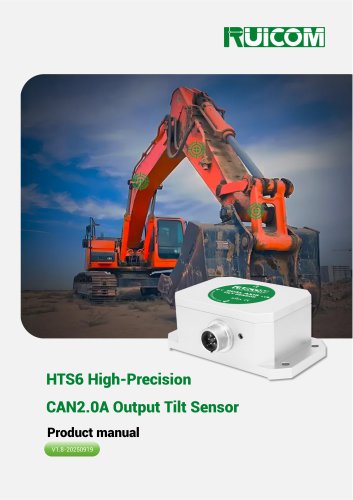
HTS6 High-Precision CAN2.0A Output Tilt Sensor
The HTS6-CAN2.0A is a high-performance tilt sensor developed by RUICOM Technology, offering improved measurement accuracy and temperature drift characteristics. It uses a 16-bit A/D differential converter and a fifth-order digital filtering algorithm to measure tilt and pitch angles. The sensor features a CAN 2.0A communication interface and a digital temperature sensor for real-time temperature drift compensation. It operates at a default frequency of 50Hz, with customizable options available.
Application Scope
This sensor is suitable for industrial automation, machinery platform leveling, photovoltaic tracking systems, aerospace attitude systems, and precision instrument leveling.
Technical Highlights
- Measuring range: ±1° to ±35°
- Accuracy: 0.001° for small ranges
- Resolution: 0.001°
- Vibration resistance: >2000g
- Voltage input: DC 9~36V
- Output: CAN2.0A
Performance Parameters
- Power supply: 9-36V
- Operating temperature: -40 to +85°C
- Measurement accuracy: 0.005° to 0.01° RMS
- Long-term stability: 0.01° to 0.02°
- Response frequency: 20Hz
- Output rate: Configurable up to 50Hz
- Protection class: IP67
Order Selection
Models are defined by axis, range, communication protocol, and installation direction. Example: HTS6X10-C2-H indicates X-axis, ±10° range, CAN2.0A protocol, horizontal installation.
Interface Definition
Pin definitions include power supply, CAN_L, CAN_H, and ground connections.
Product Dimensions
Dimensions are L90×W59.1×H34mm, with recommended M4 screws for installation.
Indicator Light Operation
The red indicator light shows power status and connection success or failure.
Communication Protocol
Includes modifying node numbers, setting CAN baud rates, and parsing angle data. The sensor outputs angle data immediately upon power-on, with specific message formats for requests and responses. Baud rates can be set to 500K, 250K, 125K, or 100K bps, with a default of 125K bps. Angle data is parsed from a 24-bit binary number, with conversion examples provided.
Catalog excerpts
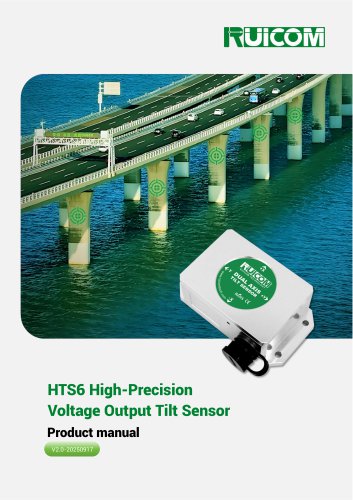
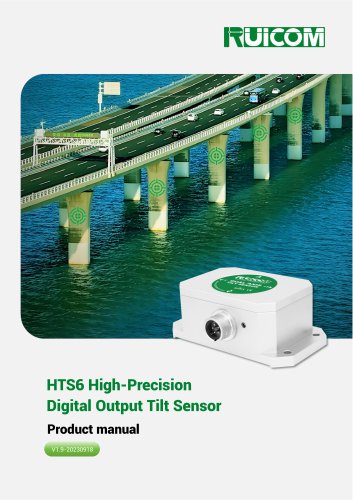
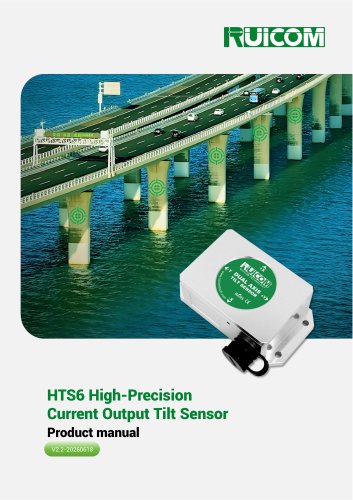
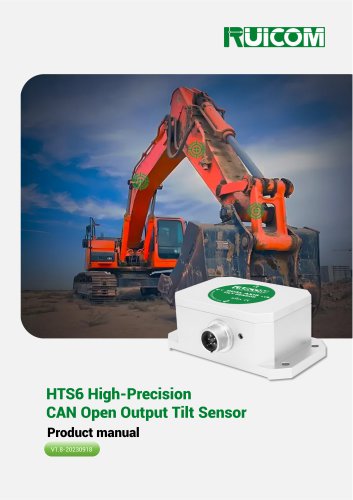
HTS6 High-Precision CAN2.0A Output Tilt Sensor Product manual V1.8-20250919
Open the catalog to page 1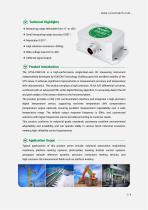
❖ Measuring range selectable from ±1 ° to ±35°; ❖ Small measuring range accuracy 0.001 ❖ High vibration resistance >2000g; ❖ Wide voltage input DC 9~36V; The HTS6-CAN2.0A is a high-performance single/dual-axis tilt measuring instrument independently developed by RUICOM Technology. Building upon the excellent stability of the STS series, it achieves significant improvements in measurement accuracy and temperature drift characteristics. This product employs a high-precision 16-bit A/D differential converter, combined with an advanced fifth-order digital filtering algorithm, to accurately detect...
Open the catalog to page 2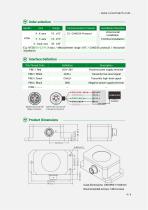
E.g: HTS6X10-C2-H: X-axis / Measurement range ±10° / CAN2.0A protocol / Horizontal installation. £vf Order selectionInterface Definition PIN3 WEIPU SF1212P-5P Male Connector Female Connector Pin/Thread Color
Open the catalog to page 4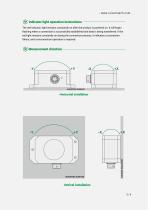
[vf Indicator light operation instructions- The red indicator light remains constantly on after the product is powered on. It will begin flashing when a connection is successfully established and data is being transferred. If the red light remains constantly on during the connection process, it indicates a connection failure, and a reconnection operation is required. Measurement direction- MOUNTING SURFACE Vertical installation
Open the catalog to page 5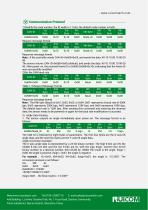
1):Modify the node number; the ID width is 11 bits; the default node number is 0x05. The CAN-ID is followed by eight bytes of parameters. The first four bytes are the X-axis tilt angle data, and the next four bytes are the Y-axis tilt angle data. Angle conversion example : The X-axis angle data is represented by a 24-bit binary number. The high 8 bits are XH, the middle 8 bits are XM, and the low 8 bits are XL, with the sign Xsign. Convert this 24-bit binary number to a decimal number, then divide by 10000; the result is the angle. Xsign = 0x00, the angle is positive; Xsign = 0x01, the angle...
Open the catalog to page 6All Shenzhen Ruicom Technology Co., Ltd. catalogs and technical brochures
 STSL Low-Power Tilt Sensor
21 Pages
 STS STANDARD OUTPUT TILT SENSOR
13 Pages
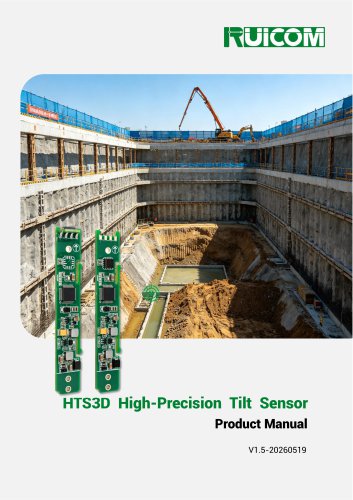 HTS3D High-Precision Tilt Sensor
15 Pages
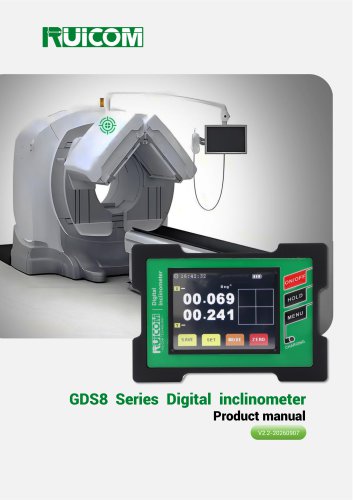 GDS8 Series Digital inclinometer
13 Pages




- Display module
- Industrial display panel
- Color display panel
- Tilt sensor
- Digital inclination sensor
- Built-in display
- 2-axis tilt sensor
- MEMS inclination sensor
- Multi-axis tilt sensor
- Analog inclination sensor
- RS-485 display panel
- High-precision tiltmeter
- IP67 inclination sensor
- 1-axis tilt sensor
- Vibration sensor
- Rugged inclination sensor
- High-resolution inclinometer
- 2" display
- Angle measurement inclination sensor
- RS-485 inclinometer