
- Catalogs
- ShenZhen ProSense Technologies Co., Ltd.
- M-VOC-5airqualitySensor

M-VOC-5airqualitySensor
M-VOC-5airqualitySensor
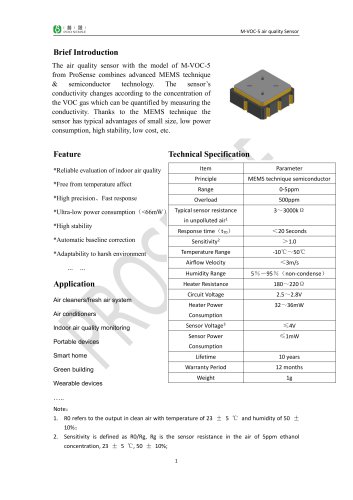
The M-VOC-5 air quality sensor by ProSense utilizes advanced MEMS and semiconductor technology to reliably evaluate indoor air quality. It is designed for high precision, fast response, and ultra-low power consumption, making it suitable for various applications such as air cleaners, air conditioners, and smart home devices.
Technical Specifications
- Principle: MEMS technique semiconductor
- Range: 0-5ppm
- Overload: 500ppm
- Typical sensor resistance in unpolluted air: 3~3000kΩ
- Response time (t70): <20 Seconds
- Sensitivity: >1.0
- Temperature Range: -10℃~50℃
- Airflow Velocity: <3m/s
- Humidity Range: 5%-95% (non-condense)
- Heater Resistance: 180~220Ω
- Circuit Voltage: 2.5~2.8V
- Heater Power Consumption: 32~36mW
- Sensor Voltage: ≤4V
- Sensor Power Consumption: ≤1mW
- Lifetime: 10 years
- Warranty Period: 12 months
- Weight: 1g
Application
The sensor is applicable in air quality monitoring systems, portable devices, green buildings, and wearable devices.
Precautions
- Avoid moving the sensor on the module.
- Prevent exposure to organic vapors and solvents.
- Reflow soldering should be done in a neutral atmosphere with a maximum temperature of 260 ℃.
- Preheat for at least 60 minutes if powered off for a long time.
- Not recommended for industrial safety or personal monitoring.
Contact Information
ProSense Technologies Co., Ltd., Building 4, Lianjian S&T Park, Longhua District, Shenzhen, China. Tel: +86 755 3669 0079, Email: [email protected]
Catalog excerpts
The air quality sensor with the model of M-VOC-5 from ProSense combines advanced MEMS technique & semiconductor technology. The sensor’s conductivity changes according to the concentration of the VOC gas which can be quantified by measuring the conductivity. Thanks to the MEMS technique the sensor has typical advantages of small size, low power consumption, high stability, low cost, etc. Technical Specification Item * Reliable evaluation of indoor air quality *Free from temperature affect *High precision, Fast response * Ultra-low power consumption (<66mW, *High stability *Automatic baseline correction * Adaptability to harsh environmen Application Air cleaners/fresh air system Indoor air quality monitoring Portable devices Smart home Green building Wearable devices 1. RO refers to the output in clean air with temperature of 23 + 5 °C and humidity of 50 + 10%; 2. Sensitivity is defined as R0/Rg, Rg is the sensor resistance in the air of 5ppm ethanol concentration, 23 + 5 °C, 50 + 10%;
Open the catalog to page 1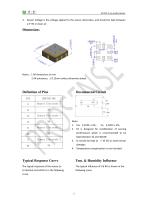
3. Sensor Voltage is the voltage applied to the sensor electrodes, and should be kept between 1.5~4V in clean air. 2 All tolerances + 0.15mm unless otherwise stated 2. R1 is designed for modification of sensing performance which is recommended to be kept between 32 and 36mW; 3. Rl should be kept at -^lO kQ to avoid sensor damage; 4. Temperature compensation is not included. The typical influence of t & RH is shown in the following curve Typical Response Curve The typical response of the sensor to to Alcohol and HCHO is in the following curve
Open the catalog to page 2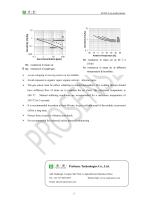
RO: resistance in clean air I Rg: resistance in target gas Ra: resistance in clean air at different temperature & humidity le welding furnace shoul r- /woia cnangmg or moving sensor on rne module. > Avoid exposure to organic vapor, organic solvent, silicone vapor. > The gas sensor must be reflow soldering in neutral atmosphere. The welding furnace should have sufficient flow of clean air to maintain the air clean. The maximum temperature is 260 °C. Manual soldering conditions are recommended for a maximum temperature of 350 °C for 5 seconds. > It is recommended to preheat at least 60 min. to...
Open the catalog to page 3All ShenZhen ProSense Technologies Co., Ltd. catalogs and technical brochures
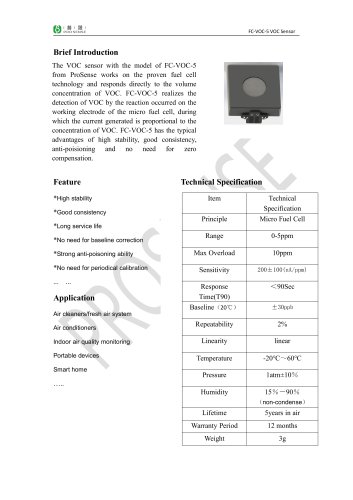 FC-VOC-5VOCSensor
2 Pages
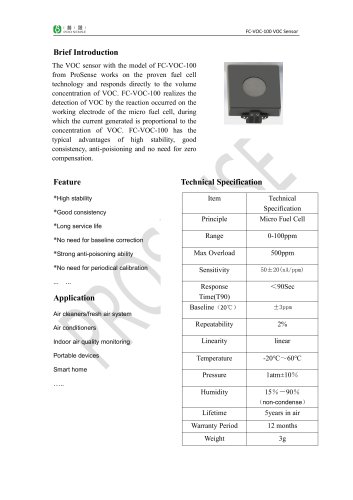 FC-VOC-100VOCSensor
2 Pages
 PS-VOC-E Air Quality Module
5 Pages
 PS-NH3-100 Ammonia Module
5 Pages
 PS-NH3-100 Ammonia Module
5 Pages
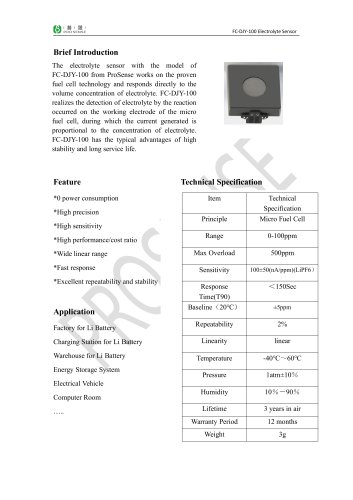 FC-DJY-100ElectrolyteSensor
2 Pages
 Dart Sensors WZ-S
5 Pages
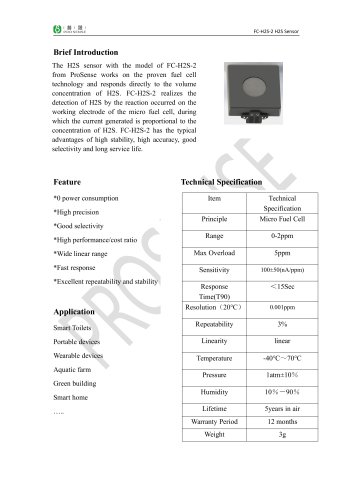 FC-H2S-2H2SSensor
2 Pages
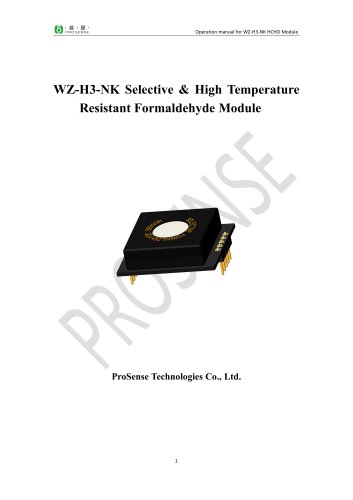 WZ-H3-NK
5 Pages
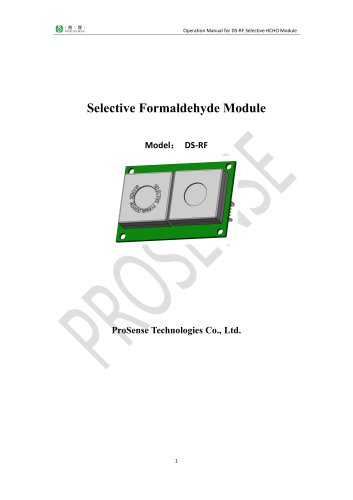 DS-RF
DS-RF6 Pages
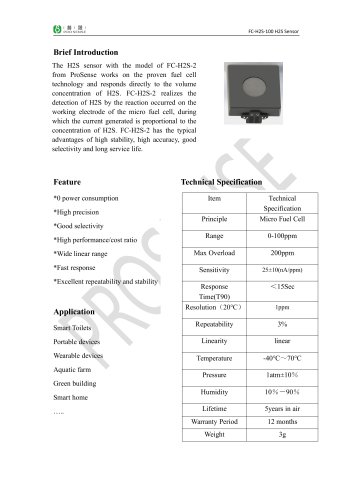 FC-H2S-100 H2S Sensor
2 Pages
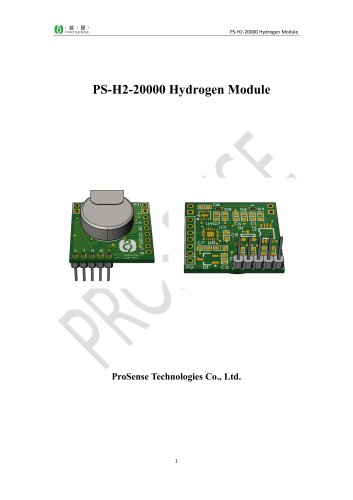 PS-H2-20000 Hydrogen Module
5 Pages
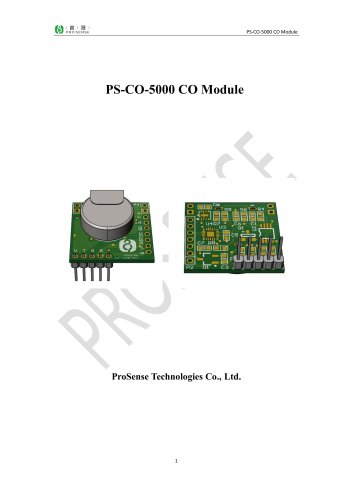 PS-CO-5000 CO Module
5 Pages
- Electrochemical gas sensor
- Monitoring gas sensor
- CO gas sensor module
- Semiconductor gas sensor
- Hydrogen gas sensor module
- Smart gas sensor
- Compact gas sensor
- Oxygen gas sensor module
- Hydrogen sulfide gas sensor module
- Maintenance-free gas sensor
- HCHO gas sensor
- Ammonia gas sensor module
- VOC gas sensor
- Gas sensor for the petrochemical industry
- Gas sensor for mining applications
- Agriculture and animal husbandry gas sensor
- Precalibrated gas sensor
- MEMS gas sensor
- Photoacoustic gas sensor