
- Catalogs
- Shenzhen DeepMaterial Technologies Co., Ltd
- UV Conformal Coating


- Company
- Products
- Catalogs
- News & Trends
- Exhibitions
UV Conformal Coating

UV Conformal Coating
Conformal coatings are widely used to protect electronic circuit boards from UV radiation and environmental hazards. These coatings, made from materials like acrylics, polyurethanes, and silicones, offer long-lasting protection.
Explanation
UV Conformal Coating involves applying a thin protective film on substrates, commonly used in electronics manufacturing. The coating is cured using ultraviolet light, providing excellent protection against moisture and environmental damage.
Protection
UV Conformal Coating protects substrates from UV light, moisture, and chemicals, particularly on printed circuit boards (PCBs). It is a clear coating that does not yellow over time and does not interfere with soldering or assembly.
Advantages
Different types of UV conformal coatings offer various benefits, such as improved durability, electrical insulation, and corrosion resistance. Choosing the right type is crucial for specific applications.
Method to Use
The coating is applied as a thin film on sensitive electronic components and cured with UV light. This process enhances durability and environmental resistance.
Process of Application
The coating is applied in liquid form and cured with UV light, often used on PCBs and other components like sensors and LCDs. Proper application is essential for optimal protection.
Conclusion
UV Conformal Coating is essential for protecting PCBs from environmental factors and enhancing their durability. Various types are available, each offering unique benefits.
Catalog excerpts

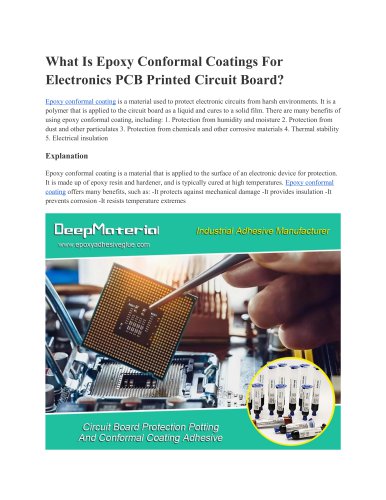
DeepMaterial UV Conformal Coating To Protect Electronic Circuit Board Conformal coatings are one of the most popular methods for protecting circuit boards from the harmful effects of UV radiation. When properly applied, these coatings can last for years and provide excellent protection against UV damage. Conformal coatings are typically made from a variety of materials, including acrylics, polyurethanes, silicones, and more. Explanation UV Conformal Coating is a process of applying a thin film of material onto a substrate in order to protect it. This method is commonly used in the manufacture of electronics, as it provides excellent protection against moisture and other environmental hazards. The UV in UV Conformal Coating refers to the ultraviolet light that is used to cure, or harden, the conformal coating material. This makes it an ideal solution for applications where traditional methods, such as thermal curi.
Open the catalog to page 1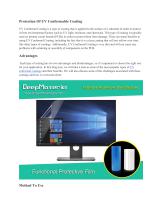
Protection Of UV Conformable Coating UV Conformal Coating is a type of coating that is applied to the surface of a substrate in order to protect it from environmental factors such as UV light, moisture, and chemicals. This type of coating is typically used on printed circuit boards (PCBs) in order to protect them from damage. There are many benefits to using UV Conformal Coating, including the fact that it is a clear coating that will not yellow over time like other types of coatings. Additionally, UV Conformal Coating is very thin and will not cause any problems with soldering or assembly of...
Open the catalog to page 2
UV Conformal Coating is a method of applying a thin film of material to a substrate in order to protect it from the environment. This type of coating is typically used on printed circuit boards (PCBs) and other electronic components that are sensitive to moisture, chemicals, or temperature extremes. The UV in UV Conformal Coating stands for ultraviolet light. This type of light is used to cure, or harden, the conformal coating material once it has been applied to the substrate. There are many benefits to using UV Conformal Coating, including improved durability, better electrical insulation,...
Open the catalog to page 3All Shenzhen DeepMaterial Technologies Co., Ltd catalogs and technical brochures
 SMT Epoxy Adhesive
3 Pages
 SMT Epoxy Red Adhesive
3 Pages
 PCB Potting Compound
3 Pages
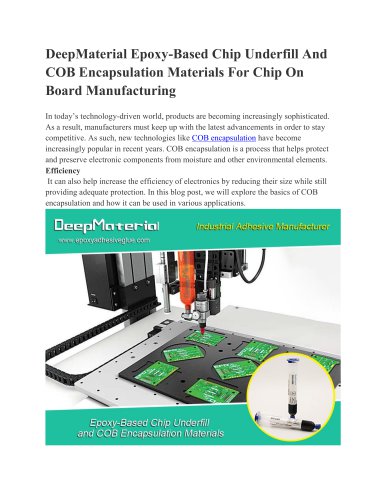 DeepMaterial Epoxy-Based
3 Pages
 BGA Underfill Epoxy
3 Pages
 UV curable adhesive
3 Pages
 Underfill Epoxy BGA
3 Pages
 Two component Epoxy Adhesive
4 Pages
 PUR Structural Adhesive
3 Pages
 Epoxy Encapsulant
3 Pages
 Waterproof adhesive glue
4 Pages
 SMT SMD epoxy adhesive
4 Pages
 Optical bonding adhesive
4 Pages
 Hot melt adhesive glue
4 Pages
 Magnet bonding adhesives
4 Pages
 LCD optical bonding adhesive
4 Pages
 Best epoxy adhesie for metal
4 Pages
 UV Curing UV Adhesive
13 Pages
 Structural Bonding Adhesive
10 Pages
 Functional Protective Film
3 Pages









- Single-component adhesive
- Adhesive tape
- Metal adhesive
- Industrial adhesive
- Plastic adhesive
- Glass adhesive
- Dispersion adhesive
- Epoxy adhesive
- Bonding adhesive
- Two-component adhesive
- Electronic adhesive
- Ceramic adhesive
- Sealing adhesive
- Fast curing adhesive
- Viscosity adhesive
- Conductivity adhesive
- Wood adhesive
- Packaging foil
- Rubber adhesive