
- Catalogs
- Shenzhen DeepMaterial Technologies Co., Ltd
- Underfill Epoxy BGA


- Company
- Products
- Catalogs
- News & Trends
- Exhibitions
Underfill Epoxy BGA

Underfill Epoxy BGA
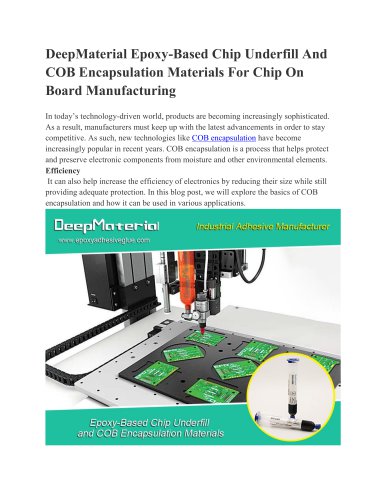
The document discusses the use of DeepMaterial Epoxy Based Chip Underfill for Ball Grid Array (BGA) and Chip on Board (COB) encapsulation in semiconductor manufacturing. The underfill process involves placing a die on a substrate and applying epoxy to enhance structural support, thermal conductivity, and mechanical stability.
Underfill epoxy BGA is crucial for protecting semiconductor devices from shock and vibration, making it an essential step in the manufacturing process.
Epoxy BGAs are favored in the semiconductor industry for packaging integrated circuits due to their mechanical strength and thermal cycling resistance. However, underfilling can be challenging and, if not done correctly, may lead to reliability issues like delamination and cracking.
The process of underfilling epoxy BGA offers benefits such as improved thermal conductivity and mechanical stability. Despite its advantages, challenges exist, and the document provides tips to overcome these challenges to maximize the benefits of underfill.
Underfill epoxy BGA fills the space between solder balls and the substrate, providing mechanical support to prevent ball cracking during thermal cycling and drop shock. It enhances the mechanical and thermal connection between semiconductor devices and their packages.
Epoxy BGA underfill has been used for over two decades to improve solder joint reliability and mechanical strength between BGAs and PCBs. It reduces stress from thermal cycling, prevents cracking and delamination, and acts as a barrier against contamination and corrosion.
Catalog excerpts

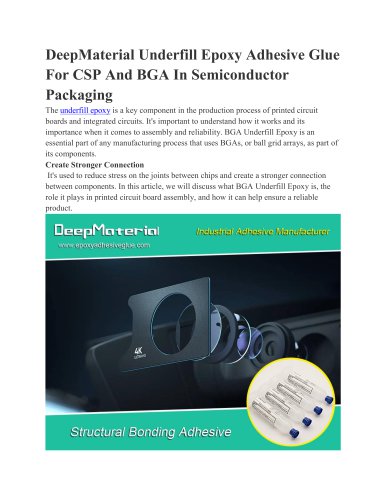
DeepMaterial Epoxy Based Chip Underfill BGA And COB Encapsulation Materials Ball Grid Array (BGA) under fill is a process used in the manufacture of semiconductor devices. The process involves the placement of a die on a substrate, followed by the Underfill epoxy BGA. The purpose of underfill epoxy BGA is to provide structural support to the device, as well as improve thermal conductivity and mechanical stability. Protection Of Device It also helps to protect the device from shock and vibration. Underfill epoxy BGA is a critical step in the manufacturing process of semiconductor devices, and thus it is important to understand its function and how it works. In this blog post, we will take a look at the underfill epoxy BGA process and how it can benefit your semiconductor device.
Open the catalog to page 1
Explanation Epoxy BGAs are commonly used in the semiconductor industry to package integrated circuits (ICs). They offer many benefits over other types of packaging, such as better mechanical strength and resistance to thermal cycling. However, one of the challenges with using epoxy BGAs is that they can be difficult to underfill. Underfilling is the process of filling the space between the IC and the package substrate with a material that helps to dissipate heat. If not done properly, under filling can lead to reliability issues such as delamination and cracking. In this blog post, we will discuss...
Open the catalog to page 2
underfilling epoxy BGA, as well as the challenges and benefits associated with it. We will also provide a few tips on how to overcome some of the challenges so that you can get the most out of your underfill. Uses Of Underfill Epoxy BGA Epoxy BGA underfill is a process of filling the space between the solder balls of a BGA device and the substrate to which it is being soldered. The under fill provides mechanical support to prevent ball cracking during thermal cycling and drop shock. Epoxy underfill is a material used to improve the mechanical and thermal connection between a semiconductor device...
Open the catalog to page 3All Shenzhen DeepMaterial Technologies Co., Ltd catalogs and technical brochures
 SMT Epoxy Adhesive
3 Pages
 SMT Epoxy Red Adhesive
3 Pages
 PCB Potting Compound
3 Pages
 DeepMaterial Epoxy-Based
3 Pages
 BGA Underfill Epoxy
3 Pages
 UV curable adhesive
3 Pages
 UV Conformal Coating
3 Pages
 Two component Epoxy Adhesive
4 Pages
 PUR Structural Adhesive
3 Pages
 Epoxy Encapsulant
3 Pages
 Waterproof adhesive glue
4 Pages
 SMT SMD epoxy adhesive
4 Pages
 Optical bonding adhesive
4 Pages
 Hot melt adhesive glue
4 Pages
 Magnet bonding adhesives
4 Pages
 LCD optical bonding adhesive
4 Pages
 Best epoxy adhesie for metal
4 Pages
 UV Curing UV Adhesive
13 Pages
 Structural Bonding Adhesive
10 Pages
 Functional Protective Film
3 Pages














- Single-component adhesive
- Adhesive tape
- Metal adhesive
- Industrial adhesive
- Plastic adhesive
- Glass adhesive
- Dispersion adhesive
- Epoxy adhesive
- Bonding adhesive
- Two-component adhesive
- Electronic adhesive
- Ceramic adhesive
- Sealing adhesive
- Fast curing adhesive
- Viscosity adhesive
- Conductivity adhesive
- Wood adhesive
- Packaging foil
- Protective sheet
- Rubber adhesive