
- Catalogs
- Shenzhen DeepMaterial Technologies Co., Ltd
- SMT SMD epoxy adhesive


- Company
- Products
- Catalogs
- News & Trends
- Exhibitions
SMT SMD epoxy adhesive

SMT SMD epoxy adhesive
SMT epoxy adhesive is a liquid adhesive that solidifies upon contact with a surface. It is widely used in the electronics industry for its non-conductive properties and strong adhesion capabilities.
This adhesive is primarily used to bond printed circuit boards (PCBs) to substrates. It is a two-component, room temperature curing adhesive that can also be used to adhere various materials such as glass, metal, and plastic.
SMT epoxy adhesives are composed of two parts: an activator and a resin. These are mixed to form a liquid that can be applied using a syringe or brush. The adhesive can be used for both assembling components and reassembling already assembled components.
- Epoxy Resin: A liquid that cures into a solid material when exposed to air or heat.
- Hardener: A curing agent mixed with the resin to alter its properties and accelerate curing.
- Solvents: Facilitate quicker curing and ease of application.
Epoxy adhesives serve as an alternative to solder paste in surface mount board assembly. They are categorized into conductive and dielectric types, with conductive epoxies being suitable for components that dissipate heat.
The adhesive is a resin-based, two-part system consisting of an epoxy resin and an amine hardener. It is applied to the PCB, followed by component placement, and cured through heating to secure the components.
Catalog excerpts
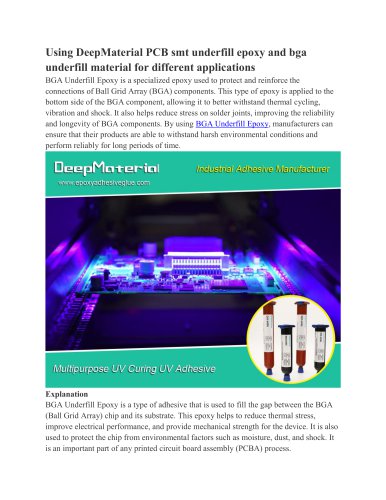
How To Use Smt SMD Epoxy Adhesive Red Glue For PCB Underfill Process SMT epoxy adhesive is a liquid that becomes solid when it comes in contact with a surface. SMT epoxy adhesive can be used in many ways. It can be used to adhere objects to surfaces or as an adhesive for other materials. It is often used in the electronics industry because it does not conduct electricity and can provide strong adhesion. Uses of SMT epoxy adhesive
Open the catalog to page 1
The SMT epoxy adhesive is used to bond the printed circuit boards to the substrate. The epoxy adhesive is a two-component, room temperature curing adhesive. The SMT epoxy adhesive is used to bond the printed circuit boards to the substrate. It has a two-component, room temperature curing adhesive. The SMT epoxy adhesive is a type of epoxy adhesive that is used in the assembly of SMT components. The SMT epoxy adhesive can be applied to the surface of a PCB or a component, and it will adhere to both. The SMT epoxy adhesive can also be applied to the surface of an already assembled component and...
Open the catalog to page 2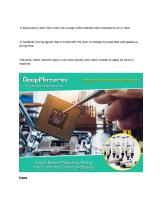
-A liquid epoxy resin that cures into a tough solid material when exposed to air or heat. -A hardener (curing agent) that is mixed with the resin to change its properties and speed up curing time. -Solvents, which help the epoxy cure more quickly and make it easier to apply by hand or machine.
Open the catalog to page 3
Epoxy adhesives for SMT are used as an alternative to solder paste in the assembly of surface mount boards. The epoxies are applied to a surface and then the component is placed on top. The epoxy is cured at a high temperature and the component is permanently attached to the board. Epoxy adhesives can be categorized into two types - conductive and dielectric. Conductive epoxies have a lower viscosity than dielectric ones, which means they are more suitable for attaching components that need to dissipate heat, such as power semiconductors. Epoxy Adhesives are a type of adhesive that is used for...
Open the catalog to page 4All Shenzhen DeepMaterial Technologies Co., Ltd catalogs and technical brochures
 SMT Epoxy Adhesive
3 Pages
 SMT Epoxy Red Adhesive
3 Pages
 PCB Potting Compound
3 Pages
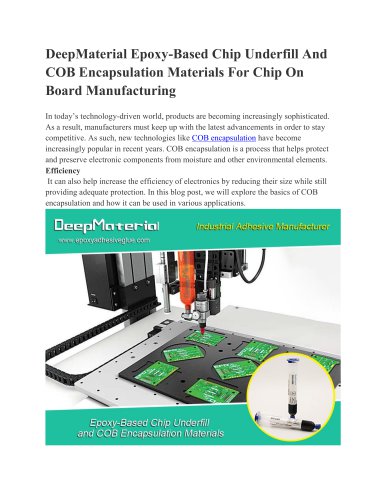 DeepMaterial Epoxy-Based
3 Pages
 BGA Underfill Epoxy
3 Pages
 UV curable adhesive
3 Pages
 UV Conformal Coating
3 Pages
 Underfill Epoxy BGA
3 Pages
 Two component Epoxy Adhesive
4 Pages
 PUR Structural Adhesive
3 Pages
 Epoxy Encapsulant
3 Pages
 Waterproof adhesive glue
4 Pages
 Optical bonding adhesive
4 Pages
 Hot melt adhesive glue
4 Pages
 Magnet bonding adhesives
4 Pages
 LCD optical bonding adhesive
4 Pages
 Best epoxy adhesie for metal
4 Pages
 UV Curing UV Adhesive
13 Pages
 Structural Bonding Adhesive
10 Pages
 Functional Protective Film
3 Pages









- Single-component adhesive
- Adhesive tape
- Metal adhesive
- Industrial adhesive
- Plastic adhesive
- Glass adhesive
- Dispersion adhesive
- Bonding adhesive
- Two-component adhesive
- Electronic adhesive
- Ceramic adhesive
- Sealing adhesive
- Fast curing adhesive
- Viscosity adhesive
- Conductivity adhesive
- Wood adhesive
- Packaging foil
- Protective sheet
- Rubber adhesive