
- Catalogs
- Shenzhen DeepMaterial Technologies Co., Ltd
- Epoxy-Based Chip Underfil and COB Encapsulation Materials


- Company
- Products
- Catalogs
- News & Trends
- Exhibitions
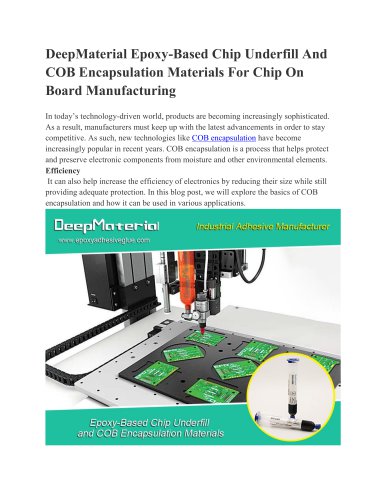
Epoxy-Based Chip Underfil and COB Encapsulation Materials

Epoxy-Based Chip Underfil and COB Encapsulation Materials
One component epoxy adhesives are versatile and ideal for bonding dissimilar materials with high shear and peel strength. They are used across various industries such as automotive, aerospace, and electronics due to their strong bond and resistance to harsh environments.
- Strong and durable, comparable to two-part epoxies.
- Cure at room temperature without mixing.
- Longer working time, allowing for better alignment and positioning.
- More forgiving for less experienced users.
- Structural Adhesives: Designed for high-stress bonds, offering excellent strength and durability.
- Assembly Adhesives: Suitable for bonding assemblies of parts with good strength and durability.
- Finishing Adhesives: Used for cosmetic applications where aesthetics are important.
One component epoxy adhesives are epoxy-based and require no separate activator. They resist temperature and chemicals, making them suitable for harsh environments. They can be applied using brushes, rollers, or sprays.
- Pros: Stronger and more durable than traditional adhesives, easy to apply, and versatile across surfaces.
- Cons: May yellow over time and require special tools for application.
Ideal for repairing surfaces, bonding dissimilar materials, and creating waterproof seals on metal, glass, wood, and plastic.
- Clean surfaces thoroughly to remove contaminants.
- Roughen surfaces to increase adhesive grip.
- Apply adhesive evenly and press surfaces together firmly.
- Allow at least 24 hours for curing before applying stress.
One component epoxy adhesives are a reliable choice for strong, durable bonds on various materials, justifying their higher cost with superior performance.
Catalog excerpts
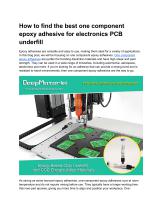
How to find the best one component epoxy adhesive for electronics PCB underfill Epoxy adhesives are versatile and easy to use, making them ideal for a variety of applications. In this blog post, we will be focusing on one component epoxy adhesives. One component epoxy adhesives are perfect for bonding dissimilar materials and have high shear and peel strength. They can be used in a wide range of industries, including automotive, aerospace, electronics and more. If you’re looking for an adhesive that can provide a strong bond and is resistant to harsh environments, then one component epoxy adhesives are the way to go. As strong as some two-part epoxy adhesives, one-component epoxy adhesives cure at room temperature and do not require mixing before use. They typically have a longer working time than two-part epoxies, giving you more time to align and position your workpiece. One-
Open the catalog to page 1
component epoxy adhesives are also often more forgiving than their two-part counterparts, making them ideal for less experienced users or for situations where precise mixing is difficult. 2. Types of One Component Epoxy Adhesives One component epoxy adhesives are available in a variety of formulations to suit different bonding needs. The three main types of one component epoxy adhesives are: - Structural adhesives: These adhesives are designed for bonds that need to withstand high stresses. They have excellent strength and durability, making them ideal for structural applications. - Assembly...
Open the catalog to page 2
1. Structural adhesives are designed for bonding high strength materials such as metals and composites. They typically have a very strong bond strength and can resist high temperatures and stress. 2. Instant adhesives are designed for quick bonding of materials such as plastics and rubbers. They have a fast setting time and provide a strong bond. 3. Low temperature adhesives are designed for bonding materials that are sensitive to heat, such as electronics. They have a low cure temperature and can be used in difficult to reach areas. 4. High temperature adhesives are designed for applications...
Open the catalog to page 3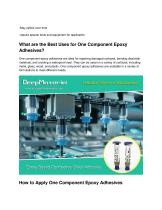
-May yellow over time -require special tools and equipment for application What are the Best Uses for One Component Epoxy Adhesives? One component epoxy adhesives are ideal for repairing damaged surfaces, bonding dissimilar materials, and creating a waterproof seal. They can be used on a variety of surfaces, including metal, glass, wood, and plastic. One component epoxy adhesives are available in a variety of formulations to meet different needs. How to Apply One Component Epoxy Adhesives
Open the catalog to page 4
If you're looking for a reliable and long-lasting adhesive, then one component epoxy adhesives are a great option. They can be used on a variety of materials, including metal, glass, and plastics, and they provide a strong bond that can withstand high temperatures and harsh environments. Applying one component epoxy adhesives is relatively simple, but there are a few things to keep in mind to ensure the best results. First, be sure to clean both surfaces that will be bonded together with the adhesive. Any dirt, grease, or other contaminants will weaken the bond and could cause it to fail. Next,...
Open the catalog to page 5All Shenzhen DeepMaterial Technologies Co., Ltd catalogs and technical brochures
 SMT Epoxy Adhesive
3 Pages
 SMT Epoxy Red Adhesive
3 Pages
 PCB Potting Compound
3 Pages
 DeepMaterial Epoxy-Based
3 Pages
 BGA Underfill Epoxy
3 Pages
 UV curable adhesive
3 Pages
 UV Conformal Coating
3 Pages
 Underfill Epoxy BGA
3 Pages
 Two component Epoxy Adhesive
4 Pages
 PUR Structural Adhesive
3 Pages
 Epoxy Encapsulant
3 Pages
 Waterproof adhesive glue
4 Pages
 SMT SMD epoxy adhesive
4 Pages
 Optical bonding adhesive
4 Pages
 Hot melt adhesive glue
4 Pages
 Magnet bonding adhesives
4 Pages
 LCD optical bonding adhesive
4 Pages
 Best epoxy adhesie for metal
4 Pages
 UV Curing UV Adhesive
13 Pages
 Structural Bonding Adhesive
10 Pages
 Functional Protective Film
3 Pages









- Single-component adhesive
- Adhesive tape
- Metal adhesive
- Industrial adhesive
- Plastic adhesive
- Glass adhesive
- Dispersion adhesive
- Bonding adhesive
- Two-component adhesive
- Electronic adhesive
- Ceramic adhesive
- Sealing adhesive
- Fast curing adhesive
- Viscosity adhesive
- Conductivity adhesive
- Wood adhesive
- Packaging foil
- Protective sheet
- Rubber adhesive