
- Catalogs
- Shaw Moisture Meters
- Trace Moisture Measurement in Ozone Generation

- Company
- Products
- Catalogs
- News & Trends
- Exhibitions
Trace Moisture Measurement in Ozone Generation
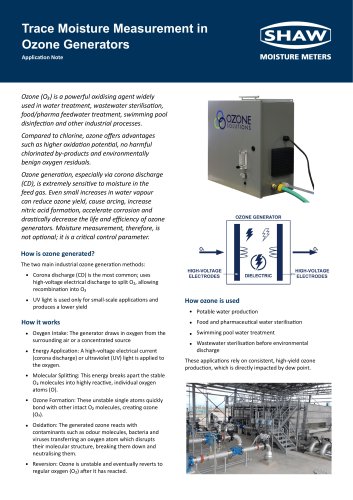
Trace Moisture Measurement in Ozone Generation
Ozone (O₃) is a potent oxidizing agent used in various industrial processes such as water treatment and sterilization. It offers advantages over chlorine, including higher oxidation potential and environmentally friendly by-products. However, ozone generation, particularly via corona discharge (CD), is highly sensitive to moisture, which can significantly reduce efficiency and lifespan.
1. Corona Discharge (CD): The most common method, using high-voltage electrical discharge to split O₂, allowing recombination into O₃.
2. UV Light: Used for small-scale applications, producing lower yields.
Ozone is used in potable water production, food and pharmaceutical water sterilization, swimming pool water treatment, and wastewater sterilization. Consistent, high-yield ozone production is crucial for these applications.
1. Oxygen Intake: Oxygen is drawn from the air or a concentrated source.
2. Energy Application: High-voltage current or UV light is applied.
3. Molecular Splitting: Energy breaks O₂ into reactive oxygen atoms.
4. Ozone Formation: Reactive atoms bond with O₂ to form O₃.
5. Oxidation: Ozone reacts with contaminants, neutralizing them.
6. Reversion: Ozone eventually reverts to O₂.
Moisture in the feed gas can lead to nitric acid formation, corrosion, and reduced ozone yield. At a dew point of −70°C, generators achieve 100% yield, but at −5°C, output may drop to 50%. Moisture also affects oxygen concentrators, reducing purity and causing early failure.
Dew point meters are crucial for monitoring and optimizing ozone generation systems. They ensure extremely dry feed gas, prevent arcing and nitric acid formation, and are integrated with PLC/SCADA systems for automatic shutdowns if moisture levels rise.
Moisture is a critical contaminant affecting ozone generator performance. Dew point meters are essential for maintaining efficiency and preventing damage. For product advice, contact Shaw Meters.
Catalog excerpts
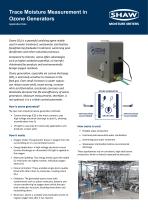
Application Note MOISTURE METERS Ozone (O3) is a powerful oxidising agent widely used in water treatment, wastewater sterilisation, food/pharma feedwater treatment, swimming pool disinfection and other industrial processes. Compared to chlorine, ozone offers advantages such as higher oxidation potential, no harmful chlorinated by-products and environmentally benign oxygen residuals. Ozone generation, especially via corona discharge (CD), is extremely sensitive to moisture in the feed gas. Even small increases in water vapour can reduce ozone yield, cause arcing, increase nitric acid formation, accelerate corrosion and drastically decrease the life and efficiency of ozone generators. Moisture measurement, therefore, is not optional; it is a critical control parameter. The two main industrial ozone generation methods: • Corona discharge (CD) is the most common; uses high-voltage electrical discharge to split O2, allowing recombination into O3 • UV light is used only for small-scale applications and produces a lower yield • Oxygen Intake: The generator draws in oxygen from the surrounding air or a concentrated source • Energy Application: A high-voltage electrical current (corona discharge) or ultraviolet (UV) light is applied to the oxygen. • Molecular Splitting: This energy breaks apart the stable O2 molecules into highly reactive, individual oxygen atoms (O). • Ozone Formation: These unstable single atoms quickly bond with other intact O2 molecules, creating ozone (Os). • Oxidation: The generated ozone reacts with contaminants such as odour molecules, bacteria and viruses transferring an oxygen atom which disrupts their molecular structure, breaking them down and neutralising them. • Reversion: Ozone is unstable and eventually reverts to regular oxygen (O2) after it has reacted. • Potable water production • Food and pharmaceutical water sterilisation • Swimming pool water treatment • Wastewater sterilisation before environmental discharge These applications rely on consistent, high-yield ozone production, which is directly impacted by dew point.
Open the catalog to page 1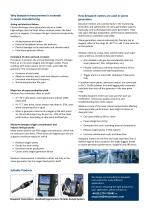
Arcing and electrical failure Corona discharge ozone generators rely on a stable high-voltage electrical field. When moisture enters the feed gas (air or oxygen), it increases the gas's electrical conductivity, leading to: • Arcing between electrodes • Electrical breakdown across the dielectric • Physical damage to the electrodes and chamber walls • Premature generator failure Formation of nitric acid and corrosion If moisture is present, the corona discharge converts nitrogen (from air or non pure oxygen) into nitrogen oxides. These combine with water vapour to form nitric acid inside the generator....
Open the catalog to page 2All Shaw Moisture Meters catalogs and technical brochures
 Superdew 3 WP Instruction Manual
28 Pages




- Display module
- Flowmeter
- Volume flow monitor
- Industrial display panel
- Pressure gauge
- Pressure limiter
- Gas flow monitor
- Stainless steel flow monitor
- Single-stage pressure regulator
- Industrial pressure limiter
- Analog pressure gauge
- LED display panel
- Filter housing
- Electronic display panel
- Dial pressure gauge
- Gas pressure limiter
- Programmable display system
- Cartridge filter housing
- Industrial printer
- Bourdon tube pressure gauge