
- Catalogs
- Shaw Moisture Meters
- Application Note - Trace Moisture Measurement in LNG and LPG Bulk Carriers

- Company
- Products
- Catalogs
- News & Trends
- Exhibitions
Application Note - Trace Moisture Measurement in LNG and LPG Bulk Carriers
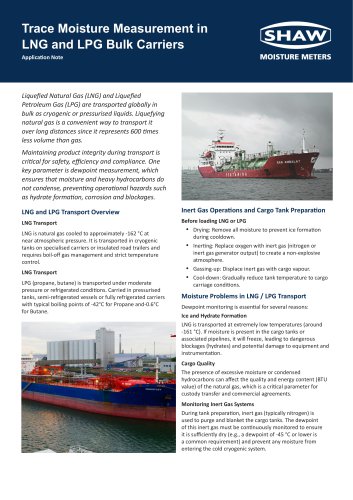
Application Note - Trace Moisture Measurement in LNG and LPG Bulk Carriers
- LNG Transport: LNG is natural gas cooled to approximately -162°C at near atmospheric pressure, transported in cryogenic tanks on specialized carriers or insulated road trailers. It requires boil-off gas management and strict temperature control.
- LPG Transport: LPG (propane, butane) is transported under moderate pressure or refrigerated conditions in pressurized tanks, semi-refrigerated vessels, or fully refrigerated carriers. Typical boiling points are -42°C for Propane and -0.6°C for Butane.
- Inert Gas Operations and Cargo Tank Preparation: Before loading, tanks must be dried to remove moisture, inerted to replace oxygen with inert gas, gassed-up to displace inert gas with cargo vapor, and cooled down to cargo carriage conditions.
- Moisture Problems: Dewpoint monitoring is crucial to prevent ice and hydrate formation, which can cause blockages and equipment damage. Excessive moisture affects cargo quality and energy content.
- Monitoring Inert Gas Systems: Continuous monitoring of the inert gas dewpoint is necessary to ensure it is dry enough to prevent moisture from entering the cryogenic system.
- Dewpoint Meters: Used during inert gas operations and cargo tank preparation to prevent ice or liquid condensation. They monitor the quality and dryness of inert gas and verify the dryness of cargo tanks before loading.
- Key Uses: Include inerting and purging systems, cargo tank preparation, and spot checks for moisture levels to ensure safe conditions.
- Portable Sample System
- SADP Intrinsically Safe Hygrometer
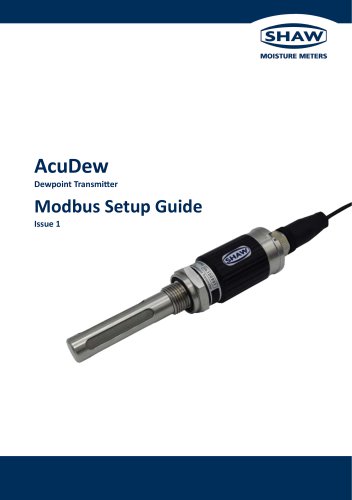
- Dewpoint Sensor
- ISO 23306:2020 – LNG as marine fuel specification
- ASTM D1142 – Water vapor in natural gas
- ASEE-gas Common Business Practice 2005-001/01
- API MPMS – Manual of Petroleum Measurement Standards
Catalog excerpts
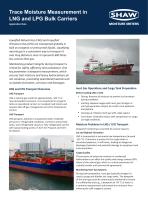
Application Note MOISTURE METERS Liquefied Natural Gas (LNG) and Liquefied Petroleum Gas (LPG) are transported globally in bulk as cryogenic or pressurised liquids. Liquefying natural gas is a convenient way to transport it over long distances since it represents 600 times less volume than gas. Maintaining product integrity during transport is critical for safety, efficiency and compliance. One key parameter is dewpoint measurement, which ensures that moisture and heavy hydrocarbons do not condense, preventing operational hazards such as hydrate formation, corrosion and blockages. LNG is natural gas cooled to approximately -162 °C at near atmospheric pressure. It is transported in cryogenic tanks on specialised carriers or insulated road trailers and requires boil-off gas management and strict temperature control. LPG (propane, butane) is transported under moderate pressure or refrigerated conditions. Carried in pressurised tanks, semi-refrigerated vessels or fully refrigerated carriers with typical boiling points of -42°C for Propane and-0.6°C for Butane. • Drying: Remove all moisture to prevent ice formation during cooldown. • Inerting: Replace oxygen with inert gas (nitrogen or inert gas generator output) to create a non-explosive atmosphere. • Gassing-up: Displace inert gas with cargo vapour. • Cool-down: Gradually reduce tank temperature to cargo carriage conditions. Dewpoint monitoring is essential for several reasons: LNG is transported at extremely low temperatures (around -161 °C). If moisture is present in the cargo tanks or associated pipelines, it will freeze, leading to dangerous blockages (hydrates) and potential damage to equipment and instrumentation. Cargo Quality The presence of excessive moisture or condensed hydrocarbons can affect the quality and energy content (BTU value) of the natural gas, which is a critical parameter for custody transfer and commercial agreements. Monitoring Inert Gas Systems During tank preparation, inert gas (typically nitrogen) is used to purge and blanket the cargo tanks. The dewpoint of this inert gas must be continuously monitored to ensure it is sufficiently dry (e.g., a dewpoint of -45 °C or lower is a common requirement) and prevent any moisture from entering the cold cryogenic system.
Open the catalog to page 1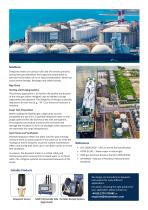
Solutions Dewpoint meters are used on LNG and LPG vessels primarily during inert gas operations and cargo tank preparation to prevent the formation of ice or liquid condensation, which can cause severe damage, blockages and safety hazards. Key Uses Inerting and Purging Systems The primary application is to monitor the quality and dryness of the inert gas (often nitrogen) used to blanket or purge cargo tanks and pipework. The dewpoint of this gas is typically required to be very low (e.g., -45 °C) to ensure all moisture is removed. Cargo Tank Preparation Before loading the liquified gas, cargo...
Open the catalog to page 2All Shaw Moisture Meters catalogs and technical brochures
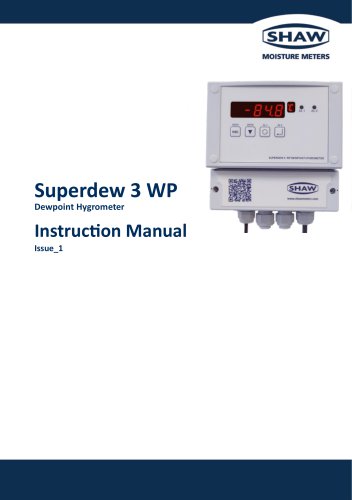 Superdew 3 WP Instruction Manual
28 Pages


- Display module
- Flowmeter
- Volume flow monitor
- Industrial display panel
- Pressure gauge
- Pressure limiter
- Gas flow monitor
- Stainless steel flow monitor
- Single-stage pressure regulator
- Industrial pressure limiter
- Analog pressure gauge
- LED display panel
- Filter housing
- Electronic display panel
- Dial pressure gauge
- Gas pressure limiter
- Programmable display system
- Cartridge filter housing
- Industrial printer
- Bourdon tube pressure gauge