
- Catalogs
- Shaw Moisture Meters
- Application Note - Trace Moisture in Hydrogen Cooled Generators

- Company
- Products
- Catalogs
- News & Trends
- Exhibitions
Application Note - Trace Moisture in Hydrogen Cooled Generators
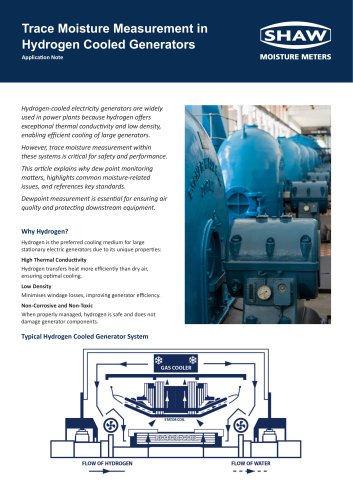
Application Note - Trace Moisture in Hydrogen Cooled Generators
Hydrogen-cooled electricity generators are prevalent in power plants due to hydrogen's excellent thermal conductivity and low density, which facilitate efficient cooling. However, monitoring trace moisture is crucial for safety and performance. This document discusses the importance of dew point monitoring, common moisture-related issues, and relevant standards.
Hydrogen is favored as a cooling medium for large generators because of its high thermal conductivity, low density, and non-corrosive, non-toxic nature, making it safe and efficient for cooling purposes.
Moisture ingress can cause significant operational and safety issues, including reduced insulation resistance, corrosion, reduced hydrogen purity, and safety hazards due to explosive mixtures.
Continuous dewpoint monitoring is essential for maintaining generator safety and performance. Key solutions include online dewpoint sensors, control systems for triggering alarms or purging, and portable dewpoint meters for checking various sample points.
For best practices and compliance, refer to standards such as IEEE Std C50.13, IEC 60034-3, and ASTM D5454. These standards guide the requirements and testing methods for hydrogen-cooled generators.
Dewpoint measurement is critical for the safe and efficient operation of hydrogen-cooled generators. By maintaining low moisture levels, operators can ensure reliable performance and minimize risks. Implementing robust monitoring and control strategies is essential for modern power generation facilities.
Catalog excerpts

Trace Moisture Measurement in Hydrogen Cooled Generators Application Note Hydrogen-cooled electricity generators are widely used in power plants because hydrogen offers exceptional thermal conductivity and low density, enabling efficient cooling of large generators. However, trace moisture measurement within these systems is critical for safety and performance. This article explains why dew point monitoring matters, highlights common moisture-related issues, and references key standards. Dewpoint measurement is essential for ensuring air quality and protecting downstream equipment. Why Hydrogen? Hydrogen is the preferred cooling medium for large stationary electric generators due to its unique properties: High Thermal Conductivity Hydrogen transfers heat more efficiently than dry air, ensuring optimal cooling. Low Density Minimises windage losses, improving generator efficiency. Non-Corrosive and Non-Toxic When properly managed, hydrogen is safe and does not damage generator components. Typical Hydrogen Cooled Generator System
Open the catalog to page 1
Moisture Problems in Hydrogen Cooled Generators Moisture ingress can lead to severe operational and safety issues: • Reduced insulation resistance Condensed water on windings lowers insulation, increasing electrical fault risk. Moisture accelerates metal degradation, causing premature component failure. • Hydrogen purity reduction Water vapour dilutes hydrogen, reducing cooling efficiency and increasing explosion risk. • Safety hazards Excess moisture can form explosive hydrogen-oxygen mixtures Continuous dewpoint monitoring is essential for maintaining generator safety and performance. • Online...
Open the catalog to page 2All Shaw Moisture Meters catalogs and technical brochures
 Superdew 3 WP Instruction Manual
28 Pages





- Display module
- Flowmeter
- Volume flow monitor
- Industrial display panel
- Pressure gauge
- Pressure limiter
- Gas flow monitor
- Stainless steel flow monitor
- Single-stage pressure regulator
- Industrial pressure limiter
- Analog pressure gauge
- LED display panel
- Filter housing
- Electronic display panel
- Dial pressure gauge
- Gas pressure limiter
- Programmable display system
- Cartridge filter housing
- Industrial printer
- Bourdon tube pressure gauge