
- Catalogs
- SHAREBOT SRL
- Snowwhite2 enduser patent report

Snowwhite2 enduser patent report
Snowwhite2 enduser patent report
Catalog excerpts
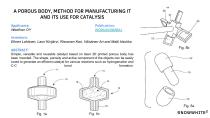
Elmeri Lahtinen, Lauri Kivijarvi, Rissanen Kari, Vaisanen Ari and Matti Haukka Simple, versatile and reusable catalyst based on laser 3D printed porous body has been invented. The shape, porosity and active component of the objects can be easily tuned to generate an efficient catalyst for various reactions such as hydrogenation and C-C bond formation.
Open the catalog to page 2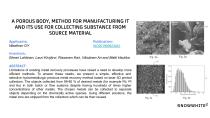
A POROUS BODY, METHOD FOR MANUFACTURING IT AND ITS USE FOR COLLECTING SUBSTANCE FROM SOURCE MATERIAL Applicants: Weefiner OY Inventors: Elmeri Lahtinen, Lauri Kivijärvi, Rissanen Kari, Väisänen Ari and Matti Haukka ABSTRACT: Limitations of existing metal recovery processes have raised a need to develop more efficient methods. To answer these needs, we present a simple, effective and selective hydrometallurgic precious metal recovery method based on laser 3D printed collectors. The objects collected from 99-80 % of desired metals (for example Pd, Pt and Au) in both batch or flow systems despite...
Open the catalog to page 3
POWDER-BASED ADDITIVE MANUFACTURING PROCESS AT LOW TEMPERATURES Applicants: COVESTRO DEUTSCHLAND AG Inventors: Achten Dirk, Akbas Levent, Arndt Wolfgang, Büchner Jörg, Büsgen Thomas, Degiorgio Nicolas, Dijkstra Dirk, Reichert Peter, Wagner Roland ABSTRACT: A process for manufacturing an article comprises the steps of: applying a layer that consists of particles to a target area; allowing, in a chamber, energy to act on a selected portion of the layer, according to a cross-section of the article, so that the particles in the selected portion are bonded, and repeating the steps of applying and...
Open the catalog to page 4
PROCESS FOR PRODUCING 3D STRUCTURES FROM POWDERED RUBBER MATERIAL AND ITS PRODUCTS Applicants: COVESTRO DEUTSCHLAND AG Inventors: Achten Dirk, Akbas Levent, Busgen Thomas, Dijkstra Dirk, Kessler Michael, Mettmann Bettina, Wagner Roland ABSTRACT: A process is described for producing a three dimensional structure, the process including the following steps a) applying of at least a first material M1 onto a substrate to build a first layer L1 onthe substrate; b) layering of at least one further layer Ly of the first material M1 or of a further material Mx onto the first layer L1, wherein the at least...
Open the catalog to page 5
METHOD FOR PRODUCING AN AT LEAST PARTIALLY COATED OBJECT Applicants: COVESTRO DEUTSCHLAND AG Inventors: Achten Dirk, Akbas Levent, Busgen Thomas, Guedou Arnaud, Hittig Jurgen, Mettmann Bettina, Michaelis Thomas, Wagner Roland ABSTRACT: The invention relates to a method for producing an at least partially coated object, comprising the step of producing the object from a construction material by means of an additive manufacturing method, the construction material comprising a thermoplastic polyurethane material. Following the production of the object, the method comprises the step of at least partially...
Open the catalog to page 6
Gimenez Jerome The present invention relates to a powder of crosslinkable polyamide spherical particles, which is suitable for selective laser sintering (SLS) technology, and a method for preparing the powder of such crosslinkable polyamide spherical particles. The present invention also relates to the production of articles by performing SLS starting from the powder of the crosslinkable polyamide spherical particles, and then performing a crosslinking step. fflffSLS. misi&fT&W&m&S.FMRo
Open the catalog to page 7
POWDERS FOR LASER SINTERING Applicants: XEROX CORP Inventors: Farrugia Valerie, Gardner Sandra J., Zwartz Edward G. ABSTRACT: Provided herein is a powder composition comprising a silica-infused crystalline polyester particle for laser sintering comprising at least one crystalline polyester resin and silica nanoparticles present in the particle an amount ranging from about 10 wt % to about 60 wt % relative to the total weight of the particle. Further provided herein are methods of preparing silica-infused crystalline polyester particles.
Open the catalog to page 8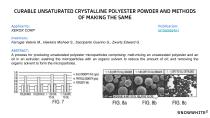
Farrugia Valerie M., Hawkins Michael S., Sacripante Guerino G., Zwartz Edward G. A process for producing unsaturated polyester microparticles comprising: melt-mixing an unsaturated polyester and an oil in an extruder; washing the microparticles with an organic solvent to reduce the amount of oil; and removing the organic solvent to form the microparticles. d BULK DENSITY AVG (gfcC) o PARTICLE DENSITY (g/cc) □ POROSITY (O) 1:1.33 (CPE TO OIL) BEAKER | 1:1.66 (CPE TO OIL) BEAKER | 1:1 (CPE TO OIL) EXTRUDED
Open the catalog to page 9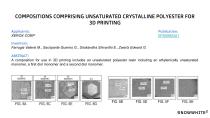
ethylenically unsaturated Applicants: XEROX CORP Farrugia Valerie M., Sacripante Guerino G., Sriskandha Shivanthi E., Zwartz Edward G. A composition for use in 3D printing includes an unsaturated polyester resin including an monomer, a first diol monomer and a second diol monomer.
Open the catalog to page 10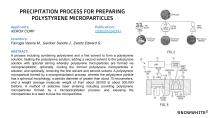
Applicants: Publication: XEROX CORP US2Q2Q1Q2427A1 Farrugia Valerie M., Gardner Sandra J., Zwartz Edward G. ABSTRACT: A process including combining polystyrene and a first solvent to form a polystyrene solution; heating the polystyrene solution; adding a second solvent to the polystyrene solution with optional stirring whereby polystyrene microparticles are formed via microprecipitation; optionally, cooling the formed polystyrene microparticles in solution; and optionally, removing the first solvent and second solvent. A polystyrene microparticle formed by a microprecipitation process, wherein...
Open the catalog to page 11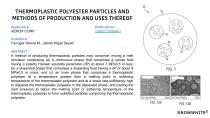
Farrugia Valerie M., Jamali Hojjat Seyed A method of producing thermoplastic particles may comprise: mixing a melt emulsion comprising (a) a continuous phase that comprises a carrier fluid having a polarity Hansen solubility parameter (dP) of about 7 MPa0.5 or less, (b) a dispersed phase that comprises a dispersing fluid having a dP of about 8 MPa0.5 or more, and (c) an inner phase that comprises a thermoplastic polyester at a temperature greater than a melting point or softening temperature of the thermoplastic polyester and at a shear rate sufficiently high to disperse the thermoplastic polyester...
Open the catalog to page 12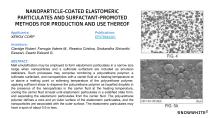
NANOPARTICLE-COATED ELASTOMERIC PARTICULATES AND SURFACTANT-PROMOTED METHODS FOR PRODUCTION AND USE THEREOF Applicants: XEROX CORP Inventors: Claridge Robert, Farrugia Valerie M., Resetco Cristina, Sriskandha Shivanthi Easwari, Zwartz Edward G. ABSTRACT: Melt emulsification may be employed to form elastomeric particulates in a narrow size range when nanoparticles and a sulfonate surfactant are included as emulsion stabilizers. Such processes may comprise combining a polyurethane polymer, a sulfonate surfactant, and nanoparticles with a carrier fluid at a heating temperature at or above a melting...
Open the catalog to page 13All SHAREBOT SRL catalogs and technical brochures
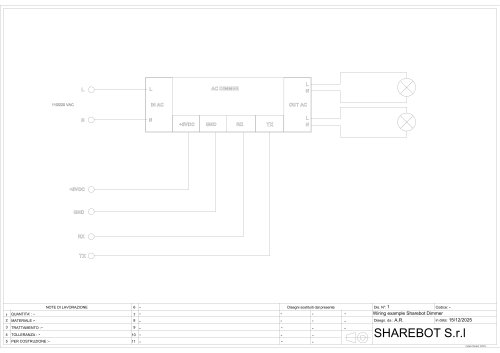 Dimmer wiring diagram
1 Page
 SDS Finishxpert Filler
30 Pages
 Snowwhite2 Handbook
40 Pages
 Snowwhite2 PCL
4 Pages
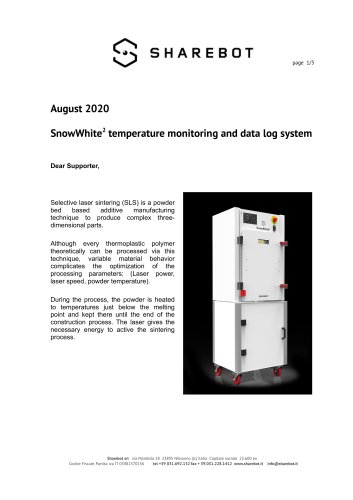 Snowwhite2 Temperature LOG
3 Pages
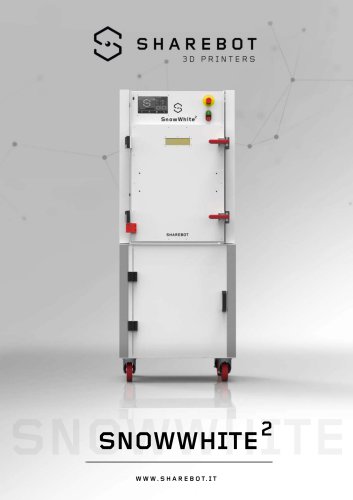 Snowwhite2 brochure
2 Pages
 Snowwhite2 User Manual
49 Pages
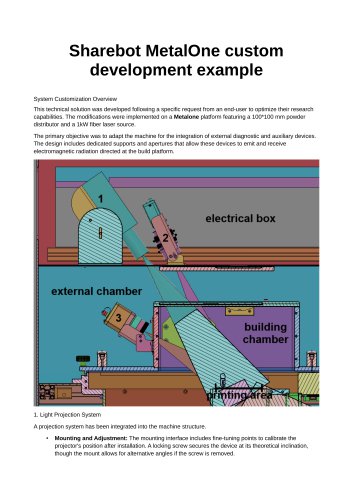 Metalone custom development
2 Pages
 Metalone User Manual
73 Pages
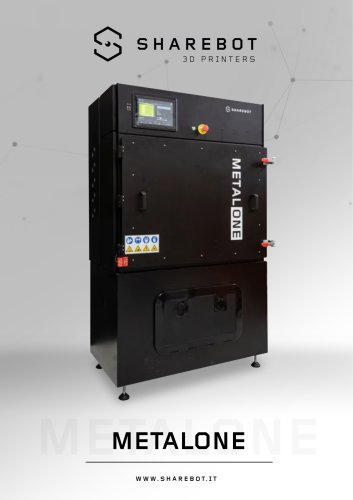 Metalone brochure
2 Pages
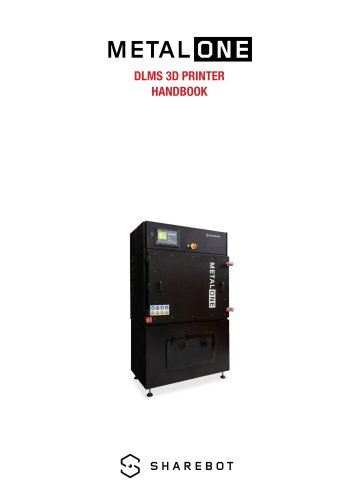 Metalone Handbook
28 Pages
 User Manual Snowwhite2HT
44 Pages
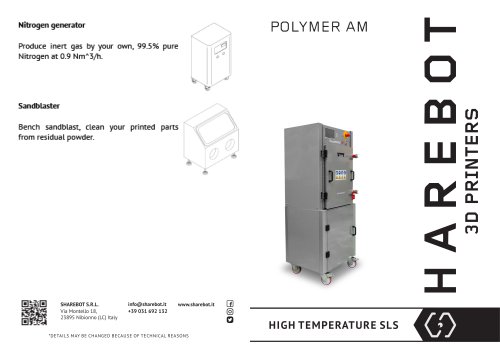 Brochure Snowwhite2HT
2 Pages
- Automatic test kit
- Industrial 3D printer
- Plastic additive manufacturing machine
- Prototyping 3D printing machine
- FDM 3D printer
- High-performance 3D printer
- Laboratory test kit
- Plastic spray
- Large-format 3D printer
- High-speed 3D printer
- Metal 3D printing machine
- ABS 3D printer
- Polyester sealant
- PLA 3D printer
- Resin 3D printer
- Desktop 3D printer
- Medical 3D printing machine
- Dental additive manufacturing machine
- PA 3D printer