

S112C

S112C
Summary of Technical Points
1. Inherent Characteristics
This section refers to the fundamental properties intrinsic to the system or components under consideration, which influence overall performance.
2. Low Frequency Response
The low frequency response of the system is governed by the external signal conditioner, indicating that the conditioning hardware plays a critical role in determining how the system handles low-frequency signals.
3. Least Square Method
The least square method is mentioned, likely as a mathematical or data fitting technique used for analysis or calibration purposes within the system.
4. Dependence on Material and Quantity of Sensing Elements
The performance or characteristics depend on both the material composition and the number of sensing elements, highlighting the importance of sensor design and selection.
Catalog excerpts

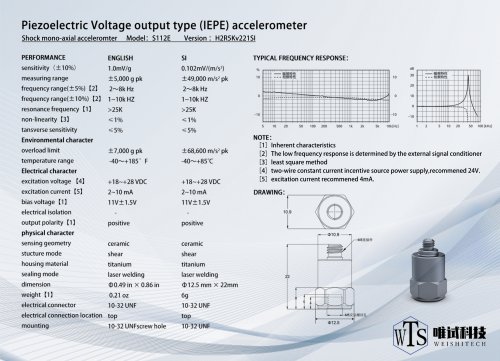
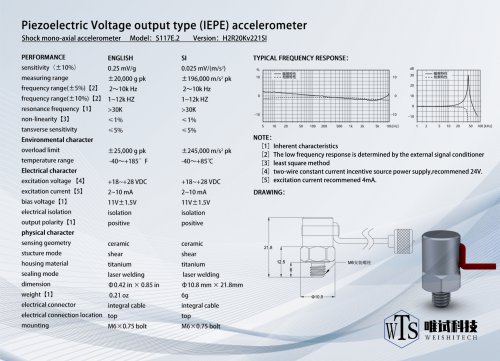
PERFORMANCE sensitivity (±10%) measuring range frequency response±5%) [2] frequency response! ±10%) [2] resonance frequency [1] Nonlinear [3] lateral sensitivity Environmental character overload limit temperature range Electrical character capacitance [4] insulation resistance output polarity [1] electrical isolation physical character sensing element stucture mode shell material sealing mode dimensions weight [1] electrical connector electrical connection location mounting thread ENGLISH 0.05 pC/g ±100,000 g pk 10kHz 12k HZ >45K <1% <5% ±130,000 gpk -40~+185° F 90 pF »1x10"Q isolation positive ceramic shear titanium laser welding 00.40 in x 0.98 in 0.15 oz integral cable top M6X0.75 bolt SI 0.005 pC/(m/s2) ±980,000 m/s2 pk 10kHz 12k HZ >45K <1% <5% ±1,274,000 m/s2 pk -40~+85°C 90 pF >1x10"Q isolation positive ceramic shear titanium laser welding 010.2 mm x 25 mm 4.3 g integral cable top M6x0.75bolt NOTE: [1] Inherent characteristics [2] The low frequency response is determined by the external signal conditioner [3] leastsquaremethod [4] It depends on the material and quantity of sensing elements
Open the catalog to page 1All Shanghai WTS Technology Co.,Ltd catalogs and technical brochures
 WTS Company Bruchure
28 Pages
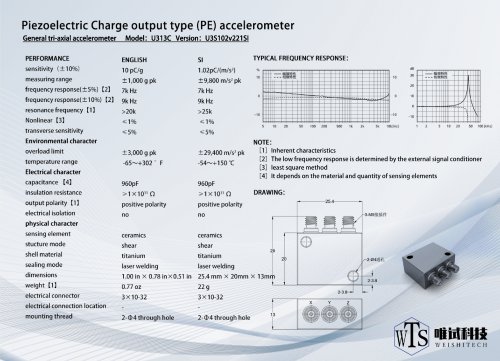 U313C
U313C1 Page
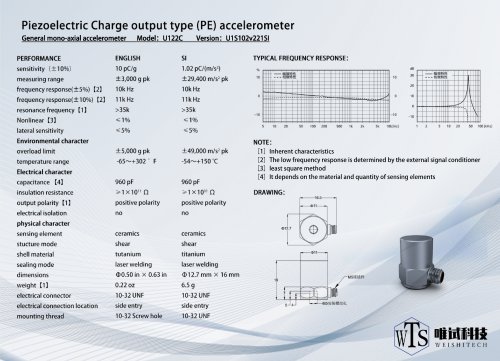 U122C
U122C1 Page
 US22E
US22E1 Page
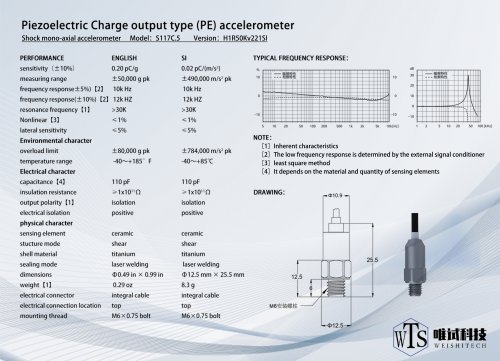 S117C.5
1 Page
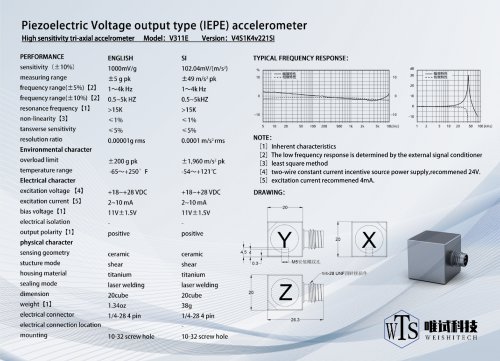
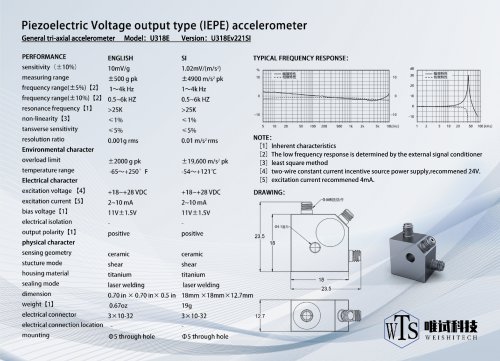
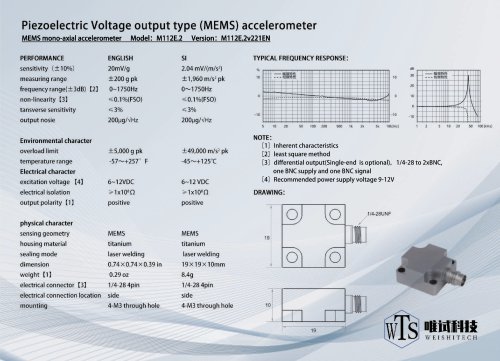
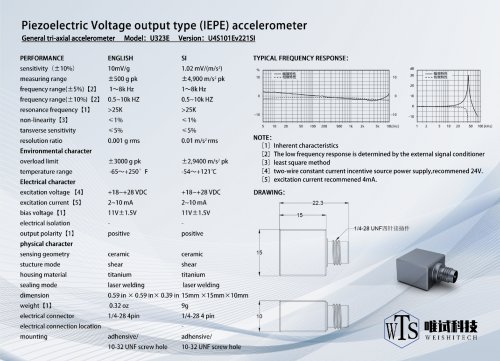
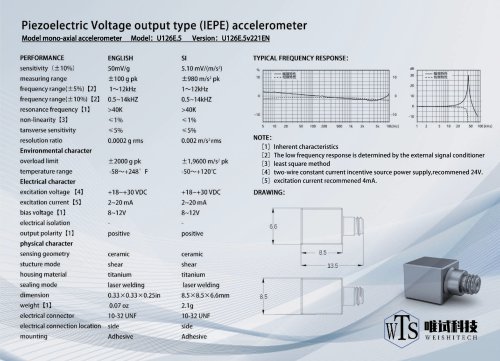
- Acceleration sensor
- Piezoelectric accelerometer
- Single-axis accelerometer
- IEPE accelerometer
- Triaxial acceleration sensor
- Compact accelerometer
- Industrial accelerometer
- MEMS accelerometer
- Interface adapter
- Rugged accelerometer
- High-sensitivity accelerometer
- Shear accelerometer
- Miniature accelerometer
- Low-noise accelerometer
- Vibrating accelerometer
- Adhesive accelerometer
- Rugged accelerometer
- USB interface
- Communication interface
- Submersible accelerometer