
- Catalogs
- Shanghai Jianping Dynamic Balancing Machine
- Railway Industry balancing machine


- Company
- Products
- Catalogs
- News & Trends
- Exhibitions
Railway Industry balancing machine

Railway Industry balancing machine
This document provides a technical overview of equipment used in the railway industry, specifically focusing on machines for dynamic balancing tests and corrections of train components such as brake discs, wheels, and wheelsets. The document highlights the features and applications of various machines designed for these purposes.
Specifications and Features
- Dynamic Balancing Machines: These machines are primarily used for the dynamic balancing of train brake discs, wheels, and other large disc-shaped workpieces. They can be equipped with weight removal devices as per customer requirements.
- Automatic Lifting and Safety Features: The machines feature automatic lifting and lowering of workpieces to reduce impact forces, and safety doors that automatically operate to ensure personnel safety.
- Drive and Precision: The machines use a gearbox and shifting fork drive, combined with a servo motor, to ensure high balance quality and precision.
- Efficiency and Power: They are characterized by a wide range of speed regulation, large driving power, and high working efficiency.
- Automatic Measurement and Correction: The equipment can automatically measure the dynamic unbalance amount and phase of wheelsets and correct them by removing weight based on the detected unbalance phase.
- Additional Functions: Features include automatic chip suction, remote diagnostic capabilities for easy upgrades and maintenance, and optional pneumatic marking and code scanning functions.
Product Descriptions
- PHLD-1100Q/3500Q: Train brake disc balancing machine.
- A1WX10: Fully automatic correction machine for train wheelsets.
- PHC-1000: Train drive shaft balancing machine.
- PHW-15000: Train motor balancing machine.
- PHZS-160: Train fan assembly balancing machine.
- AILX21-350: Fully automatic correction machine for train brake discs.
Applications
The machines are used in various applications within the railway industry, including balancing of brake discs, wheel discs, axles, and other components. They are essential for ensuring the safety and efficiency of train operations by maintaining the balance and precision of critical components.
Catalog excerpts
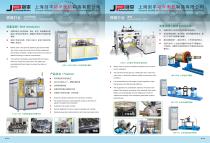
Railway Industry - Train Brake Disc Railway Industry - Other 简要说明 / Brief Introduction 简要说明 / Brief Introduction 本机采用齿轮箱,拨叉传动,配合伺服电机驱动,保 证了工件的平衡质量及精度。 具有调速范围广,驱动功率大,工作效率高的特点。 该机工件自动升降,可减少冲击力;安全门自动升降, 保障人员安全。 Mainly used in the dynamic balancing test of train brake disc, wheel, wheel set, brake disc and other large-sized disc-shaped workpiece, weight removal device can also be added according to customer requirements. The machine's workpiece automatically lifts and lowers, which can reduce the impact force; the safety door automatically lifts and lowers to protect the safety of Mainly used for dynamic unbalance detection and correction of train wheelsets. This machine adopts gear box, shifting fork drive, with servo 产品特点 / Features motor drive, to ensure the balance quality and precision of the It is characterized by wide range of speed regulation, large driving power and high working efficiency. The equipment can automatically measure the amount and
Open the catalog to page 1All Shanghai Jianping Dynamic Balancing Machine catalogs and technical brochures
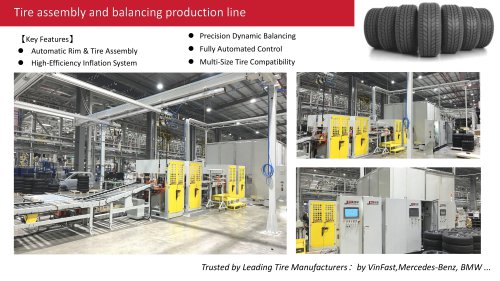 Balancing machine line series
11 Pages
 Service Support
1 Page
 Roller Industry
1 Page
 Machine Tool Industry
1 Page
 Pump Industry -
1 Page
 Measuring Systems
1 Page
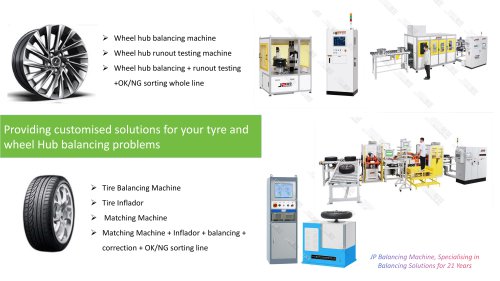


- Measuring machine
- Automatic measurement system
- Horizontal balancing system
- High-precision measurement system
- Measuring system for industrial applications
- Wheel balancer
- Rotor balancing machine
- Automatic balancer
- Vibration analyzer
- Vertical balancing machine
- Car wheel balancer
- High-accuracy balancing machine
- Automatic wheel balancer
- Compact measurement system
- Portable vibration meter
- Two-plane balancing machine
- Fan balancing machine
- Modular balancing machine