
- Catalogs
- Shandong Tianli Energy Co.,Ltd.
- Tianli/Spry Dryer


- Company
- Products
- Catalogs
- News & Trends
- Exhibitions
Tianli/Spry Dryer

Tianli/Spry Dryer
The spray dryer is designed to process various forms of raw material liquids, including solutions, emulsions, suspensions, melts, or pastes, into dried products such as powders, granules, hollow spheres, or pellets. The key component is the atomizer, specifically a pressure atomizer, which disperses the feed liquid into droplets by converting pressure energy into kinetic energy. This process is efficient for heat-sensitive materials due to rapid heat and mass transfer.
Performance Characteristics
- Simple nozzle structure for ease of use and maintenance.
- Online replaceable spray gun for continuous operation.
- Low atomization power and operational cost.
- Produces hollow spherical products with good solubility and fluidity.
- Suitable for non-sticky and low-viscous liquid materials.
Equipment Specification
The spray dryer is applicable across various industries:
- Chemical Industry: Suitable for materials like white carbon black, barium sulfate, alumina, and more.
- Food Industry: Processes dextrin, maltose, protein powder, and other food products.
- Pharmaceutical Industry: Used for Chinese and Western medicine powders, antibiotics, and vitamins.
- Building Materials Industry: Suitable for ceramic billets and glazes.
- Environmental Protection: Used in flue gas desulfurization and waste treatment.
Specification Details
The equipment comes in various sizes, with diameters ranging from 1800 mm to 13500 mm and heights from 7 m to 65 m. The atomization method is pressure nozzle atomization, with inlet air temperatures ranging from 120℃ to 700℃. Heat sources include electric heating, coal burning, fuel oil, gas, hot air stove, and flue gas furnace.
Catalog excerpts

Shandong Tianli Energy Co., Ltd. Spray Dryer Equipment Introduction The spray-dried raw material liquid may be solution, emulsion, suspension, melt or paste liquid. The dried product may be in the form of powder, granules, hollow spheres or pellets as needed. The atomizer that disperses the feed liquid into droplets is the key component of spray dryer. A pressure atomizer is used to obtain a high pressure by a high-pressure pump. When the high-pressure liquid passes through the nozzle, the pressure energy is converted into kinetic energy and dispersed as droplets at a high-speed discharge. The hot air and the atomized droplets undergo heat transfer and mass transfer processes, and the droplets are dehydrated and dried into powder, granules, hollow spheres or pellets. Due to the fast heat transfer and mass transfer in the tower, it is especially suitable for the drying of heat sensitive materials, has better heat transfer efficiency. Performance Characteristics 1. The nozzle structure is simple and easy to use and maintain. 2. The spray gun can be replaced online to achieve continuous operation of the system. 3. The atomization power is small and the running cost is low. 4. The product has a hollow spherical shape, large particle size, good solubility and fluidity. 5. Ideal for drying non-sticky and low-viscous liquid materials. Add: Jinan·China
Open the catalog to page 1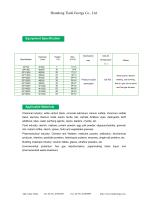
Chemical industry: white carbon black, concrete admixture, barium sulfate, chromium sulfate basic, alumina, titanium oxide, kaolin, ferrite, talc, carbide, fertilizer, dyes, detergents, ACR additives, latex, water purifying agents, resins, plastics, cryolite, etc. Food industry: dextrin, maltose, protein powder, egg yolk powder, oligosaccharides, granular oils, instant coffee, starch, spices, fruits and vegetables granules. Pharmaceutical industry: Chinese and Western medicine powder, antibiotics, biochemical products, vitamins, pesticide powders, hydrolyzed proteins, enzymes, single-cell proteins,...
Open the catalog to page 2All Shandong Tianli Energy Co.,Ltd. catalogs and technical brochures
 Tianli/Steam Rotary Dryer
2 Pages
 Tianli/Spin Flash Dryer
2 Pages
 Tianli/Rotary Dryer
2 Pages
 Tianli/Rotary Cooler
2 Pages
 Tianli/Rotary Calciner
2 Pages
 Tianli/Paddle Dryer
2 Pages
 Tianli/Fluidized Bed Dryer
2 Pages


- Kiln
- Electric furnace
- Chiller
- Liquid recirculation chiller
- Air chiller
- Combustion kiln
- Water recirculation chiller
- Gas kiln
- Industrial cooling system
- Continuous drying system
- Curing furnace
- Air blast drying system
- Air-cooled blast chiller
- Continuous oven
- Dewatering system for the food industry
- Hot air dryer
- Water-cooled recirculation chiller
- Centrifugal drying system
- Dryer for the chemical industry