

- Products
- Catalogs
- News & Trends
- Exhibitions
FlIP FLOP

FlIP FLOP
The SKAKO "Flip-Flow" screen is designed for efficient screening of problematic materials using a trampoline effect. It is particularly effective for materials with excessive moisture, low density, or those prone to clogging conventional screens.
Specifications
The screen features polyurethane meshes and a sub-resonant frame that amplifies vibrations, achieving up to 50 G acceleration. The screening surface consists of high-density polyurethane panels, which are modular and vary in size based on the material and mesh opening required. The panels are manually fixed using polyurethane wedges, simplifying maintenance.
Screening Capabilities
The screen aperture size ranges from 0.8 mm to 50 mm, with adjustable polyurethane hardness and thickness. It is suitable for various applications, including recycling of used cars, expired food and drugs, construction waste, glass, slags, urban solid waste, used tires, biomass, and metals.
Combination with Other Media
The "Flip-Flow" screen can be combined with other screening media such as conventional metal mesh, rigid polyurethane panels, metal bars, and holed plates. This allows for tailored vibration frequencies and amplitudes for different screening surfaces and products.
Quality Assurance
Each SKAKO Vibration machine undergoes factory testing to ensure reliability, maximum capacity, and efficiency. The company offers a wide range of products to provide optimized solutions for customer needs.
Applications
The screen is versatile and applicable in numerous industries, including recycling and waste management.
Catalog excerpts
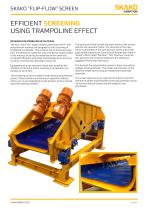
SKAKO ”FLIP-FLOW” SCREEN EFFICIENT SCREENING USING TRAMPOLINE EFFECT DESIGNED FOR PROBLEMATIC MATERIAL The new “Flip-Flow” elastic mesh screens type SN-FF with polyurethane meshes are designed for the screening of problematic materials. This could be due to excessive moisture, low density or materials with a tendency to get caught in the meshes. In particular materials which cannot be screened efficiently with other technologies such as rotary screens, conventional vibrating screens, etc. The panels are fixed to both the main frame of the screen and the sub resonant frame. The vibration of the main frame is amplified on the sub resonant frame and as the polyurethane panels are fixed to both frames they make a “bump” effect called “flip-flow”. This “flip-flow” bump effect prevents the screened material from sticking or pegging in the screen apertures. Equipped with a sub resonant frame that amplifies the vibration of the main frame, resulting in acceleration on meshes of up to 50 G. The fixing of the polyurethane panels is done manually by wedges of polyurethane. This makes maintenance of the machine simple due to its quick replacement and easy assembly. The screening surface is made of high density polyurethane panels. These panels are mounted on separate modules which vary in size depending on the product to be screened and mesh opening needed. The screen aperture size range is from 0.8 mm to 50 mm and the hardness and thickness of the polyurethane can be varied according to screen and the product to be processed.
Open the catalog to page 1
The applications where these screens are used are becoming more numerous but include among others: • Urban solid waste • Used cars recycling • Construction waste recycling • Used tires recycling • Expired food • Glass recycling • Biomass • Expired drugs • Slags from incineration For some applications where different types of screening is required, the "Flip-Flow” can be combined with different types of screen surfaces either on the same machine or as a set of two machines. With the advantage of separate machines being the ability to combine different vibration frequencies and amplitudes appropriate...
Open the catalog to page 2All Shako catalogs and technical brochures
 MASTERMIX
2 Pages
 RECYCLING INDUSTRY
4 Pages
 SKAKO CONCRETE ROTOCONIX®
4 Pages
 High-performance Mixers
2 Pages
 PRODUCTS AND SOLUTIONS
9 Pages


- Dynamic agitator
- Batch agitator
- Screening unit
- Liquid homogenizer
- Vertical homogenizer
- Automatic dispensing system
- Vibrating screening machine
- Solid dosing unit
- Automatic blender
- High-precision dosing unit
- Turbine homogenizer
- Recycling screening machine
- Construction scalper screen
- Waste screening machine
- Gravimetric dispensing system
- Hopper dispensing system
- Manual dosing unit
- Pneumatic dispensing system
- Rotary sieving machine
- Belt dispensing system