
- Catalogs
- Shaanxi CXMET Technology Co., Ltd.
- Standard Specification for Titanium and Titanium Alloy Wire1

Standard Specification for Titanium and Titanium Alloy Wire1

Standard Specification for Titanium and Titanium Alloy Wire1
This document specifies various grades of titanium and titanium alloy wire, detailing their composition and applications. It includes unalloyed titanium with different oxygen levels and titanium alloys with elements like aluminum and vanadium. Some grades, marked with an 'H', are suitable for pressure vessels, ensuring a minimum ultimate tensile strength of 58 ksi.
The specification references ASTM standards for testing and analysis, including tension testing and spectrometric analysis, as well as AWS standards for welding electrodes and rods.
Definitions are provided for terms such as 'coils', 'straight lengths', 'weld wire', and 'wire', which includes various shapes and dimensions.
Wire products are classified into coils, straight lengths, and weld wire, each with specific requirements for dimensions, chemistry, and mechanical properties. Welding filler metal has stricter element limits due to oxygen increase during welding.
Orders must specify grade, product description, chemistry, mechanical properties, marking, packaging, finish, dimensions, required reports, special tests, and handling of rejected material.
Chemical composition requirements for each grade are outlined, including alloy additions and inherent elements. Product analysis must meet specified limits, with additional analysis for residual elements available upon request.
Annealed materials must meet mechanical property requirements, with tension testing conducted as specified. Testing procedures for different wire dimensions include yield strength and elongation measurements.
Tolerances on diameter are specified, with tensile and yield strengths detailed in both ksi and MPa. Elongation percentages are also specified.
Permissible variations in product analysis and size are outlined, with specific tolerances for wire in coils or straight lengths.
Shipping weight may exceed theoretical weight by up to 10%.
Wire must be free of imperfections and may be polished, cleaned, ground, or descaled.
Samples must be representative and contamination-free. Hydrogen analysis is performed on the final product.
ASTM standard methods are typically used, but other methods may be agreed upon.
If initial tests fail, retests may be conducted. Conforming retest results become the certification values.
In case of disagreement, a referee will perform tests using ASTM methods.
Values are rounded to the nearest unit according to Practice E29.
Non-conforming material is subject to rejection and return to the manufacturer unless otherwise instructed.
The manufacturer must certify that the material meets specifications, including chemical analysis and tensile test results.
Packages must be marked with order details and provide adequate protection.
Recent changes include increased allowable hydrogen in Ti Grade 36 and reformatting of chemistry tables.
Titanium, titanium alloy, weld wire, wire.
Catalog excerpts
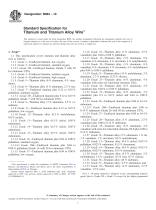
Titanium and Titanium Alloy Wire1 This standard is issued under the fixed designation B863; the number immediately following the designation indicates the year of original adoption or, in the case of revision, the year of last revision. A number in parentheses indicates the year of last reapproval. A superscript epsilon (´) indicates an editorial change since the last revision or reapproval. 1.1.16 Grade 18—Titanium alloy (3 % aluminum, 2.5 % vanadium) plus 0.04 to 0.08 % palladium, 1.1.17 Grade 19—Titanium alloy (3 % aluminum, 8 % vanadium, 6 % chromium, 4 % zirconium, 4 % molybdenum), 1.1.18 Grade 20—Titanium alloy (3 % aluminum, 8 % vanadium, 6 % chromium, 4 % zirconium, 4 % molybdenum) plus 0.04 to 0.08 % palladium, 1.1.19 Grade 21—Titanium alloy (15 % molybdenum, 3 % aluminum, 2.7 % niobium, 0.25 % silicon), 1.1.20 Grade 23—Titanium alloy (6 % aluminum, 4 % vanadium with extra low interstitial elements, ELI), 1.1.21 Grade 24—Titanium alloy (6 % aluminum, 4 % vanadium) plus 0.04 % to 0.08 % palladium, 1.1.22 Grade 25—Titanium alloy (6 % aluminum, 4 % vanadium) plus 0.3 to 0.8 % nickel and 0.04 to 0.08 % palladium, 1.1.23 Grade 26—Unalloyed titanium plus 0.08 to 0.14 % ruthenium, 1.1.23.1 Grade 26H—Unalloyed titanium plus 0.08 to 0.14 % ruthenium (Grade 26 with 58 ksi minimum UTS), 1.1.24 Grade 27—Unalloyed titanium plus 0.08 to 0.14 % ruthenium, 1.1.25 Grade 28—Titanium alloy (3 % aluminum, 2.5 % vanadium) plus 0.08 to 0.14 % ruthenium, 1.1.26 Grade 29—Titanium alloy (6 % aluminum, 4 % vanadium with extra low interstitial elements, ELI) plus 0.08 to 0.14 % ruthenium, 1.1.27 Grade 32—Titanium alloy (5 % aluminum, 1 % tin, 1 % vanadium, 1 % zirconium, 0.8 % molybdenum), 1.1.28 Grade 33—Titanium alloy (0.4 % nickel, 0.015 % palladium, 0.025 % ruthenium, 0.15 % chromium), 1.1.29 Grade 34—Titanium alloy (0.4 % nickel, 0.015 % palladium, 0.025 % ruthenium, 0.15 % chromium), 1.1.30 Grade 35—Titanium alloy (4.5 % aluminum, 2 % molybdenum, 1.6 % vanadium, 0.5 % iron, 0.3 % silicon), 1.1.31 Grade 36—Titanium alloy (45 % niobium), 1.1.32 Grade 37—Titanium alloy (1.5 % aluminum), and 1.1.33 Grade 38—Titanium alloy (4 % aluminum, 2.5 % vanadium, 1.5 % iron). 1. Scope* 1.1 This specification covers titanium and titanium alloy wire as follows: 1.1.1 Grade 1—Unalloyed titanium, low oxygen, 1.1.2 Grade 2—Unalloyed titanium, standard oxygen, 1.1.2.1 Grade 2H—Unalloyed titanium (Grade 2 with 58 ksi minimum UTS), 1.1.3 Grade 3—Unalloyed titanium, medium oxygen, 1.1.4 Grade 4—Unalloyed titanium, high oxygen, 1.1.5 Grade 5—Titanium alloy (6 % aluminum, 4 % vanadium), 1.1.6 Grade 6—Titanium alloy (5 % aluminum, 2.5 % tin), 1.1.7 Grade 7—Unalloyed titanium plus 0.12 to 0.25 % palladium, standard oxygen, 1.1.7.1 Grade 7H—Unalloyed titanium plus 0.12 to 0.25 % palladium (Grade 7 with 58 ksi minimum UTS), 1.1.8 Grade 9—Titanium alloy (3 % aluminum, 2.5 % vanadium), 1.1.9 Grade 11—Unalloyed titanium plus 0.12 to 0.25 % palladium, low oxygen, 1.1.10 Grade 12—Titanium alloy (0.3 % molybdenum, 0.8 % nickel), 1.1.11 Grade 13—Titanium alloy (0.5 % nickel, 0.05 % ruthenium), 1.1.12 Grade 14—Titanium alloy (0.5 % nickel, 0.05 % ruthenium), 1.1.13 Grade 15—Titanium alloy (0.5 % nickel, 0.05 % ruthenium), 1.1.14 Grade 16—Unalloyed titanium plus 0.04 to 0.08 % palladium, standard oxygen, 1.1.14.1 Grade 16H—Unalloyed titanium plus 0.04 to 0.08 % palladium (Grade 16 with 58 ksi minimum UTS), 1.1.15 Grade 17—Unalloyed titanium plus 0.04 to 0.08 % palladium, low oxygen, 1 This specification is under the jurisdiction of ASTM Committee B10 on Reactive and Refractory Metals and Alloys and is the direct responsibility of Subcommittee B10.01 on Titanium. Current edition approved May 1, 2010. Published May 2010. Originally approved in 1995. Last previous edition approved in 2009 as B863 – 09. DOI: 10.1520/B0863-10. NOTE 1—H grade material is identical to the corresponding numeric grade (that is, Grade 2H = Grade 2) except for the higher guaranteed *A Summary of Changes section appears at the end of this standard. Copyright. (C) ASTM International, 100 Barr Ha
Open the catalog to page 1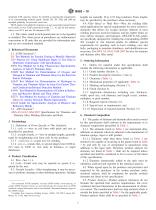
B863 – 10 lengths are normally 10 to 12 ft long (random). Exact lengths may be specified by the purchaser when necessary. 4.4 Filler Metal or Weld Wire—Wire for welding filler metal application has special requirements for more restrictive chemistry that allows for oxygen increase inherent in most welding processes used for titanium, and has tighter limits on iron, carbon, nitrogen, and hydrogen. AWS ER Ti-XX grades are specifically designed for welding the corresponding ASTM XX wrought or cast material grades. In addition, special requirements for spooling, such as layer winding, cast, and helix,...
Open the catalog to page 2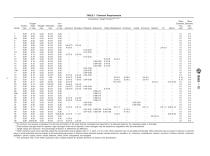
TABLE 1 Chemical Requirements Composition, Weight PercentA,B,C,D,E Nickel Molybdenum Chromium Other Other Elements, Elements, max. max. Silicon each total At minimum, the analysis of samples from the top and bottom of the ingot shall be completed and reported for all elements listed for the respective grade in this table. Final product hydrogen shall be reported. Ingot hydrogen need not be reported. Lower hydrogen may be obtained by negotiation with the manufacturer. Single values are maximum. The percentage of titanium is determined by difference. D Other elements need not be reported unless...
Open the catalog to page 3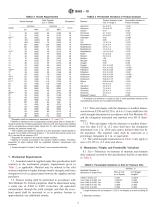
B863 – 10 TABLE 2 Tensile Requirements Yield Strength (0.2 % Offset) Tensile Strength minimum Product Analysis Limits, max or range,% Permissible Variation in Product Analysis Aluminum Aluminum Carbon Chromium Chromium Hydrogen Iron Iron Molybdenum Molybdenum Molybdenum Molybdenum Nickel Niobium Niobium Nitrogen Oxygen Oxygen Palladium Palladium Palladium Ruthenium Ruthenium Ruthenium Silicon Tin Vanadium Vanadium Zirconium Zirconium ResidualsA (each) TABLE 3 Permissible Variations in Product Analysis A A residual is an element in a metal or alloy in small quantities inherent to the manufacturing...
Open the catalog to page 4All Shaanxi CXMET Technology Co., Ltd. catalogs and technical brochures


- Fitting
- Hydraulic fitting
- Metal fitting
- Elbow fitting
- Heat exchanger unit
- Socket fitting
- Liquid/liquid heat exchanger
- Plate heat exchanger
- Barbed fitting
- Industrial heat exchanger
- Corrosion-proof fitting
- Chemical fitting
- Water/water heat exchanger
- Fitting for chemical applications
- Titanium heat exchanger
- Nickel alloy
- Welding fitting
- Lightweight fitting
- Corrosion-resistant heat exchanger
- Fitting for the aerospace industry