
- Catalogs
- Shaanxi CXMET Technology Co., Ltd.
- Standard Specification for Titanium and Titanium Alloy Strip, Sheet, and Plate1

Standard Specification for Titanium and Titanium Alloy Strip, Sheet, and Plate1

Standard Specification for Titanium and Titanium Alloy Strip, Sheet, and Plate1
This specification addresses annealed titanium and titanium alloy strip, sheet, and plate, detailing various grades with specific compositions and properties, including unalloyed titanium (Grades 1-4) and alloys with elements like aluminum and vanadium (Grades 5-38).
Several ASTM standards are referenced for testing and analysis, including tension and bend testing, and chemical analysis methods.
Definitions are provided for product classifications based on thickness and width, distinguishing strip, sheet, and plate.
Orders must specify grade number, product limitations, mechanical properties, marking, finish, packaging, additional reports, and disposition of rejected material.
The specification outlines chemical composition requirements for each grade, detailing specific elements and allowable ranges, including residual elements and product analysis tolerances.
Materials must meet mechanical property requirements such as tensile strength, yield strength, and elongation, with specified testing methods and conditions.
Dimensional tolerances for titanium and titanium alloy materials are specified in detailed tables.
Materials must be free of imperfections that interfere with their intended use, with various finishing methods allowed and minor surface imperfections removable by grinding.
Guidelines emphasize careful sampling due to titanium's affinity for certain elements.
Permissible variations in dimensions and flatness for titanium plates are outlined, focusing on annealed plates with specified tolerances for width, length, and thickness.
Includes procedures for bend tests to assess cleanliness and ductility, conducted on specimens from the same production run in both longitudinal and transverse directions.
Specifies maximum yield strength for certain grades and special flatness requirements for explosive cladding materials, detailing permissible thickness variations for different width ranges.
Notes changes from previous versions, such as adjustments in allowable hydrogen content for specific grades and reformatting of chemistry tables.
- Table 12: Details permissible variations from a flat surface for titanium plates.
- Table 13: Lists permissible thickness variations for titanium plates based on specified thickness and width.
Includes additional tests and criteria for acceptance, such as absence of cracking in bend tests and specific flatness requirements for explosive cladding applications.
Emphasizes user responsibility to determine patent rights validity and potential infringement risks, inviting comments for revision or additional standards.
Catalog excerpts
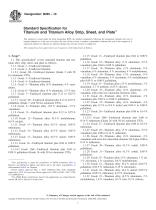
Titanium and Titanium Alloy Strip, Sheet, and Plate1 This standard is issued under the fixed designation B265; the number immediately following the designation indicates the year of original adoption or, in the case of revision, the year of last revision. A number in parentheses indicates the year of last reapproval. A superscript epsilon (´) indicates an editorial change since the last revision or reapproval. This standard has been approved for use by agencies of the Department of Defense. 1.1.15 Grade 17—Unalloyed titanium plus 0.04 to 0.08 % palladium, 1.1.16 Grade 18—Titanium alloy (3 % aluminum, 2.5 % vanadium) plus 0.04 to 0.08 % palladium, 1.1.17 Grade 19—Titanium alloy (3 % aluminum, 8 % vanadium, 6 % chromium, 4 % zirconium, 4 % molybdenum), 1.1.18 Grade 20—Titanium alloy (3 % aluminum, 8 % vanadium, 6 % chromium, 4 % zirconium, 4 % molybdenum) plus 0.04 % to 0.08 % palladium, 1.1.19 Grade 21—Titanium alloy (15 % molybdenum, 3 % aluminum, 2.7 % niobium, 0.25 % silicon), 1.1.20 Grade 23—Titanium alloy (6 % aluminum, 4 % vanadium with extra low interstitial elements, ELI), 1.1.21 Grade 24—Titanium alloy (6 % aluminum, 4 % vanadium) plus 0.04 % to 0.08 % palladium, 1.1.22 Grade 25—Titanium alloy (6 % aluminum, 4 % vanadium) plus 0.3 % to 0.8 % nickel and 0.04 % to 0.08 % palladium, 1.1.23 Grade 26—Unalloyed titanium plus 0.08 to 0.14 % ruthenium, 1.1.23.1 Grade 26H—Unalloyed titanium plus 0.08 to 0.14 % ruthenium (Grade 26 with 58 ksi minimum UTS), 1.1.24 Grade 27—Unalloyed titanium plus 0.08 to 0.14 % ruthenium, 1.1.25 Grade 28—Titanium alloy (3 % aluminum, 2.5 % vanadium) plus 0.08 to 0.14 % ruthenium, 1.1.26 Grade 29—Titanium alloy (6 % aluminum, 4 % vanadium with extra low interstitial elements, ELI) plus 0.08 to 0.14 % ruthenium, 1.1.27 Grade 30—Titanium alloy (0.3 % cobalt, 0.05 % palladium), 1.1.28 Grade 31—Titanium alloy (0.3 % cobalt, 0.05 % palladium), 1.1.29 Grade 32—Titanium alloy (5 % aluminum, 1 % tin, 1 % zirconium, 1 % vanadium, 0.8 % molybdenum), 1.1.30 Grade 33—Titanium alloy (0.4 % nickel, 0.015 % palladium, 0.02 5 % ruthenium, 0.15 % chromium), 1.1.31 Grade 34—Titanium alloy (0.4 % nickel, 0.015 % palladium, 0.025 % ruthenium, 0.15 % chromium), 1.1.32 Grade 35—Titanium alloy (4.5 % aluminum, 2 % molybdenum, 1.6 % vanadium, 0.5 % iron, 0.3 % silicon), 1. Scope* 1.1 This specification2 covers annealed titanium and titanium alloy strip, sheet, and plate as follows: 1.1.1 Grade 1—Unalloyed titanium, 1.1.2 Grade 2—Unalloyed titanium, 1.1.2.1 Grade 2H—Unalloyed titanium (Grade 2 with 58 ksi minimum UTS), 1.1.3 Grade 3—Unalloyed titanium, 1.1.4 Grade 4—Unalloyed titanium, 1.1.5 Grade 5—Titanium alloy (6 % aluminum, 4 % vanadium), 1.1.6 Grade 6—Titanium alloy (5 % aluminum, 2.5 % tin), 1.1.7 Grade 7—Unalloyed titanium plus 0.12 to 0.25 % palladium, 1.1.7.1 Grade 7H—Unalloyed titanium plus 0.12 to 0.25 % palladium (Grade 7 with 58 ksi minimum UTS), 1.1.8 Grade 9—Titanium alloy (3.0 % aluminum, 2.5 % vanadium), 1.1.9 Grade 11—Unalloyed titanium plus 0.12 to 0.25 % palladium, 1.1.10 Grade 12—Titanium alloy (0.3 % molybdenum, 0.8 % nickel), 1.1.11 Grade 13—Titanium alloy (0.5 % nickel, 0.05 % ruthenium), 1.1.12 Grade 14—Titanium alloy (0.5 % nickel, 0.05 % ruthenium), 1.1.13 Grade 15—Titanium alloy (0.5 % nickel, 0.05 % ruthenium), 1.1.14 Grade 16—Unalloyed titanium plus 0.04 to 0.08 % palladium, 1.1.14.1 Grade 16H—Unalloyed titanium plus 0.04 to 0.08 % palladium (Grade 16 with 58 ksi minimum UTS), 1 This specification is under the jurisdiction of ASTM Committee B10 on Reactive and Refractory Metals and Alloys and is the direct responsibility of Subcommittee B10.01 on Titanium. Current edition approved May 1, 2010. Published May 2010. Originally approved in 1952. Last previous edition approved in 2009 as B265 – 09a´1. DOI: 10.1520/B0265-10. 2 For ASME Boiler and Pressure Vessel Code applications see related Specifications SB-265 in Section II of that Code. *A Summary of Changes section appears at the end of this standard. Copyright. © ASTM International, 100 Barr Har
Open the catalog to page 1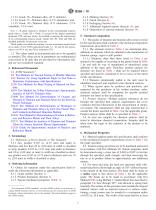
1.1.33 Grade 36—Titanium alloy (45 % niobium), 1.1.34 Grade 37—Titanium alloy (1.5 % aluminum), and 1.1.35 Grade 38—Titanium alloy (4 % aluminum, 2.5 % vanadium, 1.5 % iron). NOTE 1—H grade material is identical to the corresponding numeric grade (that is, Grade 2H = Grade 2) except for the higher guaranteed minimum UTS, and may always be certified as meeting the requirements of its corresponding numeric grade. Grades 2H, 7H, 16H, and 26H are intended primarily for pressure vessel use. The H grades were added in response to a user association request based on its study of over 5200 commercial...
Open the catalog to page 2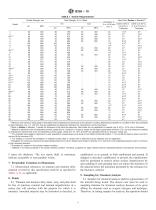
B265 – 10 TABLE 1 Tensile RequirementsA Tensile Strength, min Yield Strength, 0.2 % Offset min A Minimum and maximum limits apply to tests taken both longitudinal and transverse to the direction of rolling. Mechanical properties for conditions other than annealed or plate thickness over 1 in. (25 mm) may be established by agreement between the manufacturer and the purchaser. B Bend to Radius of Mandrel, T equals the thickness of the bend test specimen. Bend tests are not applicable to material over 0.187 in. (4.75 mm) in thickness. C Material is identical to the corresponding numeric grade (that...
Open the catalog to page 3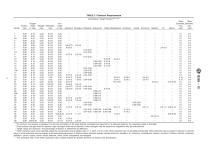
TABLE 2 Chemical Requirements Composition, Weight PercentA,B,C,D,E Nickel Molybdenum Chromium Other Other Elements, Elements, max. max. Silicon each total At minimum, the analysis of samples from the top and bottom of the ingot shall be completed and reported for all elements listed for the respective grade in this table. Final product hydrogen shall be reported. Ingot hydrogen need not be reported. Lower hydrogen may be obtained by negotiation with the manufacturer. Single values are maximum. The percentage of titanium is determined by difference. D Other elements need not be reported unless...
Open the catalog to page 4All Shaanxi CXMET Technology Co., Ltd. catalogs and technical brochures


- Fitting
- Hydraulic fitting
- Metal fitting
- Elbow fitting
- Heat exchanger unit
- Socket fitting
- Liquid/liquid heat exchanger
- Plate heat exchanger
- Barbed fitting
- Industrial heat exchanger
- Corrosion-proof fitting
- Chemical fitting
- Water/water heat exchanger
- Fitting for chemical applications
- Titanium heat exchanger
- Nickel alloy
- Welding fitting
- Corrosion-resistant heat exchanger
- Lightweight fitting
- Fitting for the aerospace industry