
- Catalogs
- SEVEN Sensor Solutions
- Snow Sensor (3S-SS-MB)


Snow Sensor (3S-SS-MB)
Snow Sensor (3S-SS-MB)
- Increased efficiency in tracker systems
- Fast and simple installation
- Free software updates
- SunSpec compliant
- Remote setup service and customer support
- 2-year warranty
- Operating humidity range: 0 to 100% RH
- Operating temperature range: -40°C to +85°C
- Power supply: 22 to 30 V DC
- Dimensions: 200 mm x 412 mm x 44 mm
- Snow ratio resolution: 0.1%
- Uncertainty: ≤ 2%
- Irradiance range: 0…1600 W/m²
- Data output: RS485 up to 38400 Baud, Modbus RTU
- Power consumption: 0.82 A max @ 24VDC (0.02 A max when heating off)
- IP Rating: IP 65
- Galvanic isolation: 1000 V between power supply and RS485 bus
Catalog excerpts
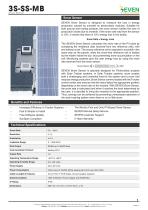
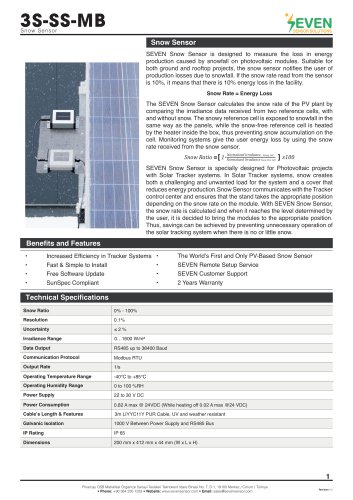
Snow Sensor Snow Sensor SEVEN Snow Sensor is designed to measure the loss in energy production caused by snowfall on photovoltaic modules. Suitable for both ground and rooftop projects, the snow sensor notifies the user of production losses due to snowfall. If the snow rate read from the sensor is 10%, it means that there is 10% energy loss in the facility. Snow Rate = Energy Loss The SEVEN Snow Sensor calculates the snow rate of the PV plant by comparing the irradiance data received from two reference cells, with and without snow. The snowy reference cell is exposed to snowfall in the same way as the panels, while the snow-free reference cell is heated by the heater inside the box, thus preventing snow accumulation on the cell. Monitoring systems give the user energy loss by using the snow rate received from the snow sensor. Normalized Irradiance Snowy ceil Snow Ratio =[ l -mr„llled s„,„„c 1 x100 SEVEN Snow Sensor is specially designed for Photovoltaic projects with Solar Tracker systems. In Solar Tracker systems, snow creates both a challenging and unwanted load for the system and a cover that reduces energy production.Snow Sensor communicates with the Tracker control center and ensures that the stand takes the appropriate position depending on the snow rate on the module. With SEVEN Snow Sensor, the snow rate is calculated and when it reaches the level determined by the user, it is decided to bring the modules to the appropriate position. Thus, savings can be achieved by preventing unnecessary operation of the solar tracking system when there is no or little snow. Increased Efficiency in Tracker Systems • Fast & Simple to Install • Free Software Update • SunSpec Compliant • The World’s First and Only PV-Based Snow Sensor SEVEN Remote Setup Service SEVEN Customer Support 2 Years Warranty Pinarcay OSB Mahallesi Organize Sanayi Tesisleri Teknokent Idare Binasi No: 7, D:1, 19100 Merkez / Corum / Turkiye • Phone: +90 364 230 1233 • Website: www.sevensensor.com • Email: [email protected]
Open the catalog to page 1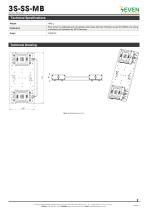
Pinarcay OSB Mahallesi Organize Sanayi Tesisleri Teknokent Idare Binasi No: 7, D:1, 19100 Merkez / Corum / Turkiye • Phone: +90 364 230 1233 • Website: www.sevensensor.com • Email: [email protected]
Open the catalog to page 2All SEVEN Sensor Solutions catalogs and technical brochures
 Albedometer (3S-ALBEDO)
4 Pages
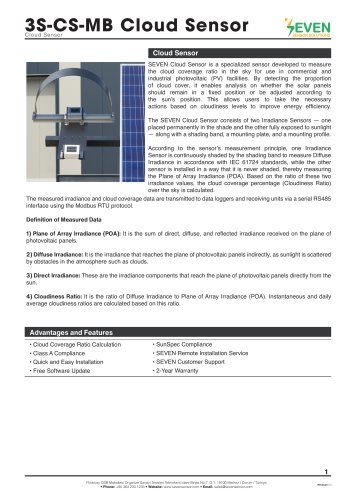 Cloud Sensor (3S-CS-MB)
3 Pages
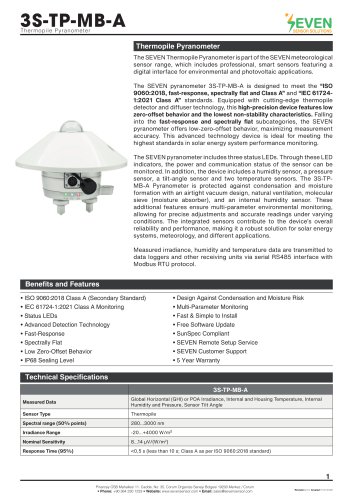
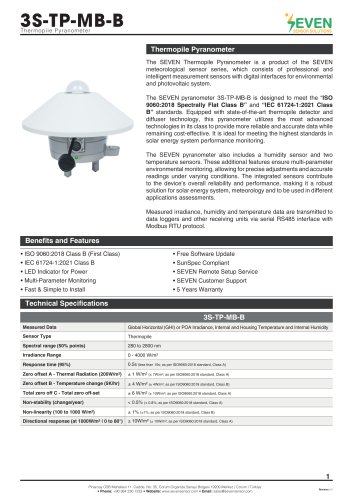
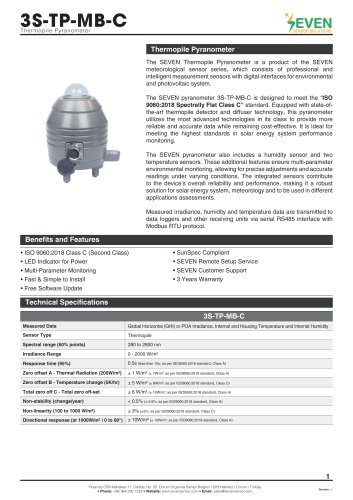
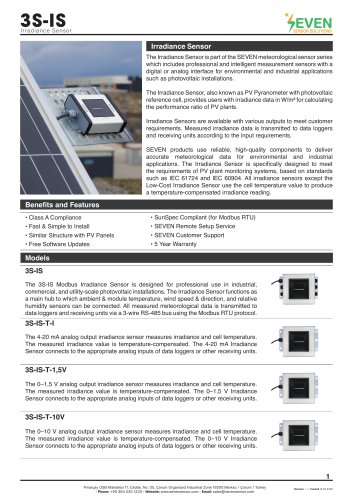 Irradiance Sensor (3S-IS)
4 Pages
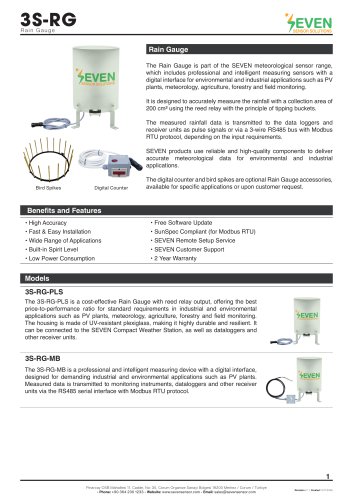 Rain Gauge (3S-RG)
3 Pages
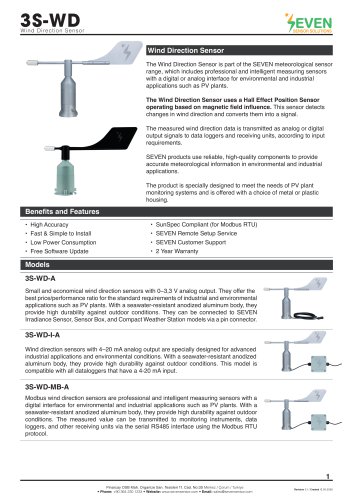
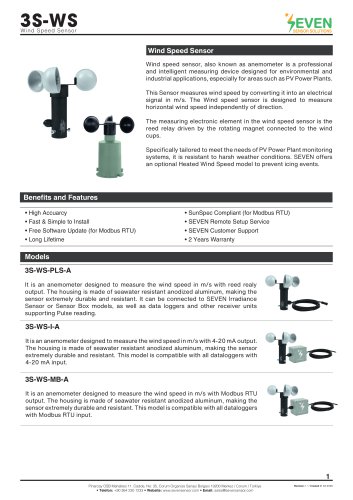 Wind Speed Sensor (3S-WS)
3 Pages
Archived catalogs
- Seven temperature sensor
- Test cabinet
- Seven resistance temperature sensor
- Temperature test chamber
- Climatic test cabinet
- Level probe
- Quality control test cell
- Liquid level sensor
- Humidity test cabinet
- Seven waterproof temperature sensor
- Analog level sensor
- Stainless steel temperature transducer
- Humidity and temperature probe
- Leak tester
- Relative humidity and temperature sensor
- Vessel level sensor
- Seven Pt1000 temperature sensor
- Temperature transmitter
- Laboratory test cabinet
- Analog temperature sensor