

- Company
- Products
- Catalogs
- News & Trends
- Exhibitions
SERVOTOUGH FluegasExact 2700 Installation Manual 02700005D_6

SERVOTOUGH FluegasExact 2700 Installation Manual 02700005D_6
- Warnings, Cautions, and Notes: Emphasizes understanding safety information, with warnings for injury or death risks, cautions for equipment damage, and notes for important facts.
- Scope: Covers installation of the SERVOTOUGH FluegasExact Combustion Gas Analyser, referencing technical specifications and additional manuals.
- General Safety Information: Installation by qualified personnel only; modifications invalidate certification and safety. Sensor head can exceed 100°C, requiring protective handling.
- Components: Describes the sensor head and control unit, including sample flow alarm features.
- Sensor Head and Probe Tube: Details on installation location, flange mounting, sample probe installation, calibration, and electrical setup, with special instructions for hazardous areas.
- Flow Alarm Relay Box: Installation location and electrical setup instructions.
- Control Unit: Installation location, electrical setup, and enclosure purge connection details.
- Includes required gases, visual inspection, power-up process, analogue output setup, and sensor calibration.
- Guidelines for maintenance, fuse replacement, preventative maintenance, and spare parts.
- Performance metrics for oxygen and combustibles measurement, flow alarm, analyser inputs/outputs, physical specifications, materials in contact with samples, and hazardous area classification.
- Include wiring schedules, compliance and standards information, product disposal guidelines, REACH regulation, and hazardous area installation drawings for North America.
The SERVOTOUGH FluegasExact Combustion Gas Analyser measures oxygen concentration and unburned combustibles in flue gases. It consists of a sensor head and a control unit, which can be mounted separately. The sensor head is installed on the flue wall, while the control unit can be placed remotely. Both units require separate power supplies and a compressed air supply for the aspirator. Optional utility units and sample flow alarms are available.
Sensor Head Description
The sensor head is mounted on the flue wall and contains measurement sensors in a heated enclosure. It uses a probe tube to extract gas samples for analysis. Various probes and filters are available for different applications. Electrical connections are made through a terminal box on the sensor head.
Control Unit Description
The control unit contains the drive electronics, microprocessor, keypad, display, and user wiring connections. It can be mounted on a wall, surface, or panel, with electrical connections made via conduit entries.
Sample Flow Alarm
The optional flow alarm includes a modified sensor head with a flow sensor, an external flow alarm relay box, and an aspirator air isolation valve. It detects low flow conditions in the sample stream and provides relay contacts for indicating low flow and flow fault conditions.
Installation Location
The sensor head should be installed in a location that allows easy access for installation and maintenance. It is supplied with a 4" flange for direct attachment to a flue wall. The operating ambient temperature should be between -20°C and +70°C, and the sensor head should be protected from radiant heat and direct sunlight.
Flange Mounting Arrangements
The sensor head is provided with a 4" flange and should be mounted using at least four M16 or 5/8" bolts. Various mounting options are available, including standard installation, weld-on flange installation, and adaptor flange installation. High temperature stand-offs and thermal spacers are available for extreme environments.
Warnings and Cautions
Installers should be trained in manual handling, and appropriate protective equipment should be worn to minimize the risk of burns. The sensor head should not be lifted by the compressed air pipe or fitted cables. Sample and calibration gases may contain hazardous components and should be vented safely. Only recommended release compounds should be used to avoid damage to the sensor.
The flow alarm relay box is suitable for both indoor and outdoor locations, with an operating temperature range of -10 to 50°C and storage temperature range of -20 to 70°C. It has an ingress protection rating of IP66, and IP20 when the lid is removed. The box can operate at altitudes up to 2000m and is designed for environments with a relative humidity of up to 95% RH, non-condensing. It falls under Overvoltage Category II and Pollution Degree 2.
Installation and Electrical Specifications
The relay box should be mounted with electrical entries on the underside. It includes terminals TB1 and TB2, with wire sizes ranging from 0.13 to 2.5 mm². The relay contacts are configured as 2 SPCO, with a maximum rating of 250VAC, 3A / 28VDC, 1A. User connections for relay outputs are specified for both DIRECT and INVERSE modes.
Control Unit Installation
The control unit should be installed in a location that minimizes ambient temperature fluctuations and vibration. It should be mounted horizontally with electrical entries on the underside. The unit is an aluminum enclosure with a protective epoxy powder paint finish and a polycarbonate window for display viewing. It has an ingress protection rating of IP65 and operates within a temperature range of -10°C to +55°C.
Electrical Installation and Safety
The control unit and sensor head have independent electrical supplies. The unit must be connected to a protective earth, and all electrical installations must conform to local and national safety requirements. The control unit does not have an integral on/off switch, so an external disconnection device is required. All cables must be rated for temperatures of at least 80°C for operation above 50°C.
Warnings and Recommendations
Special conditions for safe use must be followed if the control unit is installed in hazardous areas. The control unit should not be lifted by cables, and the door should only be opened if there is negligible risk of contamination. All cable glands and blanking plugs must maintain the specified ingress protection level and be UL or CSA approved for installations in the USA or Canada.
The document provides detailed information about the control unit enclosure, including sensor adjustments, power connections, and relay outputs. Key components include sensor coarse zero adjustments, transformer connections, mains power fuses, and relay output connections. The document emphasizes the importance of adhering to voltage limits and proper wiring for safety.
Enclosure Purge Connection
The enclosure purge is crucial for preventing corrosion. It requires air from a non-hazardous source or inert gas, with specific flow rates and pressure requirements. The purge must meet safety standards in hazardous areas.
Electrical Power Connections
Tables detail the electrical power connections for the control unit, including relay outputs and analogue output connections. The relay outputs can be configured for various functions, and the document specifies the ratings for relay contacts.
Initial Startup Procedure
The startup procedure includes gas requirements for commissioning and calibrating the analyser, visual inspections, and initial power-up steps. It outlines the necessary checks for voltage and fuse settings, as well as the importance of stable sensor temperatures.
Analogue Output Span Setup
Instructions are provided for setting up the analogue output span for oxygen and combustibles sensors, ensuring accurate readings by adjusting specific components.
Sensor Calibration
The document details the calibration process for the sensor head, including the application of calibration gases and verification of analyser readings. It recommends checking calibration and filters within a few days after initial setup.
Flow Alarm Calibration
The flow alarm calibration involves setting thresholds for zero and normal flow rates. The procedure includes disabling alarms during calibration to prevent false alerts and ensuring proper sample flow through the analyser.
The document outlines the setup and activation procedures for the Flow Alarm system. The Flow Alarm trigger point should be set between 50-70% for normal operation. To activate, set the Fault/Alarm relay Enable/Disable switch to ON. An operational check involves reducing the sample gas flow to test the alarm's response.
Maintenance and Safety Warnings
Maintenance should be performed by skilled personnel. The sensor head can be hot, and care should be taken to avoid contamination of electronic circuits. Regular inspections and cleaning are recommended to prevent hazardous gas leaks.
Preventative Maintenance
Servomex recommends an annual preventative maintenance program to ensure the analyser operates correctly and complies with regulatory guidelines. This includes inspections and repairs, with a full report provided post-maintenance.
Spare Parts
Only Servomex-supplied parts should be used for replacements. Tables list spare parts for control units, sensor heads, and other components.
Technical Specifications
Oxygen Measurement: Ranges from 0-1% to 0-25% O2 with a display resolution of 0.01% O2 and accuracy of ±1% of reading or 0.1% O2.
Combustibles Measurement: Ranges from 0-500ppm to 0-30,000ppm COe with a display resolution of 1ppm(v) COe and accuracy of ±5% of full scale.
Flow Alarm: Repeatability of ±20ml/min at 200ml/min with a response time of <20 seconds.
Inputs and Outputs
The analyser features a digital display, user interface, analogue outputs, relay outputs, and digital inputs. Specifications include maximum load, isolation voltage, and contact ratings.
Physical and Environmental Specifications
Details include dimensions, weight, power supply, ambient temperature ranges, and ingress protection ratings for various components.
Materials and Hazardous Area Classification
Materials in contact with samples include stainless steel, zirconia, and platinum. The document also provides hazardous area classifications for different regions, including ATEX and CSA certifications.
The document outlines the compliance of a Servomex analyser with North American and Canadian standards for non-incendive equipment. It is certified for use in hazardous areas classified as Class I, Div 2, Groups A, B, C & D T5, Class II, Div 2, Groups F & G T5, and Class III, Div 1 T5. The enclosure is rated IP65, suitable for ambient temperatures from -10°C to +55°C, with a CSA certificate number 2578918.
Installation in high velocity dust-laden environments should be avoided to minimize the risk of brushed discharges.
The document provides detailed wiring specifications for oxygen, combustibles, and dual sensor versions. It specifies the use of twisted pairs with overall screening and outlines the maximum loop resistance for sensor heater lines. Recommended cable suppliers include Alpha and Belden.
The analyser complies with the European EMC Directive, ICES-003 of Canada, and FCC Rules for Class A equipment. It is assessed to IEC 61010-1 for electrical safety and is manufactured by a BS EN ISO 9001 and BS EN ISO 14001 certified organization.
The product is not within the scope of the WEEE Directive 2002/96/EC and should be recycled according to local regulations. A decontamination certificate is required for any returned units.
Information on Substances of Very High Concern (SVHC) in Servomex products is available on their website.
Catalog excerpts

INSTALLATION MANUAL Part Number: Revision: Language:
Open the catalog to page 1
This page intentionally blank
Open the catalog to page 2
IMPORTANT INFORMATION Continued safe and reliable operation of this equipment is conditional on all installation, operation and maintenance procedures being carried out in accordance with the appropriate manuals, by personnel having appropriate qualifications, experience and training. Failure to observe the requirements of the manual may result in the user being held responsible for the consequences and may invalidate any warranty. Servomex will accept no liability for unauthorised modifications to Servomex supplied equipment. Servomex has paid particular attention to Health and Safety throughout...
Open the catalog to page 3
© Servomex Group Limited. 2016
Open the catalog to page 7
Introduction Warnings, cautions and notes Read this manual and ensure that you fully understand its content before you attempt to install, use or maintain the analyser. Important safety information is highlighted in this manual as WARNINGS and CAUTIONS and NOTES, which are used as follows WARNING Warnings highlight specific hazards which, if not taken into account, may result in personal injury or death. CAUTION Cautions highlight hazards which, if not taken into account, can result in damage to the analyser or to other equipment or property. NOTES Alerts the user to pertinent facts and conditions....
Open the catalog to page 8
General safety information WARNING You must install and use the analyser in accordance with the requirements of this section and subsequent sections of the manual. If you do not, people may be injured, the protection facilities incorporated into the design of the analyser may not operate as intended, sample gas measurements may not be accurate, or the analyser may be damaged. The analyser must be installed by a suitably skilled and competent technician or engineer. You must not modify the analyser in any way (either mechanically or electrically). If you do, the certification of the analyser will...
Open the catalog to page 9
Hazardous Area approval and certification Copies of all hazardous area certificates are provided in the Certificate Manual (part number 02700008D) which is supplied with each hazardous area certified unit. Unpacking WARNING The sensor head and control unit weigh approximately 17Kg (37.5lb) and 11Kg (24.3lb) respectively and care must be taken when handling. Remove the analyser components from their packing and inspect for obvious external damage. If damage has occurred, inform Servomex or its agent immediately. Retain all packing and shipping information for future use. © Servomex Group Limited....
Open the catalog to page 10
Analyser Overview Overview Figure 1 Analyser sensor head and control unit overview 1 Terminal enclosure cover Sample probe Sensor head cover Sample probe filter Control unit Wall mounting brackets Flue/process wall The SERVOTOUGH FluegasExact Combustion Gas Analyser measures the oxygen concentration and/or the level of unburned combustibles. The analyser comprises two separate units which may be mounted up to 300m (975ft) apart for oxygen only and 100m (325ft) apart whenever the combustibles measurement option is fitted. An overall system will consist of sensor head/sample probe/filter mounted...
Open the catalog to page 11
ensure that both the sensor head and control unit have their own separate power supply. Also required is a compressed air supply with a pressure regulator to control the aspirator air supply. Optional utility units are available to supply the sensor head with compressed air, or compressed air and calibration gases. Details of these units can be found in the User and Installation manual for the Utilities Unit, part number 02730001A. An optional sample flow alarm is also available with an external flow alarm relay box. Sensor head description The sensor head is flange mounted on to the flue wall...
Open the catalog to page 12
Installation of Sensor Head and Probe Tube Installation location Refer to Figure 2. NOTE All Servomex adaptor flanges, interface flanges, probe support tubes, stand-offs and thermal spacers, including the integral flange on the sensor head, are suitable for fitting onto the standard flanges (raised face [<1.6mm] or flat faced). They do not comply with any national or international standards and the analyser’s maximum process pressure is limited to 0.34 barg (5 psig). Select a location which allows convenient access for installation and maintenance to the terminal box enclosure. The sensor head...
Open the catalog to page 13
Ambient operating temperature Storage temperature Ingress protection AC power supply Factory set for either a) 100-120Vac 50/60Hz b) 220-240Vac 50/60Hz Overvoltage category Pollution degree The sensor head/terminal box is rated Pollution Degree 2. The sample probe protruding into the flue and the adjacent face of the flange is rated Pollution Degree 4. See Note 1 Relative humidity Note 1: Where the installation is such that the enclosure ingress protection IP66 is maintained and the covers remain securely fitted, the apparatus is suitable for use in locations where there may be significant deposits...
Open the catalog to page 14
WARNINGS When fitted with a sample probe and interconnecting cables the sensor head may weigh over 18 kg with the load being unbalanced. Consequently, the following precautions shall be taken before and during its installation: The sensor head is heated and may be attached to a hot flue and so the appropriate protective equipment shall be worn to minimise the risk of burns. Installers shall be appropriately trained in manual handling. The work shall be planned to minimise any stooping, stretching or reaching above shoulder height or sideways twisting of the body. Floors or platforms shall be...
Open the catalog to page 15
Figure 2. Sensor head dimensions (typical) 1 Purge gas entry 1/4” NPT (INT) or blanking plug Sample vent port 1/8” NPT (INT) Signal cable entry 3/4” NPT (INT) or specified adaptor Sample probe connection 1/2” NPT (INT) Mains cable entry 3/4” NPT (INT) or specified adaptor Calibration gas / blowback gas inlet 1/4” OD compression fitting Aspirator air supply inlet 1/8” NPT (INT) Purge gas exit 1/4” NPT (INT) or breather fitting Analyser mounting flange 4” Unused entry © Servomex Group Limited. 20
Open the catalog to page 16All SERVOMEX catalogs and technical brochures
 Gas Guide Issue 6
74 Pages
 Product Guide Issue 10
14 Pages
 Service Guide Issue 5
12 Pages
 SERVOTOUGH Oxy 1810
9 Pages
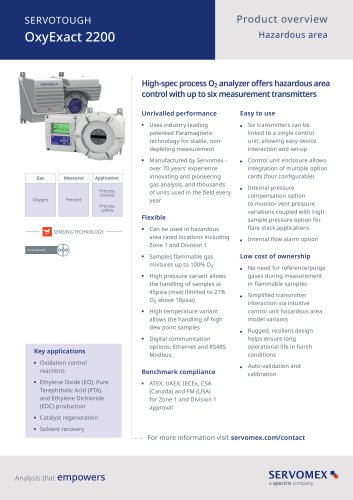 SERVOTOUGH OxyExact 2200
16 Pages
 SERVOPRO 4900 Multigas
10 Pages
 SERVOPRO PureGas
4 Pages
 DF560E Operator Manual
144 Pages
 DF-745 Operator Manual
112 Pages
 SERVOPRO Plasma Operator Manual
78 Pages
 ES 39 Sustainability
11 Pages
 ES 38 Korea Special
19 Pages
 ES 37 Clean Air part II
11 Pages
 ES 36 Purity & Specialty
11 Pages
 ES 35 Photometric Analysis
11 Pages
 ES 34 70th Anniversary
15 Pages
 ES30 Air Separation Units
11 Pages
 ES 29 Clean Air
11 Pages
 ES 28 Gas Analysis Applications
11 Pages
 Sensing Technologies
13 Pages
 DF760E Operator Manual
182 Pages
 DF750 Operator Manual
112 Pages
 DF745SGMax Operator Manual
90 Pages
 DF-740 Operator Manual
87 Pages
 DF-730 Operator Manual
82 Pages
 DF560E Operator Manual 082616
146 Pages
 DF550E Operator Manual 082616
134 Pages













Archived catalogs
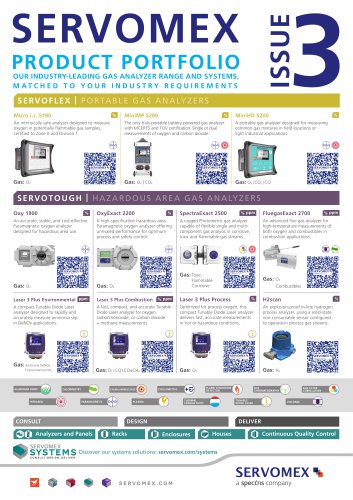
 Servomex Product Portfolio
2 Pages
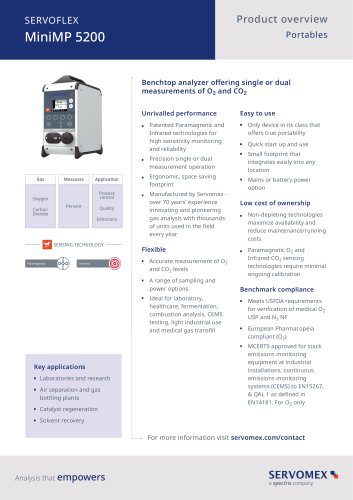 SERVOFLEX MiniMP 5200
7 Pages
 Servomex Product Guide - Issue 8
15 Pages
 Servomex Service Guide - Issue 3
13 Pages
 Servomex Gas Guide - Issue 4
76 Pages
 SERVOPRO HFID
4 Pages
 SERVOPRO NOx
4 Pages
 Servomex Product Guide Issue 7
13 Pages
 Servomex Service Guide Issue 2
11 Pages
 Servomex GAS GUIDE issue 3
77 Pages
 Servomex Service Portfolio
2 Pages
 SERVOTOUGH H2 Scan
2 Pages
 SERVOTOUGH SpectraScan 2400
2 Pages
 Servomex Gas Guide 2022
65 Pages





- SERVOMEX gas analyzer
- SERVOMEX concentration analyzer
- SERVOMEX monitoring analyzer
- Liquids analyzer
- Automatic analyser
- SERVOMEX benchtop analyzer
- Solids analyser
- SERVOMEX process analyzer
- SERVOMEX portable analyzer
- Continuous analyzer
- Real-time analyzer
- SERVOMEX integration analyzer
- SERVOMEX oxygen analyzer
- Laboratory analyzer
- SERVOMEX compact analyzer
- SERVOMEX digital analyzer
- Infrared analyser
- Calibration analyzer
- Waterproof analyzer
- Temperature analyzer