
- Catalogs
- Seraphin Test Measures
- Volumetric Trailer (Series J)

Volumetric Trailer (Series J)

1 / 15 PagesView full catalog
Volumetric Trailer (Series J)
Product catalog summary
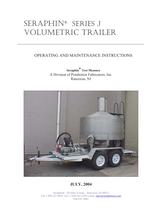
Introduction: This document provides comprehensive operating and maintenance instructions for the Seraphin® Series J Volumetric Trailer, a mobile prover system designed for precision volumetric measurements in petroleum applications. The system includes a stainless steel prover, a pump-off system, and is mounted on a trailer.
Specifications: The system features a precision volumetric stainless steel prover connected to a pump-off system and mounted on a trailer. It includes a manual hose reel with a hose and nozzle for directing petroleum to storage tanks.
Operation: Official procedures reference the API Manual of Petroleum Measurement Standards. A schematic diagram (Figure 1) is included for system alignment during filling or draining.
Set-up Procedure: Key steps involve grounding the trailer, ensuring valves are closed, and inspecting the prover for debris. Proper grounding is crucial to prevent static electricity hazards.
Prover Wetting Procedure: The prover must be filled and drained once to wet internal surfaces, ensuring consistent liquid measurement.
Draining Procedures: Detailed steps are provided for draining the prover via gravity drain or pump system, with safety warnings to prevent simultaneous valve openings.
Testing Procedure: Involves grounding the trailer, filling the prover, and comparing meter readings to actual volume measurements. Proper disposal of drained fluids is advised.
Maintenance: Regular checks for dents, leaks, and proper operation of pumps, valves, and piping are recommended. Tire maintenance includes checking pressure, inspecting for damage, and ensuring proper inflation.
Trailer Maintenance: Includes inspecting lights, brakes, axles, and hitching procedures. Emphasizes proper loading to maximize trailer performance and safety.
General Safety: Users are advised to read the pump's operation and maintenance manual. Safety is the user's responsibility, and non-compliance can lead to injuries or equipment damage.
Safety and Operational Guidelines for Pump Usage:
- Stop the pump immediately if overheating occurs, allow it to cool, and vent cautiously before restarting as per the manufacturer's manual.
- Ensure all guards and shields are in place during operation and approach operational pumps with caution.
- Only pump liquids for which the pump is designed, avoiding flammable or corrosive liquids unless specified.
- Operating with closed suction or discharge can cause overheating; ensure correct rotation to prevent damage.
- Locate pumps accessibly and check lubricants before use. Use appropriate lifting equipment for pump handling.
- Self-priming pumps must be filled with liquid before operation to avoid damage.
- Do not remove components from overheated pumps until cooled, and avoid operating against closed valves.
- Regularly check suction strainers and secure pumps in their operating position.
- Ensure pumps are designed for explosive environments if used there, and inspect for shipping damage upon delivery.
- Follow safety protocols, including locking control panels and ensuring proper ventilation in underground systems.
Terminology and Standards:
- Definitions are provided for terms like bottom loading, nominal capacity, and cubical coefficient of thermal expansion.
- Standards for field test measures and provers are outlined, including reference temperatures and tolerance levels.
Safety Considerations:
- Users must establish safety practices and comply with regulatory limitations for hazardous materials.
- Safety devices and grounding are essential to prevent accidents and electrical hazards.
- All electrical connections must be explosion-proof and comply with the National Electrical Code.
Warranty Information:
- Pemberton Fabricators, Inc. offers a warranty for repair or replacement of defective parts within one year of use or 18 months after shipment.
- Liability is limited to the cost of repair or replacement, excluding special or consequential damages.
See more
Catalog excerpts
Seraphin > ή Test Measure >
Open the catalog to page 1
PEMBERTON FABRICATORS, INC. (SERAPHIN > DIVISION) SHALL NOT BE LIABLE FOR TECHNICALOR EDITORIAL ERRORS IN THIS MANUAL OR OMISSIONS FROM THIS MANUAL. SERAPHIN > ή MAKESNO WARRANTIES,EXPRESSED OR IMPLIED, INCLUDINGTHEIMPLIED WARRANTIES OFMERCHANTABILITY AND FITNESS FOR A PARTICULAR PURPOSEWITHRESPECT TOTHIS MANUALAND,IN NO EVENT, SHALL SERAPHIN > BE LIABLE FORANY SPECIALOR CONSEQUENTIALDAMAGESINCLUDING,BUTNOT LIMITED TO, LOSS OF PRODUCTION, LOSS OF PROFITS, ETC.PRODUCT NAMES USED HEREIN AREFORMANUFACTURER ORSUPPLIERIDENTIFICATIONONLYAND MAYBE TRADEMARKS/REGISTERED TRADEMARKS OF THESE COMPANIES.THE...
Open the catalog to page 2Archived catalogs
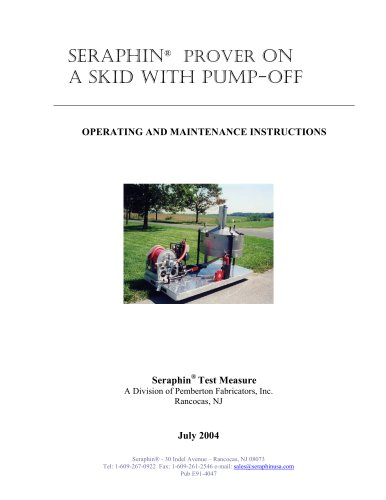 Skid with Prover and Pump-off System
12 Pages
 Gasoline Calibration Trailer
11 Pages
 Motor Fuel Calibration Trailer
14 Pages
 Slip-on Unit with prover
11 Pages
 Slip-on Unit
9 Pages
 Volumetric Trailer (Series K)
14 Pages
Related Searches
*Prices are pre-tax. They exclude delivery charges and customs duties and do not include additional charges for installation or activation options. Prices are indicative only and may vary by country, with changes to the cost of raw materials and exchange rates.
About DirectIndustry
DirectIndustry is a marketplace that offers B2B players a complete experience, from product sourcing to purchase. DirectIndustry is an entity of VirtualExpo Group.
Are you a buyer?
Are you a supplier?