
- Catalogs
- Sentry Equipment
- Back Pressure Regulator Valve

Back Pressure Regulator Valve

Back Pressure Regulator Valve
Catalog excerpts
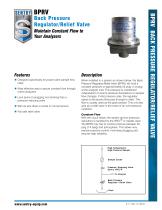
Back Pressure Regulator/Relief Valve Maintain Constant Flow to Your Analyzers Designed specifically for power plant sample flow rates When installed in a system as shown below, the Back Pressure Regulator/Relief Valve (BPRV) will hold a constant pressure of approximately 20 psig (1.4 barg) at the analyzer inlet. This pressure is maintained independent of source pressure fluctuations or sample flow changes. If inlet pressure rises, the regulator opens to let excess flow pass through to drain. This flow is usually used as the grab sample. This unit also acts as a relief valve in the event of an over-pressure condition. Most effective way to assure constant flow through online analyzers Less prone to plugging and sticking than a pressure reducing valve Will not wire draw or erode in normal service Fail safe relief valve Constant Flow With the circuit below, the severe service (pressure reduction) is handled by the VREL® or needle valve. The BPRV only has to control pressure between 20 psig (1.4 barg) and atmosphere. This allows very precise pressure control, minimizes plugging and ensures high reliability. BPRV Back Pressure Regulator/Relief Val
Open the catalog to page 1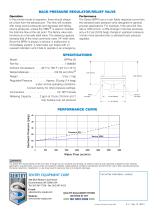
BACK PRESSURE REGULATOR/RELIEF VALVE Operation In the normal mode of operation, there should always be a flow from the exhaust port. This flow will increase with rising source pressures and decrease with falling source pressures, unless the VREL® is reset to maintain the total line flow at the set point. The Sentry valve also functions as a fail safe relief valve. The relieving capacity exceeds that of the most commonly used 1/4" relief valve. Since the BPRV is always in service, a malfunction is immediately evident. A relief valve can freeze with no outward indication until it fails to operate...
Open the catalog to page 2All Sentry Equipment catalogs and technical brochures
 SENTRY ISOLOK SAA SAMPLER
2 Pages
 SENTRY SA SAMPLER
2 Pages
 SENTRY B1 SAMPLER
2 Pages
 SENTRY SINGLE LINE
2 Pages
 SENTRY VREL CONTROL VALVE
2 Pages
 SENTRY SBC CONTROLLER
2 Pages
 SENTRY ISOLOK MSA SAMPLE
2 Pages
 Sample Sequencer 5
2 Pages
 DCCP Reboiler
2 Pages
 Corrosion Product Sampler
2 Pages
 Resin Column (RC 100)
2 Pages
 Resin Column (RC 200/400)
2 Pages
 Thermal Shut Off Valve (TSV)
2 Pages
 AutoVREL
2 Pages
 VREL
VREL2 Pages
 TCU Air Cooled
2 Pages
 Sentry Automatic Samplers
8 Pages
 API Sampling Suite
4 Pages
 Sample Chiller
2 Pages
 Sample Cooler TLR
2 Pages
 Blowdown XC
2 Pages
 Dual Tube Coil Sanitary
2 Pages
 Dual Tube Coil (DTC-8)
2 Pages
 Dual Tube Coil (DTC-4)
2 Pages
 Dual Tube Coil (DTC-6)
2 Pages
 Spiral Heat Exchanger
2 Pages
 SampleCooler USC
2 Pages
 Sample Cooler WSW
2 Pages
 Sample Cooler TRB
2 Pages
 Sample Cooler FXR
2 Pages
 Sample Cooler FLR
2 Pages
 Model MSE ISOLOK®
2 Pages
 Model MSD ISOLOK®
2 Pages
 Sentry MT-1 Magnetic Trap
2 Pages
 Sentry MT-2 Magnetic Trap
2 Pages
 Sentry MT-5 Magnetic Trap
2 Pages
 Sentry AutoVREL Spec Sheet
2 Pages


Archived catalogs
 2017 Sample Coolers
8 Pages
 2013 Sample Coolers
8 Pages
 Sample Sequencer® 5
2 Pages
 Corrosion Products Sampler
2 Pages
 Resin Column RC100
2 Pages
 Resin Column RC200/RC400
2 Pages
 Thermal Shut-off Valve (TSV)
2 Pages
 Twist-Lock Cell Holder (TLC)
2 Pages
 AutoVREL
2 Pages
 VREL®
VREL®2 Pages
 TCU Air-Cooled
2 Pages
 2017 Manifold Valve
2 Pages
 TCU Water-Cooled
2 Pages
 Power Generation Solutions
6 Pages
 Spiral Tube / Tube-in-Tube
8 Pages
 Model RPG Data Sheet 18.1.4
2 Pages
 Model MCL Sampler IOM
1 Page


- Control valve
- Stainless valve
- Water valve
- Regulating valve
- On/off valve
- Chiller
- Electric valve
- Butterfly valve
- Gate valve
- Liquid recirculation chiller
- Heat exchanger unit
- Lift valve
- Compact valve
- Electrically-actuated valve
- Liquid/liquid heat exchanger
- Water recirculation chiller
- 3-way valve
- Monitoring detector
- Compact recirculation chiller