

- Company
- Products
- Catalogs
- News & Trends
- Exhibitions
Metal industry - LiquiSonic® Applications in steel and rolling mills
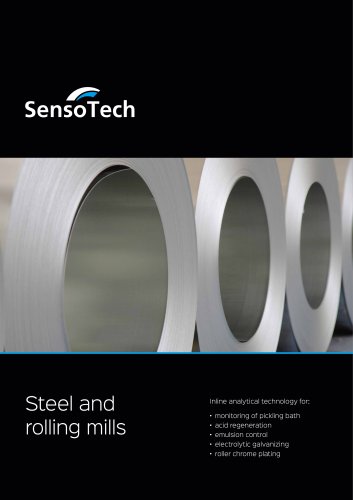
Metal industry - LiquiSonic® Applications in steel and rolling mills
LiquiSonic® is an inline analytical system tailored for steel and rolling mills, enabling real-time monitoring of liquid concentrations during production. It ensures high-quality output and resource efficiency through phase separation and reaction monitoring.
User Benefits
- Provides optimal plant control with real-time data.
- Enhances process efficiency and product quality.
- Reduces laboratory costs and allows immediate process change detection.
- Facilitates energy and material savings with instant disruption alerts.
- Delivers repeatable and accurate measurements.
Technical Specifications
- Measures absolute sonic velocities and liquid concentrations.
- Features a robust, maintenance-free design for temperatures up to 200°C (390°F).
- Can be installed directly into pipes, tanks, or vessels.
- Supports data transmission via fieldbus, analog outputs, serial interface, or Ethernet.
Processes and Applications
Pickling
LiquiSonic® measures pickling bath concentrations online, aiding in the redosing of fresh acid to maintain bath quality. It is applicable for acids like sulfuric, phosphoric, hydrochloric, nitric, and hydrofluoric.
Acid Regeneration
The system refreshes used pickling acids by removing contaminants, supporting crystallization and spray roasting for acid recovery.
Cold Rolling
Ensures continuous quality control of rolling oil emulsions, preventing quality variations in rolling stock.
Electrolytic Galvanizing
Controls electrolyte concentration for optimal zinc coating on steel surfaces.
Roller Chrome Plating
Detects chrome electrolyte components, enhancing process safety and optimizing sharpening.
Further Applications
Used for monitoring temper fluids, emulsion control, detecting flotation agents, and more.
LiquiSonic® System
Includes sensors and a controller, with options for hazardous area use, supporting network integration and remote operation.
Conclusion
LiquiSonic® provides a robust, precise, and user-friendly solution for inline process analysis in steel production, improving efficiency and product quality while reducing costs.
The LiquiSonic® 40 analyzer determines concentrations in 3-component liquids using sonic velocity and conductivity measurements. It integrates with process control systems via analog outputs and fieldbus interfaces, includes a data logger with up to 2 GB storage, and supports up to 99 data sets. Sensors are stainless steel and maintenance-free, featuring flow monitoring and high-power technology for stable measurements.
Installation and Integration
Integrates into corporate networks via Ethernet, supporting remote control and data transfer. Offers fieldbus options like Modbus and Profibus DP for process automation. The controller is available in rack-mounted or field housing options, with network integration features such as web server, FTP, and email notifications.
Quality and Support
SensoTech emphasizes quality management, certified by ISO 9001, ensuring maximum functionality and safety. Offers global customer support, including remote access and training, optimizing process liquids analysis to enhance product quality and plant safety across industries.
Company Overview
SensoTech specializes in inline measurement of liquid concentration and density, providing user-friendly and precise systems. Their technology is applied in industries like chemical, pharmaceutical, and food technology, aiming to maximize manufacturing efficiency and safety.
Catalog excerpts
Steel and rolling mills Inline analytical technology for: • monitoring of pickling bath • acid regeneration • emulsion control • electrolytic galvanizing • roller chrome plating
Open the catalog to page 1
Increase quality, save resources: LiquiSonic®. With high-quality, innovative sensor technology. Robust, precise, user-friendly. LiquiSonic® LiquiSonic® is an inline analytical system for determining the concentration in liquids directly in the production process. The analyzer is also used for phase separation and reaction monitoring. Sensor installation within the product stream means an extremely fast measurement that responds immediately to process changes. User benefits include: • optimal plant control through online and real-time information about process states • maximized process efficiency...
Open the catalog to page 2
Roller chrome plating 9 Controller and field housing 12
Open the catalog to page 3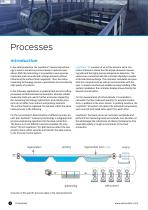
Processes Introduction In the steel production, the LiquiSonic® measuring technology is used in numerous process levels to optimize operations. With this technology it is possible to save process chemicals, such as acids and cooling lubricants without influencing the surface finish negatively. Thus, the online measuring technology ensures a permanent and consistently high quality of products. In the following, applications in pickling bath and cold rolling processes are demonstrated as examples, whereas related measuring tasks are used in further processes. Regarding the measuring technology,...
Open the catalog to page 4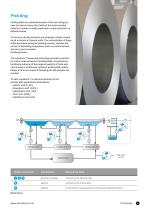
Pickling baths are used downstream of the hot rolling process, but also in many other fields of the metal-working industry to remove, modify, passivate or clean surfaces in a defined manner. To this end, pickling solutions are employed, mainly consisting of a mixture of mineral acids. The concentration of these acids decreases during the pickling process, whereas the portion of disturbing components such as contaminations and carry-over increases. Pickling process The LiquiSonic® measuring technology provides a solution for online measurements of pickling bath concentrations facilitating redosing...
Open the catalog to page 5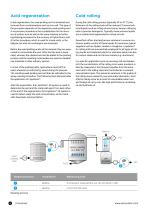
Acid regeneration Cold rolling In the regeneration, the used pickling acid is refreshed and removed from contaminations such as iron salt. The type of the procedure depends on the respective used pickling acid. A very known procedure is the crystallization for the recovery of sulfuric acid as well as the spray roasting or buttering-floating procedure for the recovery of hydrochloric acid. A further procedure, which is used for mixed acids, is the dialysis, but also ion exchangers are employed. During the cold rolling process (typically 40 to 70 °C), the thickness of the rolling stock will be...
Open the catalog to page 6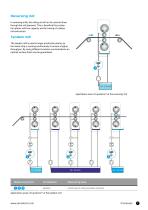
In reversing mills, the rolling oil will run for several times through the mill (passes). This is beneficial for production plants with low capacity and for having of a better microstructure. The tandem mill is used in larger production plants, as the metal strip is running continuously to ensure a higher throughput. By using different emulsion concentrations an optimal surface finish can be guaranteed. Measuring point Installation Measuring task pipeline Application areas of LiquiSonic® at the tandem mill monitoring of rolling oil-water emulsion
Open the catalog to page 7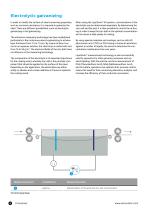
Electrolytic galvanizing In order to modify the surface of steel concerning properties, such as corrosion resistance, it is required to galvanize the steel. There are different possibilities, such as electrolytic galvanizing or hot galvanizing. The ultrasonic measuring technology has been established particularly in the continuous electro-galvanizing to achieve layer thickness from 2.5 to 7.5 µm. By means of direct current in an aqueous solution, the steel strip is coated with zinc from 18 to 54 g/m2. The electrical fields of the zinc bath have no influence on the measuring technology. The composition...
Open the catalog to page 8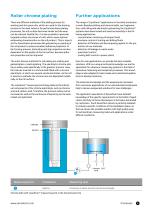
Roller chrome plating Further applications There are different methods of the plating process for working and skin pass rolls, which are used for the forming process in the steel industry. By performing these plating processes, the roll surface becomes harder and the wear can be reduced. Beside this, it is also possible to generate targeted surface structures of rolls, which cause optimal embossing characteristics on the roll product. This is important for downstream processes like galvanizing or painting of the roll product to ensure excellent adhesive properties. In the forming process, lubricating...
Open the catalog to page 9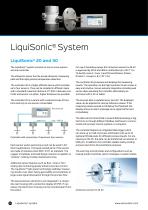
LiquiSonic® System LiquiSonic® 20 and 30 The LiquiSonic® system consists of one or more sensors and one controller. The ultrasonic sensor has the actual ultrasonic measuring path and the highly precise temperature detection. The controller 30 is a highly efficient device which includes up to four sensors. They can be installed in different steps with a standard maximum distance of 1,000 m between controller and sensor. As option, higher distances are possible. The controller 20 is a variant with a reduced scope of functions and only to one sensor connectable. For use in hazardous areas, the immersion...
Open the catalog to page 10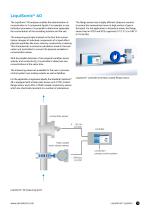
LiquiSonic® 40 The LiquiSonic® 40 analyzer enables the determination of concentration in 3-component liquids. For example, in neutralization processes it is possible to determine separately the concentration of the scrubbing solution and the salt. The flange sensor has a highly efficient ultrasonic ceramic to ensure the measurement even at high portion of gas in the liquid. For the application in hazardous areas, the flange sensor has an ATEX and IECEx approval (II 1/2 G / Ex d IIB T1 to T6 Ga/Gb). The measuring principle is based on the fact that concentration changes of individual components...
Open the catalog to page 11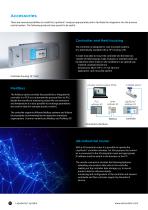
Accessories There are several possibilities to install the LiquiSonic® analyzer appropriately and to facilitate the integration into the process control system. The following products have proved to be useful. Controller and field housing The controller is designed for rack-mounted systems. It is alternatively available with a 19“ housing 4 HU. In order to be able to mount the controller into the field, two variants of field housings made of plastic or stainless steel can be delivered, which meet on-site conditions in an optimal way. • material: anodized aluminum • dimensions: 482.9 (19“) x 177...
Open the catalog to page 12All SensoTech catalogs and technical brochures
 Company Profile
8 Pages

- Gas analyzer
- Concentration analyzer
- Monitoring analyzer
- Liquids analyzer
- Automatic analyser
- Benchtop analyser
- Process analyzer
- Portable analyzer
- Continuous analyzer
- Real-time analyzer
- Laboratory analyzer
- Compact analyzer
- Digital analyzer
- Waterproof analyzer
- Temperature analyzer
- In-line analyzer
- Sampling analyzer
- Analyzer for the food industry
- Control analyzer
- Carbon dioxide analyzer