

- Company
- Products
- Catalogs
- News & Trends
- Exhibitions
Bath monitoring - Inline analysis technology for cleaning, rinsing, treating, hardening and coating
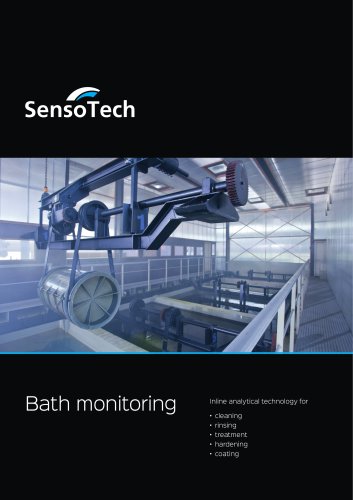
Bath monitoring - Inline analysis technology for cleaning, rinsing, treating, hardening and coating
LiquiSonic® is an inline analytical system for real-time monitoring of liquid concentrations in production processes. It is used for phase separation and reaction monitoring, providing fast and precise measurements that adapt to process changes. The system is robust, user-friendly, and aids in optimizing plant control, enhancing product quality, and reducing costs.
Key Features and Benefits
- Provides real-time process information for optimal plant control.
- Enhances process efficiency and product quality.
- Reduces laboratory costs and detects process changes immediately.
- Saves energy and materials with instant warnings for disruptions.
- Offers highly accurate and fail-safe measurements with integrated temperature detection.
- Features a robust, maintenance-free sensor design suitable for high temperatures and corrosive environments.
Applications in Various Industries
Automotive and Aircraft: Ensures cleanliness and reliability by removing impurities from components. Allows continuous quality control of preservatives.
Metal Processing: Monitors cleaning agents continuously to ensure consistent results and reduce manual sampling costs.
Hardening: Monitors quench liquid concentration to prevent material cracking and ensure optimal hardness.
Coating: Ensures effective coating by monitoring concentration and quality of materials.
Electronics: Removes residues from components and PCBs, suitable for explosive atmospheres, and provides continuous documentation.
Plastics: Removes surface contaminants and prepares components for further processing, ensuring optimal cleaning.
System Components and Support
- LiquiSonic® sensors and controllers are easy to install and integrate into existing systems.
- Supports multiple sensors and data transmission via various interfaces.
- Offers comprehensive process documentation and quality assurance.
SensoTech provides systems for analyzing and optimizing process liquids, focusing on inline measurement of liquid concentration and density. Their LiquiSonic® systems enhance product quality and plant safety across various industries.
LiquiSonic® QC System
The LiquiSonic® QC system is designed for quality control in environments where inline measurement is impractical. It offers fast, precise measurements and reliable data documentation, supporting up to 20 measurement points with easy data export and analysis.
Benefits
- Provides fast and precise measurement with reliable documentation.
- Features intuitive operation via touchscreen with multi-language support.
- Allows data export for further analysis and documentation.
- Manages multiple measurement points with customizable configurations.
LiquiSonic® System Components
The system includes durable and precise sensors capable of operating in hazardous environments. The controller analyzes and visualizes data, integrates with corporate networks, and supports automatic regulation of cleaning processes.
Quality and Support
SensoTech emphasizes technical progress and customer-centric service, offering innovative solutions tailored to specific measurement challenges. They maintain high standards of quality management, certified by ISO 9001, and provide effective customer support through a global network.
Conclusion
SensoTech's LiquiSonic® systems offer accurate, real-time analysis of process liquids, enhancing efficiency and safety across industries. Their commitment to innovation and customer service positions them as leaders in process analysis technology.
Catalog excerpts
Bath monitoring Inline analytical techn°l°gy for
Open the catalog to page 1
Increase quality, save resources: LiquiSonic®. With high-quality, innovative sensor technology. Robust, precise, user-friendly. LiquiSonic® is an inline analytical system for determining the concentration in liquids directly in the production process. The analyzer is also used for phase separation and reaction monitoring. Sensor installation within the product stream means an extremely fast measurement that responds immediately to process changes. User benefits include: • optimal plant control through online and real-time information about process states • maximized process efficiency • increased...
Open the catalog to page 2
Measuring point management 13 Limit value display 13
Open the catalog to page 3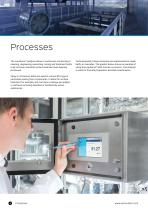
Processes The LiquiSonic® analyzer allows a continuous monitoring of cleaning, degreasing, quenching, rinsing and treatment baths in all common industrial surface treatment and cleaning processes. Spray or immersion baths are used to remove film-type or particulate soiling from components. In baths for surface treatment, for example, anti-corrosion coatings are applied or surfaces are being densified or hardened by active substances. Technologically, these processes are implemented in single baths or cascades. The graphic below shows an example of using the LiquiSonic® bath monitor in process....
Open the catalog to page 4
During the mixing of bath chemicals from supplied concentrates and the solvent (e.g. water), dilution control for target concentration is necessary as it ensures an efficient use of the materials used with consistent implementation of quality-related parameters. The dilution control can also be done directly in the bath in a separate storage tank. Process documentation is particularly important to have a proof of compliance with the quality related parameters „bath concentration" and „bath temperature" within the process chain. The information on bath concentration is used to redose the cleaning...
Open the catalog to page 5
ApplicationsAutomotive and aircraft In order to meet the cleanliness requirements of specific components and to ensure long-term reliability, impurities such as oil and mineral deposits are removed from finished components. Otherwise damages of the components arise, once they are used under extreme loads. At high cleaning volumes, components are purified with aqueous cleaners such as Hakupur that consists of inorganic ingredients (builder) and tensides. These cleaners can remove oily ingredients well and disperse in the cleaning liquid. For components with a complex geometry and very high cleaning...
Open the catalog to page 6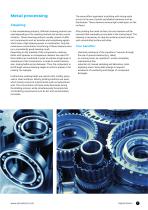
In the metalworking industry, different cleaning products are used depending on the cleaning method and surface contamination. These cleaning products usually consist of different components such as tensides and complexing agents, which have a high cleaning power in combination. Only the continuous concentration monitoring of these cleaners ensures a consistently good cleaning result. Depending on the material of the components, cleaning baths with aqueous or nonaqueous cleaners are used. Different baths are combined in order to achieve a high level of cleanliness of the components. In order...
Open the catalog to page 7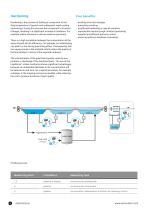
Your benefits: Hardening is the process of heating a component to harding temperature of quench and subsequent rapid cooling (quenching). During this process the component‘s structure changes, resulting in a significant increase in hardness. For example, saline solutions or oils are used as quenchant. avoiding incorrect dosages preventing cracking insufficient hardening in case of overdose reproducible results trough constant quenching targeted and efficient process control ensuring optimum hardness of products There is a high correlation between the concentration of the quench liquid and its...
Open the catalog to page 8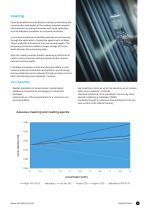
Ensuring an effective and efficient coating by monitoring the concentration and quality of the coating materials requires inline analysis in coating processes with liquid substrates such as adhesion promoters or corrosion protection. A corrosion protection of metallic materials can be ensured through the application of protective agents such as Wigol. These inhibit the formation of rust over several weeks. The temporary protection enables a longer storage of the products between the processing steps. After the coating, another product cleaning is performed in order to remove excess coating material...
Open the catalog to page 9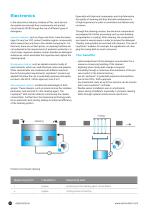
In the electronics industry, residues of flux, resin and solder pastes are removed from components and printed circuit boards (PCB) through the use of different types of detergents. Aqueous cleaners, such as Vigon and Atron, have the advantage of a very low VOC content (volatile organic compounds), which means they only have a few volatile components. Furthermore, there are no flash points, so cleaning facilities are not subjected to the requirements of explosion protection. In most cases, aqueous cleaners contain tensides as detergent substances, which assimilate the impurities and capture the...
Open the catalog to page 10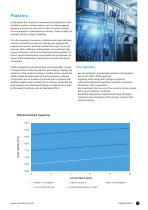
In the production of plastic components and polymeric intermediates, surface contaminations such as release agents, abrasion and dust are removed in order to further process the components in subsequent processes. These include, for example, gluing, coating or painting. For other products, monomers, inhibitors and other additives must be removed from polymer. Mostly pure solvents like propanol are used to dissolve residual monomers in an optimal way. Often, different cleaning baths are combined with various solvents to achieve the maximum cleaning effect. In order to avoid transmission rinsing...
Open the catalog to page 11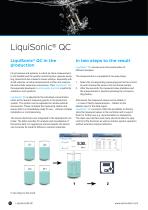
LiquiSonic® QC LiquiSonic® QC in the production For processes and systems in which an inline measurement is not feasible and the quality monitoring thus requires sampling, SensoTech has created a clever solution. Especially with small volumes, an inline measurement is often not reasonable and entails expensive conversions. Thus, LiquiSonic® QC, the especially developed central quality test site, is perfectly suitable in such systems. LiquiSonic® QC is adjusted to the individual concentration ratios at the relevant measuring points in the production system. The system can be expanded to include...
Open the catalog to page 12All SensoTech catalogs and technical brochures
 Company Profile
8 Pages

- Gas analyzer
- Concentration analyzer
- Monitoring analyzer
- Liquids analyzer
- Automatic analyser
- Benchtop analyser
- Process analyzer
- Portable analyzer
- Continuous analyzer
- Real-time analyzer
- Laboratory analyzer
- Compact analyzer
- Digital analyzer
- Waterproof analyzer
- Temperature analyzer
- In-line analyzer
- Analyzer for the food industry
- Sampling analyzer
- Control analyzer
- Carbon dioxide analyzer