
- Catalogs
- SENECA | AUTOMATION INTERFACES
- Distributed systems


Distributed systems

1 / 2 PagesView full catalog
Distributed systems
Product catalog summary
Overview: The document discusses ModBUS technology used for distributed control and data acquisition in various industrial applications. It highlights the integration of communication systems, I/O expansion, and control devices.
Communication Systems: The technology supports various communication systems including GSM/GPRS, DSL PSTN, WiLAN, and UHF. It facilitates connectivity with printers, operator panels, and identification systems.
Connection and Power Supply: The system uses a connection system with power-supply terminals/data lines in a vertical position. It is constructed with nylon loaded PA6 with 30% fiberglass for durability.
Input/Output Specifications:
- Analogue Input/Output: Supports standard analog signals with resolution up to 15 bit + sign.
- Digital Input: Isolated inputs for various sensors and contacts, supporting frequencies up to KHz.
- Digital Output: Includes SPST relay with delay features.
Regulators and Special Modules: Features Z-PID for universal input and control settings, and Z-D-IO for I/O slave or automatic functioning. Special modules include temperature control, load cells, and electric network analyzers.
Communication Interfaces: Supports RS232/RS485 ModBUS RTU, Ethernet - ModBUS TCP, and other interfaces for data transmission and remote control.
Software and Development Tools:
- Software Platform: Includes integrated automation and telecontrol functions with tools like ZNET3, CODESYS, and ISAGRAF.
- Development Environment: Offers html/java supervision pages and real-time data exchange software.
Application Areas: The technology is applicable in building and infrastructure automation, providing a distributed system for supervisory and control integration.
See more
All SENECA | AUTOMATION INTERFACES catalogs and technical brochures
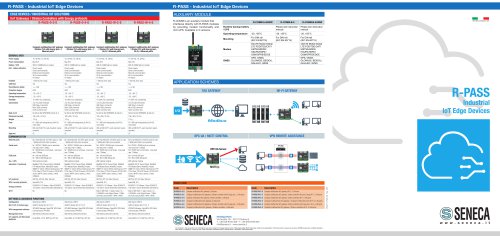 R-PASS
2 Pages
 SSD SURPRISE SMART DISPLAY
16 Pages
 Z-D-IN
1 Page
 IoT ADVANCED GATEWAYS
8 Pages
 Z-LTE
Z-LTE2 Pages
 DATA RECORDER
8 Pages
 Z-KEY-WIFI
2 Pages
 RTUs and Telemetry Solutions
2 Pages
 S401 OLED ModBUS Display
2 Pages
 Power & Energy Monitoring System
16 Pages
 Advanced dataloggers
6 Pages
 K Line Compact Converters
8 Pages
 Fiber Optic converters
4 Pages




Archived catalogs
 S401
S4012 Pages
 Energy Efficiency
8 Pages
 Universal Converter
2 Pages
 Ultra slim line converters
2 Pages
 ModBUS Display
1 Page
 Photovoltaic Systems
2 Pages
 Loop powered display
2 Pages


Related Searches
- Display module
- DC power supply
- AC/DC power supply
- Temperature probe
- Management software solution
- Monitoring analyzer
- Surge protector
- SENECA data-logger
- Resistance temperature sensor
- SENECA digital I/O
- Process software
- Real-time software
- Windows software
- SENECA I/O module
- Calibration system
- Temperature datalogger
- SENECA digital indicator
- SENECA analog I/O
- SENECA digital I/O module
*Prices are pre-tax. They exclude delivery charges and customs duties and do not include additional charges for installation or activation options. Prices are indicative only and may vary by country, with changes to the cost of raw materials and exchange rates.
About DirectIndustry
DirectIndustry is a marketplace that offers B2B players a complete experience, from product sourcing to purchase. DirectIndustry is an entity of VirtualExpo Group.
Are you a buyer?
Are you a supplier?